
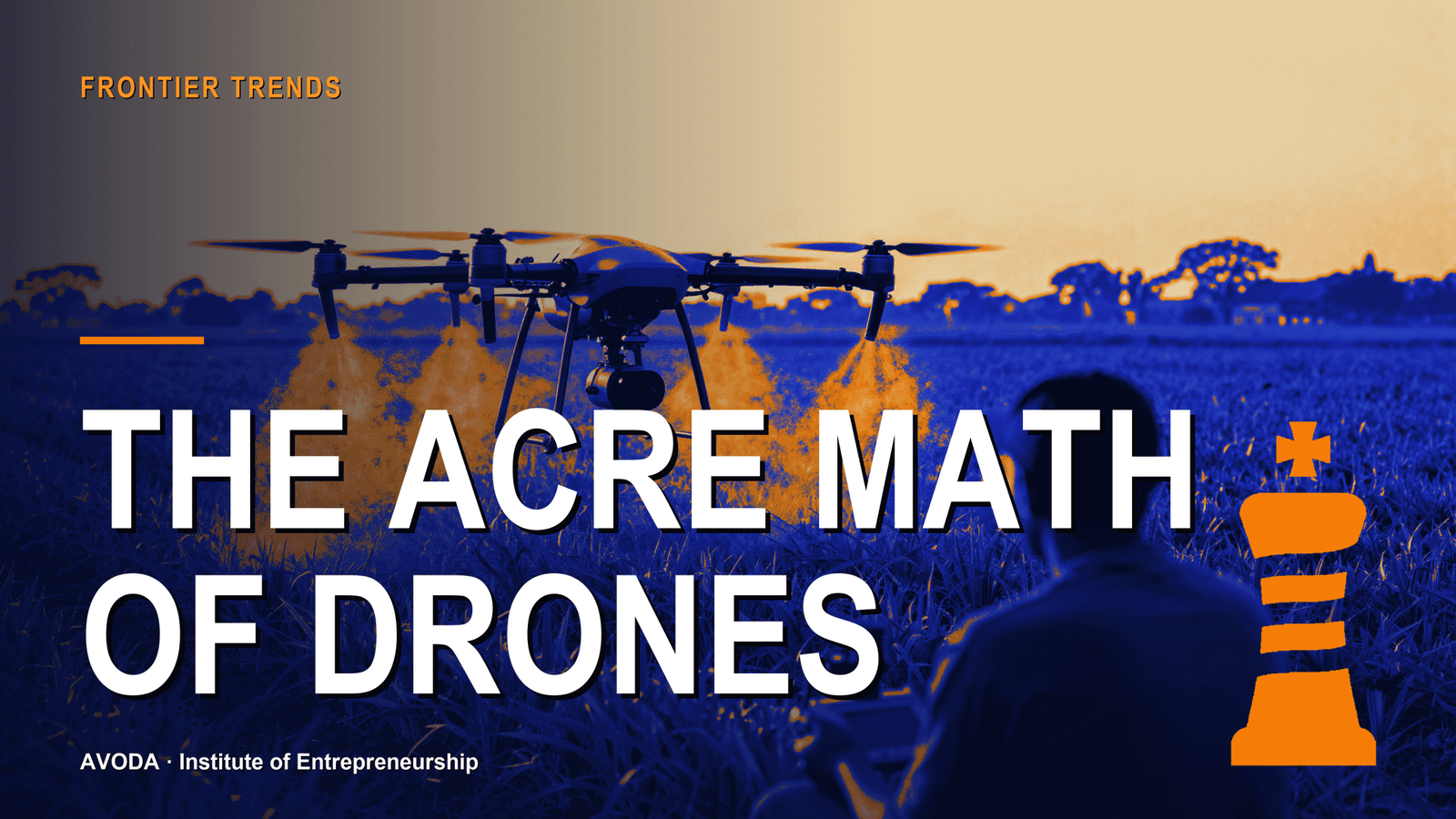
The region proved the aircraft before it proved the farm case. Zipline’s Rwanda operation made East Africa the world’s reference for drone logistics, blood and medical supplies delivered across ridge country at scale, and Ghana’s expansion confirmed the model travels. But medical delivery is a special economics, life-critical payloads, government contracts, centralized dispatch, and the question that matters for the region’s largest industry is different: when do drones pay on the farm? The global answer has clarified fast, with agricultural drones now spraying a meaningful share of paddy and row crops across Asia at costs competing with manual labor, and the regional answer is assembling through service providers in Kenya, Nigeria, and beyond: spraying first, surveying second, delivery for high-value cargo third, almost always as a service purchased per acre rather than a machine purchased per farm. The distinction is the essay’s spine, because the drone’s farm economics are aggregation economics: the aircraft is affordable the way the tractor never quite became, through operators who spread its cost across a district’s demand, and the business model, not the airframe, is where regional fortunes will be decided.
Key Takeaways
- The proven regional use cases rank: spraying (labor substitution with measurable chemical savings), surveying and mapping (data for credit, insurance, and precision), and niche delivery (high-value, time-critical payloads).
- Ownership rarely pays at smallholder scale: the working model is drone-as-a-service, operators amortizing aircraft, batteries, pilot certification, and maintenance across clustered demand.
- The binding constraints are regulatory and operational, not technological: aviation authority licensing, chemical-application rules, battery logistics, and the skilled-operator pipeline.
- The Acre Math framework prices a service venture honestly: utilization against seasonality, the full cost stack per sprayed acre, the cluster’s density, and the data upsell that lifts margins.
- The adjacent prize is information: surveyed, mapped, yield-estimated farms become creditable and insurable, plugging drones into the region’s agricultural finance gap.
What actually pays in the field?
Spraying leads, because it substitutes for the farm’s scarcest labor at measurable rates. A spray drone covers in minutes what knapsack crews cover in days, with documented chemical and water savings from precision application, and the Asian deployment wave, millions of hectares now drone-sprayed annually, has driven airframe costs down the curve into service-viable territory. Regionally the arithmetic bites first in high-value and labor-tight moments: horticulture and export crops where application timing decides grade, locust and armyworm response where speed is the product, and large outgrower blocks where an anchor buyer contracts spraying across hundreds of smallholder plots at once, the aggregation pattern that makes the unit economics work. Surveying is the quieter second market: mapped boundaries feed land documentation, crop-health imagery feeds agronomy and input credit decisions, and yield estimation feeds insurers and buyers, services sold to institutions, banks, insurers, processors, rather than to the farmer directly, which is where the margins live. Delivery remains the niche: proven for medical logistics, viable for high-value agricultural cargo, day-old chicks, vaccines, cold-chain samples, but wrong for maize sacks, whose value-to-weight ratio no rotor will rescue.
Why does the service model beat ownership?
Because the aircraft’s costs are fixed and the farm’s demand is spiky. A working spray operation carries the drone itself, batteries in multiples, charging logistics off-grid, a certified pilot’s salary and licensing, insurance, maintenance and parts, and regulatory compliance, a cost stack that only amortizes across high utilization, while any single farm needs spraying a handful of weeks per season. The mismatch is the tractor problem reborn, and the solution is the same one the region evolved for tractors and threshers: specialized service providers, booking demand across a cluster, running the asset at utilization no owner-farmer could achieve. The model’s regional refinements are already visible: operators anchored on outgrower schemes and cooperatives that aggregate bookings; per-acre pricing that puts the service inside a smallholder’s reach for the seasons it matters; agent-network distribution of booking and payment over mobile rails; and pilot academies converting the youth employment question into a skilled-trade answer, the drone pilot as the region’s newest fundi, a craft with certification, equipment literacy, and apprenticeship structure.
What is the Acre Math?
The named framework of this essay: four numbers that decide whether a drone-service venture is a business or a demo, computable before the first aircraft is imported.
- Utilization against seasonality. Sprayable days per year in the cluster’s crop calendar, across crops whose seasons stagger, because an aircraft earning ten weeks a year dies of its own depreciation. Multi-crop clusters and cross-service revenue, surveying between spray seasons, are how the calendar fills.
- The full stack per acre. Aircraft depreciation, batteries (the honest consumable), pilot, transport to field, chemicals handling compliance, insurance, and the regulator’s fees, divided by realistic acres per day, priced against the alternative: knapsack crew rates plus the chemical savings precision delivers.
- Cluster density. Bookable acres within economic transport radius, which is the model’s real moat: a dense outgrower block or irrigation scheme beats scattered smallholders at any price, and the anchor-firm partnership that aggregates demand is worth more than a second aircraft.
- The data upsell. Margin’s second story: the same flights that spray can map, and mapped, monitored acres sell to lenders, insurers, and buyers as risk data, converting a labor-substitution business into an information business, the visibility economics that finance pays for.
The framework’s verdict pattern: ventures fail on utilization and transport radius, survive on aggregation partnerships, and get rich, where they do, on the data layer.
What has to move for the sector to scale?
Regulation, power, and pilots, in that order. Regulation: the region’s aviation authorities have moved from prohibition toward licensing regimes, Rwanda’s performance-based approach being the continental reference, but spray certification, chemical-application rules, and beyond-visual-line-of-sight permissions remain uneven, and operators’ associations engaging regulators with safety receipts will shape whether the sector scales or stalls. Power: battery logistics off-grid decide field productivity, making solar charging infrastructure part of the service stack and the solar-EV convergence’s rural charge points a shared-infrastructure opportunity. Pilots: certified-operator scarcity is the scaling constraint everyone meets second, and the training pipeline, academies, apprenticeships, TVET partnerships, is both the bottleneck and the jobs dividend. For the region’s builders and investors the sector’s shape is now legible: not drones sold to farmers, but service networks anchored on aggregated demand, filling calendars across crops and services, and mining the data exhaust for agricultural finance, the pattern this corpus keeps finding, where the machine matters less than the network that shares it.
FAQ
What drone services actually pay in East African agriculture?
Spraying first, labor substitution with chemical savings, especially on high-value crops and aggregated blocks; surveying and crop monitoring second, sold to banks, insurers, and processors; delivery only for high-value, time-critical payloads.
Should a farm buy a drone?
Rarely below plantation scale: costs are fixed, demand is seasonal. The working model is drone-as-a-service, with operators amortizing aircraft, batteries, and pilots across a cluster’s bookings.
What is the Acre Math?
Four venture-deciding numbers: utilization against the crop calendar, the full cost stack per acre versus knapsack alternatives, bookable density within transport radius, and the data upsell to financial institutions.
What are the main constraints?
Regulatory certification for spraying and flight permissions, battery-charging logistics off-grid, and the certified-pilot pipeline, ahead of any airframe limitation.
Where is the deepest value long-term?
The information layer: mapped, monitored, yield-estimated farms become creditable and insurable, plugging drone data into the agricultural finance gap that constrains the whole sector.
Related Reading
- Asset-Based Development for Marketplace Programs
- Rural Acceleration: The Model Nobody Has Cracked
- Productive-Use Solar in East Africa
- The Solar-EV Convergence in the Boda Economy
Sources and Evidence
- Zipline: the Rwanda and Ghana medical delivery operations.
- FAO on agricultural drones: use cases and smallholder-context economics.
- DJI Agriculture reports: global spray-drone deployment scale and cost curves.
- Rwanda Civil Aviation Authority: the performance-based drone regulation reference.