
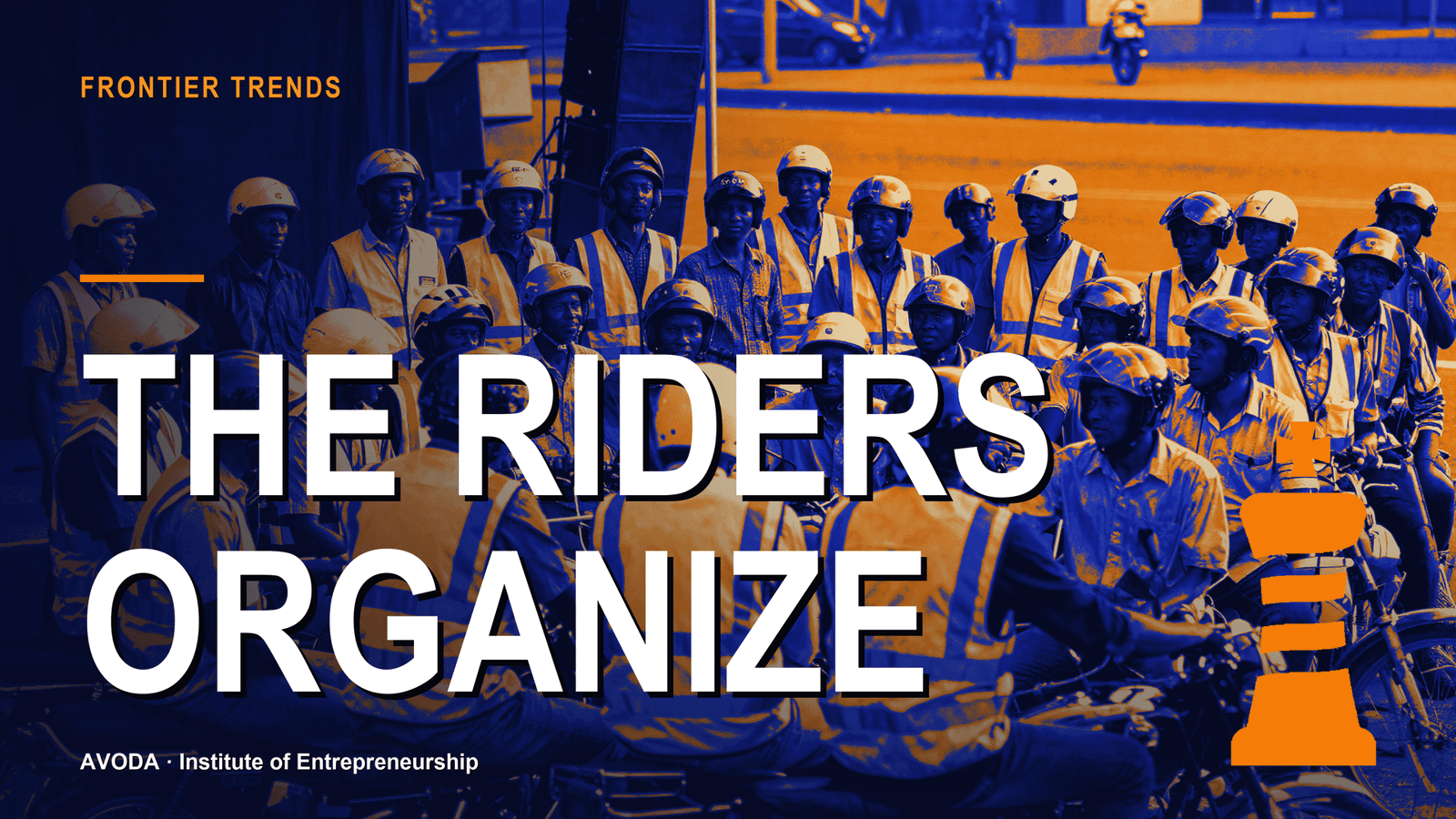
The strikes stopped being hypothetical years ago. Nairobi’s ride-hailing drivers have repeatedly switched off apps in coordinated protest over commission rates and pricing; Kenyan law responded, capping platform commissions at eighteen percent, an intervention few Western regulators have matched; delivery riders in Nairobi and Kampala have organized associations, boda stages have federated into savings-and-representation structures, and the platforms, Uber, Bolt, Glovo, Little, and the local challengers, now negotiate with worker bodies they once declined to recognize. The regional gig economy, in other words, is running one of the world’s live experiments in platform-worker power, and it is doing so with distinctive materials: the stage and SACCO as pre-existing organizing infrastructure, WhatsApp as the strike hall, governments willing to regulate commissions directly, and a workforce for whom the app is not side income but the household’s entire payroll. For platforms, investors, and the SMEs building on gig logistics, worker organization is no longer a risk-register footnote. It is a market structure, and reading it correctly is operational.
Key Takeaways
- East African gig workers have already won material concessions: Kenya’s commission cap, negotiated fare adjustments, and recognized associations mark real bargaining power, achieved with regional organizing tools.
- The power’s sources are structural: worker density at physical stages, WhatsApp coordination, multi-homing that makes switching costless, and governments responsive to visible urban constituencies.
- The disputes’ substance is the gig bargain itself: commission rates, pricing control, deactivation due process, and the social protections, insurance, pensions, that classification as independents excludes.
- The Fair Platform framework reads the settlement coming: transparent take rates, due process on deactivation, portable benefits contributions, and voice mechanisms, adopted ahead of force rather than after it.
- For faith-driven readers the frame is old: the laborer’s wages, the day’s dignity, and the scales’ honesty apply to algorithmic employers exactly as to human ones.
Where does the workers’ leverage actually come from?
From physics, phones, and politics that platform models did not anticipate. Density: unlike the atomized Western gig worker, the region’s riders congregate, at stages, malls, and restaurant clusters, and physical co-presence is organizing’s oldest asset, conversation, trust, and collective discipline forming daily where the algorithm assumed isolated contractors. Coordination: WhatsApp collapses the cost of assembly, a city’s drivers can convene, vote, and switch off within hours, and the strike’s infrastructure is the same tool the platforms use to dispatch. Exit options: multi-homing is universal, riders run several apps plus street work, so any single platform’s discipline is weak, the worker can starve one app without starving. And politics: gig workers are a visible, sympathetic, urban constituency, and regional governments, unburdened by Western classification theology, have shown willingness to regulate the commercial terms directly, Kenya’s commission cap being the landmark, with digital-economy taxation and labor-code reviews keeping the file open. The composite is a bargaining position Western gig labor has struggled decades to assemble, arrived at here through the region’s own institutions.
What are the disputes actually about?
The division of a thin margin, and the dignities the contract ignores. The take rate leads: commissions plus fees against fuel, financing payments on the bike, data, and maintenance, an arithmetic where the platform’s percentage decides whether the day fed the household, hence the ferocity of the commission fights and the significance of Kenya’s cap. Pricing control follows: surge algorithms and promotional discounts set unilaterally, riders bearing discounts they never agreed to fund. Deactivation is the due-process front: accounts, which is to say livelihoods, suspended by algorithm or unverified complaint, with appeals opaque, the digital firing this corpus’s shepherding ethics would fail on every count. And the protection gap is the deep structure: independent-contractor classification excludes the workforce from insurance, pensions, sick leave, and injury cover, in trades, road logistics, with the region’s most dangerous occupational risk profile, the funeral-collection frequency in rider associations being its own grim statistic. The organizing agenda, read whole, is not revolutionary: it is the standard employment bargain, requested from employers whose defining innovation was structuring themselves out of it.
What is the Fair Platform framework?
The named framework of this essay: the four-part settlement the disputes are converging toward, adoptable by platforms voluntarily now or imposed by force later, and readable by investors as diligence.
- Transparent take rates. The full extraction, commission, fees, promotional funding, published per trip and stable by notice, the honest scales applied to the algorithm’s split, with Kenya’s cap as the floor precedent where law has spoken.
- Due process on deactivation. Stated grounds, human review, appeal with response times, and graduated sanctions, the layoff protocol’s minimums delivered digitally, because livelihood termination by unexplained algorithm is the grievance that most reliably converts individual anger into collective action.
- Portable benefits contributions. Per-trip platform contributions into worker-attached funds, insurance, pension, injury cover, portable across apps, the model emerging globally and fitting regional rails perfectly: mobile-money-native, SACCO-administered, multi-homing-compatible.
- Voice mechanisms. Recognized worker bodies with scheduled consultation on rate and rule changes, because the associations exist regardless, and the platform’s only real choice is whether it meets them across a table or across a strike.
The framework’s investor reading: platforms adopting it early buy stability, regulatory goodwill, and workforce quality, while holdouts accumulate strike risk, cap risk, and the reputational exposure of being the case study when the labor code catches up.
How should the region’s builders and believers read this?
As the oldest labor text meeting the newest employer. The corpus’s employment ethics do not pause for classification innovations: the laborer deserves wages, withheld pay cries out, the scales must be honest, and the sojourner-and-servant protections attach to the work relationship’s substance, not its contractual costume, so a faith-driven reading sides, in structure, with the fair-bargain agenda while holding the workers’ own organizations to their own standards, associations that serve members rather than capture them, strikes that refuse destruction, stage groups whose funds are governed cleanly. For SMEs building on gig logistics, the operational read is diversification and terms-awareness: multi-rail delivery arrangements, contracts that survive strike days, and preference for platforms whose worker relations are settlement-shaped rather than siege-shaped. And for the region’s own platform founders, the opportunity is the framework itself: the fair platform, transparent, due-process-run, benefits-contributing, voice-recognizing, is buildable now as a competitive identity, the redemptive-system claim at algorithmic scale, and the workforce it attracts and keeps will be its moat. The apps automated dispatch. They did not automate justice, and the riders, stage by stage, are re-introducing the subject.
FAQ
What have East African gig workers actually won?
Material precedents: Kenya’s statutory cap on platform commissions, negotiated fare and rate adjustments after coordinated switch-offs, and recognition of driver and rider associations as bargaining counterparts.
Why is organizing stronger here than in Western gig markets?
Structural advantages: physical density at stages, WhatsApp-speed coordination, universal multi-homing that weakens platform discipline, and governments willing to regulate commercial terms directly.
What are the core disputes?
The take rate against the household arithmetic, unilateral pricing and promotion funding, deactivation without due process, and the exclusion from insurance, pensions, and injury cover in a high-risk trade.
What is the Fair Platform framework?
The converging settlement: published and stable take rates, due process on deactivation, per-trip portable benefits contributions administered on regional rails, and recognized worker voice on rule changes.
How should businesses using gig logistics respond?
Diversify across platforms, write strike-resilient arrangements, and weight platform choice by worker-relations quality: settlement-shaped platforms carry less operational and regulatory risk than siege-shaped ones.
Related Reading
- The Boda Economy: AI, Routing, and Financing
- Chama and Savings Groups: Covenant Economics
- Hiring, Firing, and Shepherding
- Sabbath for Your Staff, Not Just Yourself
Sources and Evidence
- Kenya’s transport network company regulations: the commission cap and platform licensing framework.
- Fairwork project ratings for Kenya and Uganda: platform-by-platform labor standards assessments.
- ILO on platform work: classification, protections, and emerging benefit models.
- James 5:4, ESV: the withheld wages that cry out.