
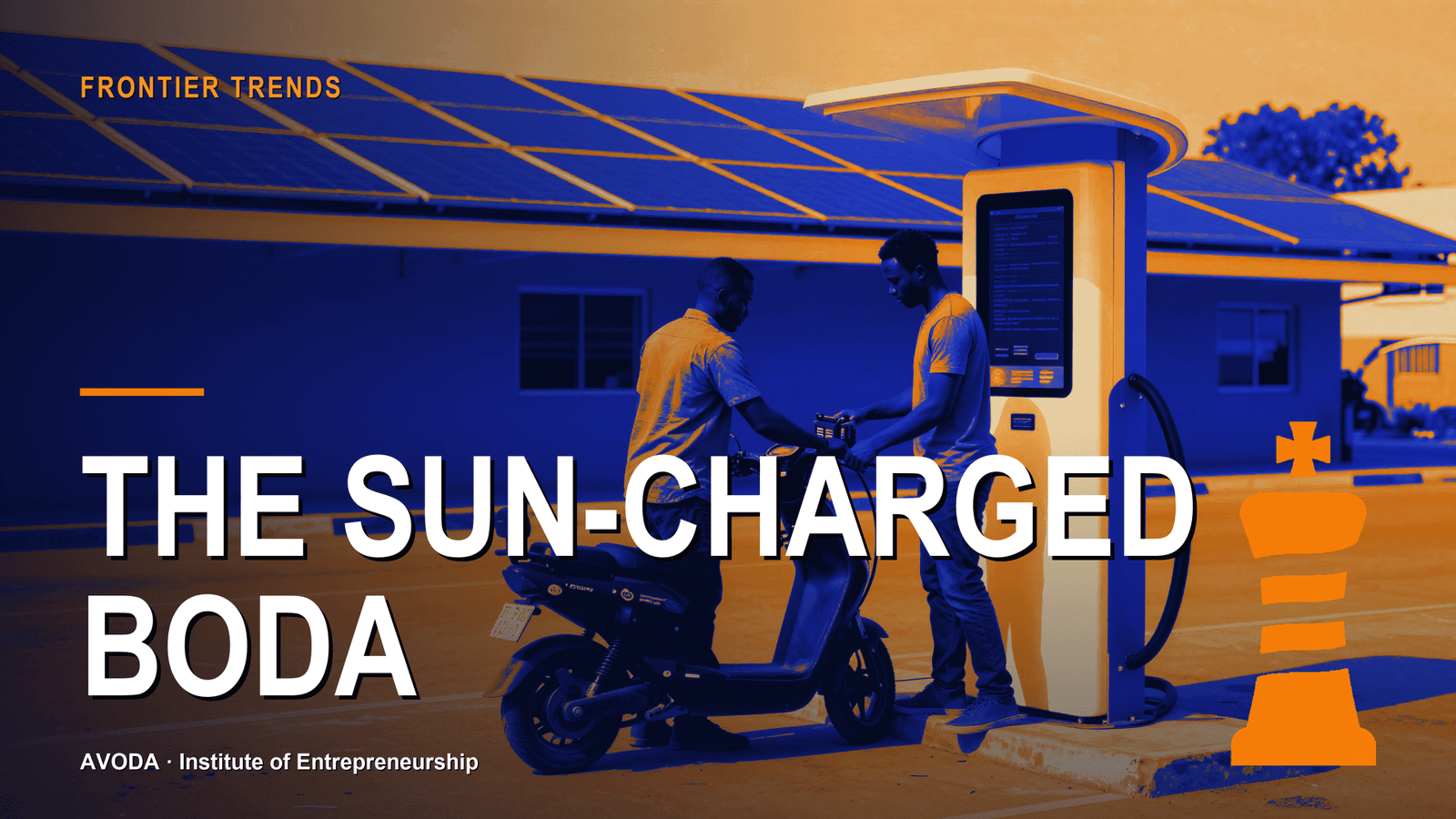
Two technology cost curves are crossing over the region’s most important vehicle. The boda boda, several million strong across East Africa, is the region’s taxi, ambulance, delivery fleet, and first rung of capital ownership, and its economics are dominated by two lines: fuel, the rider’s largest daily cost, and financing, the asset loan that decides whether the bike builds the rider’s equity or a lender’s. Electrification attacks the first line directly, electric two-wheelers cutting energy cost per kilometer by half or more against petrol, with swap-station models from Ampersand in Kigali to Spiro’s multi-country network and Kenya’s growing fleet proving the operations at scale. Solar attacks the second flank: charging that bypasses expensive, unreliable grids, swap stations and hubs running on their own generation, and the productive-use solar industry discovering in mobility its anchor load. Where the curves converge, a sun-charged, swap-served, pay-as-you-drive-financed electric boda, the region gets something rarer than a cleaner vehicle: a structurally cheaper transport economy whose fuel is domestic sunlight rather than imported dollars, and the convergence’s business models are the essay’s subject.
Key Takeaways
- The rider’s arithmetic drives adoption: energy cost per kilometer falls dramatically on electric, and daily savings against petrol are the marketing, the financing collateral, and the margin all at once.
- Battery swapping, not home charging, is the regional model: batteries stay operator-owned, swap stations replace range anxiety, and the battery’s cost leaves the bike’s price, fixing the affordability stack.
- Solar integration converts the energy supply from a grid dependency into an asset: swap stations with their own generation stabilize costs, reach off-grid corridors, and anchor rural charge infrastructure.
- The Swap-Station Economics framework prices the system: station utilization, battery fleet turns, energy source mix, and the financing stack riding on telemetric repossession.
- The macro stakes are national: boda fuel is a major petroleum import line, and electrification-by-sunlight converts a dollar-denominated recurring import into domestic infrastructure jobs.
Why does the rider switch, and what stops him?
The daily ledger switches him; the capital stack stops him. A petrol boda’s fuel spend dominates its operating day, and electric energy per kilometer, on regional tariffs or solar, runs at a fraction of it, with maintenance savings, fewer moving parts, no oil changes, stacking on top; operators across Kigali, Nairobi, and Kampala report the savings arithmetic selling itself once riders see a week’s numbers, the evidence-over-claims rule in transport form. The stoppers are structural: the electric bike’s upfront price runs above the petrol incumbent, largely the battery’s cost; charging infrastructure is sparse outside pilot corridors; grid power is unreliable where it exists; and the asset-financing machinery, the real gatekeeper of the boda economy, has to relearn residual values, repossession telemetry, and duty cycles before it lends at scale. Every successful regional deployment is, at bottom, a solution to the stoppers rather than the vehicle: the technology was never the bottleneck; the system around it was, and the system’s central invention is the swap.
Why is battery swapping the region’s model?
Because it moves the battery from the rider’s balance sheet to an operator’s, and solves four problems in one structure. Affordability: with batteries leased per swap rather than sold with the bike, the electric boda’s sticker price drops toward petrol parity, the pay-as-you-go unbundling that solar home systems pioneered, applied to the vehicle’s most expensive component. Range and time: a sixty-second swap replaces hours of charging, matching the boda’s all-day duty cycle. Battery stewardship: operator-owned fleets get professional charging, cooling, and end-of-life management, protecting the asset class’s residual values and the e-waste stream from amateur abuse. And energy purchasing: the swap operator becomes a bulk electricity buyer who can arbitrage tariffs, add its own solar, and site stations where riders are rather than where the grid is strong, the aggregation economics this corpus keeps finding, the tractor and the drone, applied to electrons. The model’s proof points are regional and multiplying: Ampersand’s Kigali network sustaining thousands of daily swaps, Spiro’s cross-country expansion, and Kenya’s operators integrating swaps with ride platforms and financing, the system assembling in public.
What is Swap-Station Economics?
The named framework of this essay: four numbers that decide a swap network’s viability, and with it the whole convergence’s pace.
- Station utilization. Swaps per station per day against the station’s fixed costs, rent, staff, capital, the density logic again: stations follow rider corridors, stages, and delivery clusters, and a thin network fails before it ever compounds.
- Battery fleet turns. Batteries per bike ratio, cycle life, and degradation management, the true capital engine: the fleet’s cost per delivered kilometer decides pricing, and thermal-managed charging (solar-friendly, daytime-shaped) stretches the asset.
- Energy mix and cost. Grid, solar, and hybrid per station: solar’s daytime generation matches swap-charging’s load curve unusually well, hedges tariff and outage risk, and takes stations to off-grid corridors where petrol’s logistics premium makes electric’s case strongest.
- The financing stack. The bike loan’s telemetric collateral, remote immobilization, GPS, payment-linked unlocking, plus the swap subscription’s cash-flow visibility, which together give lenders repossession confidence and repayment data, pulling asset finance into the sector and, with it, scale, while the fair-platform cautions about immobilization due process apply in full.
The framework’s investor summary: the vehicle is a commodity, the battery fleet is the asset, the station network is the moat, and the financing telemetry is the flywheel.
What does the convergence mean beyond the rider?
Import substitution by sunlight, and a jobs ladder in the transition. Nationally: boda fuel is a significant slice of the region’s petroleum import bill, dollars recurring annually through FX queues, and electrification shifts that spend to domestically generated power, increasingly solar, converting a recurring import into infrastructure investment, with national assembly ambitions adding an industrial layer as kits and eventually cells localize. Locally: the transition builds a trades ladder, station technicians, battery-fleet managers, conversion and maintenance fundis, solar installers, exactly the skilled-employment dividend the youth bulge needs, and rural swap-and-charge hubs double as productive-power anchors for mills, cold rooms, and drone batteries, the shared-infrastructure pattern compounding. For the corpus’s stewardship frame, the convergence is a rare alignment: the cheaper option, the cleaner option, and the domestically-owned option are, for once, the same option, creation care with a payback period, and the builders assembling its system, stations, fleets, financing, training, are doing development work that needs no donor narrative: the riders’ own daily ledgers are the demand curve, and the sun above the stage is the supply.
FAQ
Are electric bodas actually cheaper for riders?
On energy, dramatically: cost per kilometer falls by half or more against petrol, with maintenance savings on top. Total-cost parity depends on financing terms and swap pricing, which is why the system design matters.
Why battery swapping instead of charging at home?
Swapping removes the battery from the bike’s price, fixing affordability, replaces hours of charging with a minute’s swap for all-day duty cycles, and professionalizes battery care under operator ownership.
Where does solar fit?
At the stations: daytime solar generation matches swap-charging’s load, stabilizes energy costs against tariffs and outages, and takes networks to off-grid corridors where petrol logistics are most expensive.
What is Swap-Station Economics?
Four viability numbers: swaps per station against fixed costs, battery fleet turns and degradation, the energy mix’s cost and reliability, and the telemetric financing stack that unlocks asset lending.
What are the macro stakes?
Import substitution: boda fuel is a major recurring dollar import, and electrification by domestic solar converts it into local infrastructure, jobs, and an assembly-industry opening.
Related Reading
- The Boda Economy: AI, Routing, and Financing
- Productive-Use Solar in East Africa
- East Africa’s E-Mobility Manufacturing Bet
- M-KOPA, SunCulture, and the Proof Points
Sources and Evidence
- Ampersand: the Kigali swap network’s operating model and scale.
- Spiro: multi-country African e-motorcycle and swap deployment.
- IEA Africa Energy Outlook: transport fuel imports and electrification pathways.
- BloombergNEF electric two-wheeler research: battery cost curves and emerging-market adoption economics.