
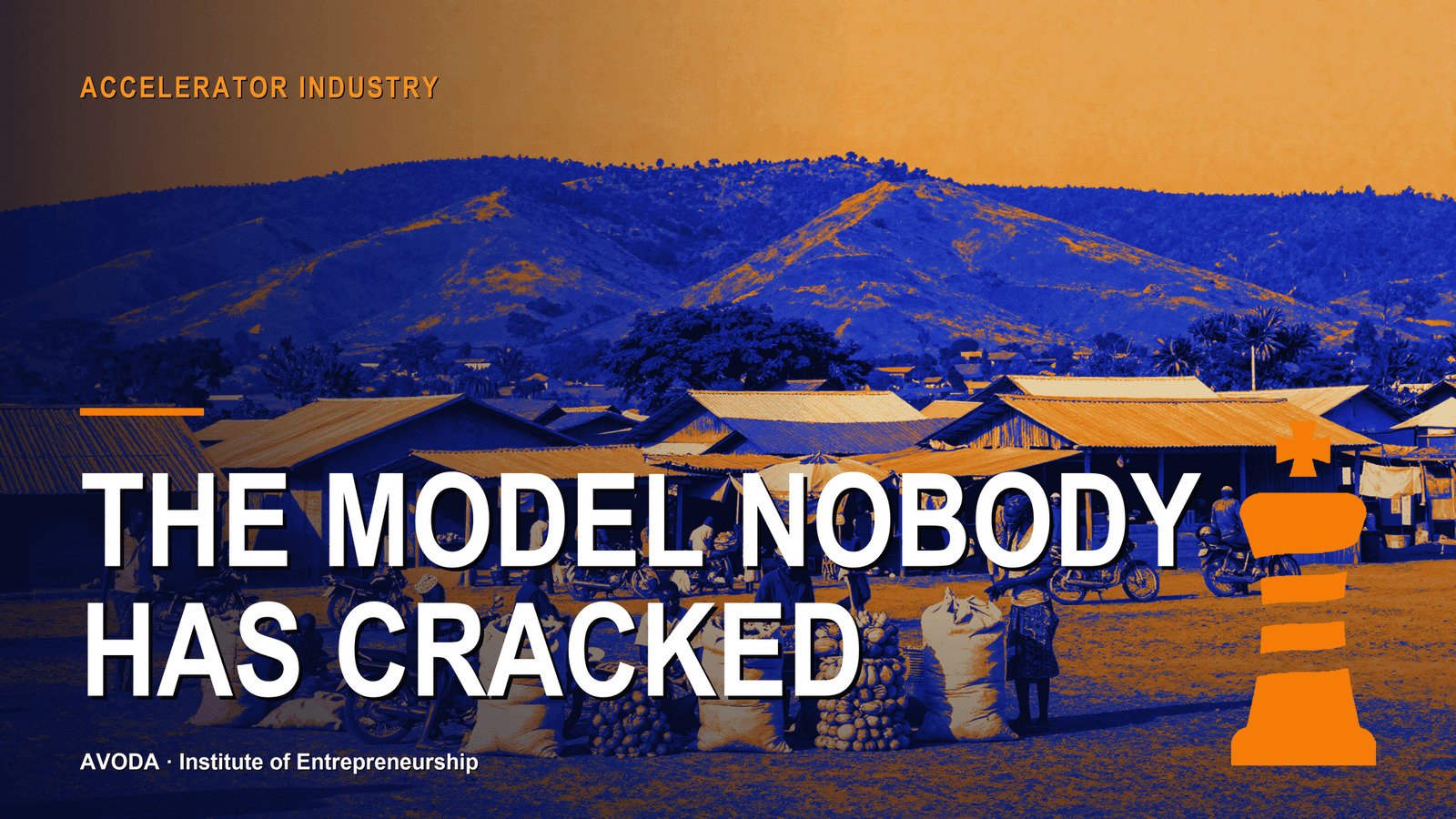
Every honest map of East African enterprise has its mass outside the cities: the trading centre wholesaler, the maize aggregator, the boda-repair cluster, the dairy collector, the agro-dealer whose shop is the last mile of every input chain. Yet acceleration, the industry’s flagship technology, is urban by construction: it assumes founder density for cohorts, mentor pools within driving distance, capital that takes meetings, and venues someone can reach weekly. Transplanted to rural markets, the model’s economics collapse, participants scattered across a district cannot cohort, the practiced operators who could teach live elsewhere, and per-founder delivery costs triple while ticket sizes shrink. The industry’s response has mostly been avoidance: rural founders appear in strategy decks and vanish from cohort lists. This essay refuses both the avoidance and the transplant, and asks the design question on its own terms: what would acceleration look like if it were invented for the trading centre rather than adapted from the capital?
Key Takeaways
- Rural enterprise is the region’s majority economy, but acceleration’s unit economics, density-dependent cohorts, mentors, and capital rooms, were built for cities and fail on transplant.
- The rural constraint profile differs in kind: seasonality governs cash and time, value chains define opportunity more than sectors, and the binding services are aggregation, inputs, and market linkage, not pitch skills.
- The working precedents are not accelerators: cooperative structures, outgrower schemes, savings groups, and agro-dealer networks are the region’s proven rural enterprise infrastructure, and design should build on them, not around them.
- The Trading-Centre Model makes four bets: value-chain cohorts over sector cohorts, circuit-riding delivery on market-day rhythms, anchor-firm partnerships as the market-access spine, and instruments synced to harvest calendars.
- Hybrid delivery helps but does not solve: the bandwidth floor is lowest exactly here, so the design must work at WhatsApp-and-radio fidelity with presence spent on trust.
Why do the transplants fail?
Because every load-bearing assumption is urban. Density: a cohort needs twenty founders within reach of a room; a sub-county yields three, so programs either bus participants at business-closing cost or dilute intake until peer effects, the model’s strongest mechanism, die of heterogeneity. Faculty: the staffing economics that strain city programs break entirely where the nearest practiced operator in the participant’s trade is two districts away. Capital: the rooms that follow demo days do not exist; rural tickets are smaller than any fund’s floor, and the relevant financiers, SACCOs, input-credit providers, buyers who prepay, were never invited to the format. Time architecture: weekly evening sessions assume urban schedules; rural cash and attention run on planting and harvest, and a program that schedules against the season teaches to empty rooms. And content: pitch decks and TAM slides land absurdly where the real curriculum is aggregation math, post-harvest loss, input quality, and the working-capital rhythm of a crop cycle. The failure is not rural founders’ capability. It is the model’s physics.
What already works out there?
The region’s own rural institutions, which the industry keeps rediscovering as if they were new. Cooperatives and producer organizations solve density by aggregation: they are standing cohorts with elected governance, exactly the covenant structures peer mechanics need, however unevenly run. Outgrower and contract-farming schemes solve market access and finance simultaneously: the anchor firm provides inputs, extension, and a guaranteed buyer, the corridor’s anchor-customer logic in agricultural form, with well-documented governance risks to design against. Savings groups and SACCOs are the capillary capital system, underwriting on community standing where credit files do not exist. Agro-dealer and agent networks are the distribution spine, and radio plus WhatsApp remain the honest media stack. The design implication is humility: rural acceleration’s job is not to introduce enterprise structure to the countryside but to bring the accelerator’s genuine additions, practiced routines, brokered linkages, growth capital instruments, into structures that already hold the people.
What is the Trading-Centre Model?
The named framework of this essay: four bets that rebuild the components for rural physics rather than diluting the urban format.
- Value-chain cohorts. Recruit along a chain, dairy, grain, poultry, horticulture, rather than across sectors: the aggregator, transporters, agro-dealers, and lead producers of one chain share problems specific enough for real peer exchange and sit within one market shed’s geography. The chain is the cohort.
- Circuit-riding on market rhythm. Delivery follows the district’s own calendar: sessions on market days in the trading centre, boosters by phone, content at radio-and-WhatsApp fidelity, and the rare full-day gatherings placed in the agricultural calendar’s troughs. The program travels; the founders do not.
- Anchor-firm spine. A processor, exporter, or institutional buyer partnered from the start, providing the market-linkage that is rural enterprise’s binding constraint, with the program brokering terms that avoid outgrower capture: transparent pricing, contract dignity, and side-market rights.
- Season-synced instruments. Capital timed to the cycle: input finance at planting, inventory credit at harvest, revenue shares collected at sale, through SACCO and group rails that already know the borrower, priced against the season rather than the calendar month.
The model’s economics change with the unit: cost per founder stays higher than urban programs, but cost per chain, one cohort lifting an entire market shed’s throughput, is the metric that makes rural work fundable, and the one reports should publish.
Who should run this, and why does it matter now?
Institutions already resident, upgraded, not urban programs on safari. District-based organizations, cooperative unions, church networks whose parishes blanket every sub-county, and the district economic units this corpus has argued into the conversation hold the presence, trust, and calendar knowledge the model requires; what they lack, curriculum, brokerage craft, instruments, is exactly what a hub organization can supply as a platform, the ESO as service provider rather than as landlord of a distant cohort. The moment matters because the demography does: the youth bulge is not waiting in the capital, secondary towns are the next urban markets, and every uncracked year routes another cohort of rural builders into subsistence or the city’s informal queue. And the faith-driven case is the oldest one in this corpus: the tradition’s own infrastructure was rural before it was urban, its parishes still stand where the programs do not reach, and a theology of work that means what it says about the boda rider and the shopkeeper owes them more than a webinar link. The model is buildable. The bets are named. Someone should place them where the people actually are.
FAQ
Why can’t urban accelerator models just expand rurally?
Physics: cohort density, mentor pools, capital rooms, and weekly scheduling all assume cities. Transplants triple delivery costs while diluting the peer mechanism that carries the model’s value.
What rural institutions should programs build on?
Cooperatives and producer groups (standing cohorts), outgrower schemes (market plus finance), SACCOs and savings groups (capillary capital), and agro-dealer networks (distribution), upgraded rather than bypassed.
What is the Trading-Centre Model?
Four bets: value-chain cohorts within one market shed, circuit-riding delivery on market-day and seasonal rhythms, an anchor-firm market-linkage spine with capture safeguards, and capital instruments synced to harvest calendars.
What metric makes rural programs fundable?
Cost per chain rather than cost per founder: one cohort lifting a market shed’s throughput, published with the honest scorecard’s disciplines.
Who is best placed to deliver?
Resident institutions, cooperative unions, church networks, district units, supplied with curriculum, brokerage, and instruments by hub organizations operating as platforms.
Related Reading
- Asset-Based Development for Marketplace Programs
- Agent Networks, Trust, and Scale
- Virtual vs In-Person Acceleration
- District Economic Development Units
Sources and Evidence
- IFAD rural enterprise programming: evidence on producer organization and value-chain development.
- World Bank agriculture finance work: seasonal credit instruments and outgrower scheme design.
- TechnoServe: value-chain cohort models in African agribusiness.
- GALI: the urban skew of accelerated ventures and rural participation gaps.