
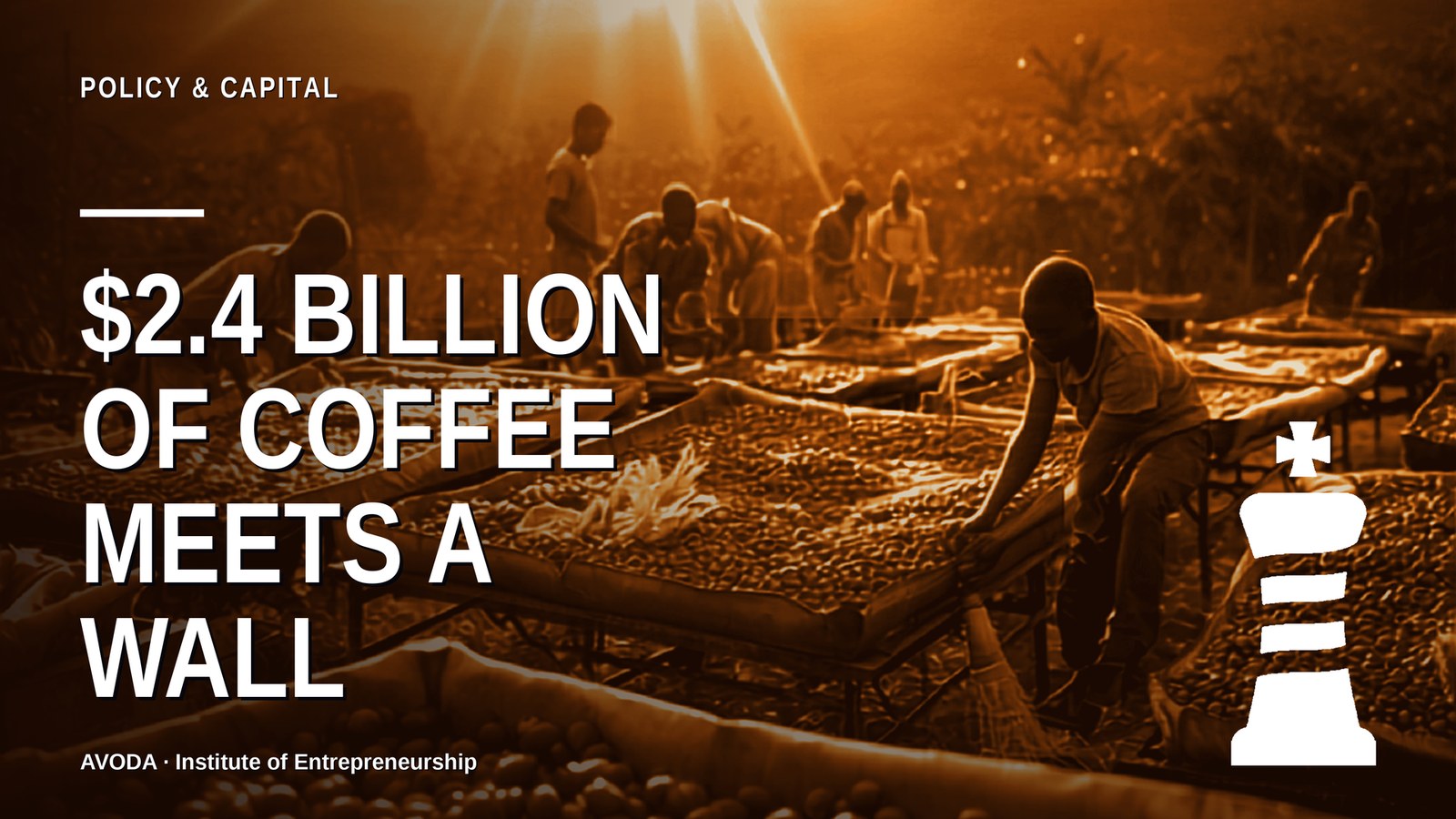
Uganda earned a record $2.4 billion from coffee, 8.8 million bags in the year to early 2026, and is now moving toward zero export of unprocessed coffee, part of a broader push to ban raw agricultural exports (1)(2). The instinct is right. Almost all the value addition, roasting, branding, packaging, happens abroad, leaving Uganda with farmgate margins. But the policy collides with a wall. The EU’s deforestation regulation takes effect December 2026, demanding plot-level geolocation and proof of no deforestation since 2020, and African smallholders who protected forests face exclusion for lacking a digital paper trail (3)(4). Here is the first-principles problem: you cannot legislate a value chain into existence from the export end. Processing migrates to where finance, power and certified capability already are. The ban only works if government solves the three real bottlenecks first.
Key Takeaways
- Uganda earned a record $2.4 billion from coffee (8.8 million bags in the year to early 2026) and is moving toward zero export of unprocessed coffee to capture more value (1)(2).
- The motivation is sound. Nearly all value addition, roasting, branding, packaging, retail, happens abroad, leaving Uganda capturing only a sliver of the final price (1).
- The EU Deforestation Regulation (EUDR) takes effect 30 December 2026 (June 2027 for small enterprises), requiring plot-level geolocation, due diligence, and proof of no deforestation since December 2020 (3).
- A “compliance paradox”: agroforestry smallholders who protected forests face EU-market exclusion because they lack the digital paper trail to prove it, even as Uganda races to register 2.8 million coffee farmers (4).
- The first-principles flaw: you cannot legislate a value chain from the export end. Processing migrates to where finance, reliable power, and certified capability already exist, not to where exports are banned.
- The ban only works if government simultaneously solves three bottlenecks: working capital for processors, reliable industrial power, and compliance infrastructure provided as a public good.
Why is the value-addition instinct correct?
Because Uganda’s coffee success is, paradoxically, a story of capturing very little: a record $2.4 billion in exports that represents a fraction of the value the coffee generates once it is roasted, branded, and sold abroad.
The headline is genuinely impressive: Uganda earned a record $2.4 billion from coffee, shipping 8.8 million bags in the year to early 2026, and has become one of Africa’s top coffee exporters (1)(2). The production engine works. But almost all of that coffee leaves Uganda as green beans, raw, unprocessed and undifferentiated commodity, and nearly all the value addition happens elsewhere: the roasting, the blending, the branding, the packaging, the retail markup that turns a few dollars of green beans into the premium price a consumer pays in Berlin or Tokyo. Uganda captures the farmgate and export value of the raw bean; the roasters, branders, and retailers abroad capture the far larger value added downstream. This is the coffee value-capture problem in its starkest form: a world-class production base earning a sliver of the value chain it feeds. The instinct to fix this, to capture more of the value at home through domestic processing, is entirely correct. A country that grows world-class coffee and exports it raw is leaving most of the money on someone else’s table, and wanting to keep more of it is sound economic ambition.
So the goal of Uganda’s value-addition push, moving toward zero export of unprocessed coffee, building domestic roasting and processing, capturing more of the value chain, is right, and the same logic applies across the horticulture and protein value chains where raw export dominates. The frustration driving the policy is legitimate: decades of being a price-taking raw exporter while others profit from Ugandan coffee. The question is not whether to want more value addition (clearly yes) but whether the method, banning raw exports, actually produces it. And here the first-principles analysis diverges sharply from the policy instinct, because wanting a value chain and legislating one into existence are very different things, and the ban arrives at the worst possible moment.
Why won’t banning raw exports build the factories?
Because processing capacity migrates to where the conditions for processing exist, meaning finance, reliable power, and certified capability. A ban on raw exports does not create those conditions. It merely punishes farmers for an industry that hasn’t been built.
The core fallacy in “ban raw exports to force value addition” is the belief that you can create a value chain from the export end: that by forbidding the export of raw coffee, you compel domestic processing to spring up. But processing does not appear because raw export is banned. It appears where the conditions for processing exist. A roasting and processing industry requires several things that have nothing to do with export rules: substantial working capital (processing ties up cash between buying beans and selling finished product); reliable, affordable industrial power (roasting and processing are energy-intensive, and unreliable or expensive power makes them uncompetitive); certified capability (the technical skills, quality systems, and certifications that let domestic processors meet the standards of premium buyers); and access to the branding and distribution that capture the downstream margin. Where these conditions exist, processing flourishes. Where they don’t, banning raw exports does not summon them. It simply leaves the coffee with nowhere viable to go domestically, depressing farmgate prices (farmers can no longer sell to the export market) without creating the processing capacity to absorb the crop at better value. The ban becomes, in effect, a tax on farmers dressed as patriotism, punishing the producers for the absence of an industry that policy failed to build.
The timing makes this worse, because the ban collides with a simultaneous rise in compliance costs. The EU Deforestation Regulation takes effect 30 December 2026 (June 2027 for small enterprises), requiring every coffee export to the EU to carry plot-level geolocation, due-diligence statements, and proof the land was not deforested after December 2020 (3). This creates what analysts call a compliance paradox: African agroforestry smallholders who actually protected forests face exclusion from the EU market because they lack the digital paper trail to prove it. The environmental virtue is real but undocumented, and the regulation rewards documentation, not conservation (4). Uganda is racing to register 2.8 million coffee farmers to build this traceability (4), but the cost and complexity are substantial, and they fall hardest on smallholders. So Ugandan coffee faces a double squeeze at the same moment: a domestic ban that depresses farmgate prices by removing the raw-export market before processing exists to replace it, and an EU regulation that raises the cost of accessing the premium market the coffee depends on. The risk is losing EU market share to better-documented Latin American supply and failing to build domestic processing: the worst of both worlds, arriving together.
What does it actually take to build the value chain?
Solving the real bottlenecks, working capital, reliable power, and compliance infrastructure, before or alongside the ban, so that domestic processing has the conditions to exist and the export-market access to survive.
If the goal (more domestic value addition) is right but the method (a bare export ban) is wrong, the constructive question is what would build the value chain. The answer is to treat the three real bottlenecks as the actual policy agenda, because these, not the export rule, are what determine whether processing happens:
Working capital for processors. Domestic roasting and processing requires substantial cash to buy beans, process them, and hold finished inventory until sale. Without accessible working-capital finance, even willing processors cannot operate at scale. Government’s role is to enable this finance, through the structured and revenue-based instruments the region is building and the SME credit channels that processing requires, not merely to ban the alternative. Capital is the first bottleneck. Banning raw exports without solving it just strands the crop.
Reliable industrial power. Processing is energy-intensive, and unreliable or expensive power makes domestic roasting uncompetitive against foreign processors with stable, cheap energy. A value-addition strategy that ignores power is building on sand: processing migrates to where the power is reliable. Solving industrial power, its generation, reliability and cost, is a precondition for competitive domestic processing, not an optional extra.
Compliance infrastructure as a public good. The EUDR traceability burden, meaning geolocation, due diligence, and documentation for millions of smallholders, is too costly for individual farmers to bear, but it is exactly the kind of infrastructure a government can provide as a public good: a national traceability and registration system (which Uganda is building) that makes compliance affordable and accessible to smallholders, turning the compliance paradox from an exclusion into a managed cost (4). This connects to digital public infrastructure as industrial policy: the cheapest way to keep smallholders in the premium market is to provide the compliance rails publicly.
A value-addition policy that solves these three bottlenecks (capital, power, compliance) creates the conditions for domestic processing to exist and for the coffee to retain its premium-market access, and then a graduated move toward more domestic processing can work, because the processing has somewhere to happen. A policy that bans raw exports without solving them legislates from the export end and taxes farmers for an industry that the bottlenecks prevent from forming. The sequence matters decisively: bottlenecks first, value chain second; not ban first, hope second.
The Three-Bottleneck Test: building value chains that hold
Here is the framework I would put to ministries of trade and agriculture. Call it the Three-Bottleneck Test: three conditions that must be met for value-addition policy to build processing rather than punish farmers, plus the sequencing rule that ties them together.
Bottleneck 1. Working capital. Is there accessible finance for domestic processors to buy, process, and hold inventory? If not, processing cannot scale, and banning raw exports strands the crop rather than upgrading it. Solve the capital bottleneck, or the value chain has no cash to run on.
Bottleneck 2. Reliable industrial power. Is power reliable and affordable enough for energy-intensive processing to be competitive? If not, processing migrates to where power is better, regardless of export bans. Solve the power bottleneck, or domestic processing cannot compete.
Bottleneck 3. Compliance infrastructure. Is the EUDR-style traceability and compliance burden provided as affordable public infrastructure, so smallholders can stay in the premium market? If not, the export market that funds the whole chain erodes. Solve compliance as a public good, or the market access collapses.
The sequencing rule: bottlenecks before bans. Solve the three bottlenecks before or alongside any move toward restricting raw exports, because the bottlenecks, not the export rule, determine whether processing happens. A ban imposed before the bottlenecks are solved is a tax on farmers. A ban (or graduated incentive) imposed after they are solved can genuinely upgrade the chain.
The Three-Bottleneck Test reframes value-addition policy from a single blunt instrument (ban raw exports) into the real work it requires: building the conditions (capital, power, compliance) under which processing can exist and the export market can survive. Pass the test, and value addition follows naturally. Fail it, and the ban only taxes the farmers it claims to champion.
What should government and the sector do?
Lead with the bottlenecks, not the ban, and provide the compliance infrastructure that turns the EUDR threat into a managed cost.
The practical agenda for government is to invert the policy sequence. Instead of banning raw exports and hoping processing follows, solve the three bottlenecks first (enable working-capital finance for processors, fix industrial power, and provide compliance traceability as a public good), and then a graduated, incentive-led shift toward domestic processing can succeed because the conditions exist. The EUDR, rather than a pure threat, becomes an opportunity if government provides the compliance infrastructure: a country that builds an affordable national traceability system can keep its smallholders in the premium EU market while better-prepared than competitors, turning a regulatory burden into a competitive edge. This is squarely the kind of trade-and-industrial-policy fluency that the value chain requires, and it pairs with the broader lesson that capturing value requires building the conditions for processing, not just mandating it.
The conclusion holds the right goal and the right method together. Uganda’s frustration is legitimate and its ambition sound: it grows world-class coffee, earns a record $2.4 billion, and captures a sliver of the value while roasters and branders abroad take the rest. Wanting to keep more of that value at home is correct. But you cannot legislate a value chain into existence from the export end. Banning raw exports does not create processing. It punishes farmers for an industry the bottlenecks prevent from forming, and it does so at the exact moment the EUDR raises the cost of the premium market the coffee depends on. Processing migrates to where finance, power, and certified capability already are. The ban works only if government first solves the three real bottlenecks (working capital for processors, reliable industrial power, and compliance infrastructure as a public good) and provides the traceability that keeps smallholders in the EU market. Solve the bottlenecks, and value addition follows. Ban raw exports without solving them, and it is a tax on farmers dressed as patriotism. The goal is right. The sequence is everything.
FAQ
How much does Uganda earn from coffee?
Uganda earned a record $2.4 billion from coffee, shipping 8.8 million bags in the year to early 2026, making it one of Africa’s top coffee exporters. However, almost all of that coffee leaves as raw green beans, with the higher-value roasting, branding, and retail happening abroad (1)(2).
What is Uganda’s value-addition policy?
Uganda is moving toward zero export of unprocessed coffee, part of a broader push to ban raw agricultural exports, aiming to force more domestic processing (roasting, branding) and capture more of the coffee value chain at home, rather than exporting raw beans at farmgate margins (1).
What is the EU Deforestation Regulation (EUDR)?
An EU rule taking effect 30 December 2026 (June 2027 for small enterprises) that prohibits importing products linked to deforestation. It requires plot-level geolocation, due-diligence statements, and proof the land wasn’t deforested after December 2020, raising compliance costs for African coffee exporters, who are in the standard-risk category (3).
What is the EUDR “compliance paradox”?
That agroforestry smallholders who actually protected forests can face EU-market exclusion because they lack the digital paper trail to prove it. The regulation rewards documentation, not conservation, so genuinely sustainable smallholders are penalized for being undocumented, which is why Uganda is racing to register 2.8 million coffee farmers (4).
Why won’t banning raw exports build a processing industry?
Because processing migrates to where its conditions exist (working capital, reliable power, and certified capability), not to where raw export is banned. A ban without those conditions strands the crop and depresses farmgate prices without creating processing capacity, becoming a tax on farmers. The bottlenecks must be solved before, or alongside, any export restriction.
Related Reading
- Uganda’s $2.4 Billion Coffee Year, and the Value-Addition Lesson
- The Avocado Signal: Horticulture’s Pivot to Asia
- eCitizen Economics: Digital Public Infrastructure Is Industrial Policy
- Closing the SME Credit Gap: Working Capital for Processors
- Carbon as Collateral: Kenya’s Registry and the SME Question
Sources and Evidence
- New Vision: “Uganda planning zero export of unprocessed coffee, Minister Kyakulaga”. Source for the zero-unprocessed-coffee-export policy and the value-capture motivation.
- Coffee Franchise Hub: “Uganda’s Coffee Industry Faces EUDR Compliance Challenges As December Deadline Approaches”. Source for Uganda’s 8.8 million bags / $2.4 billion coffee year and the EUDR collision.
- African Exponent: “EUDR 2026: How the EU deforestation regulation is reshaping African coffee exports”. Source for the EUDR’s 30 December 2026 effect date, requirements, and standard-risk classification of African origins.
- Nile Post: “Uganda Races to Register 2.8 Million Coffee Farmers Ahead of EU Deforestation Law”. Source for the traceability registration effort; the “compliance paradox” framing is from ODI.
- Food Business MEA: “Uganda to launch coffee traceability system”. Source for Uganda’s national coffee-traceability system as compliance infrastructure.