
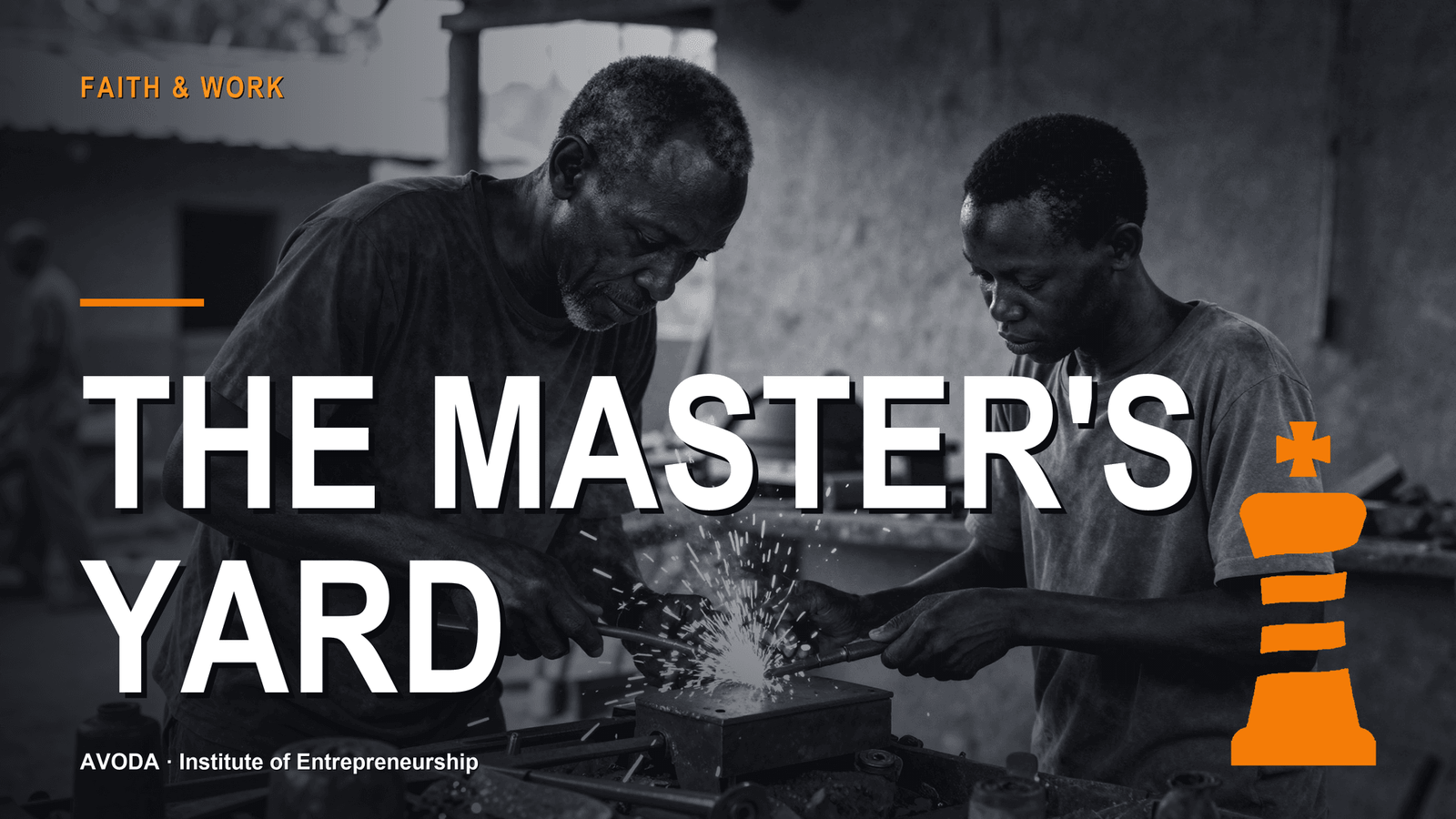
The region’s largest vocational training system has no campus, no curriculum board, and no graduation gowns. It is the workshop apprenticeship: the boy attached to the welder in the juakali yard, the girl learning tailoring at the master’s third sewing machine, the mechanic’s helper who progresses from fetching spanners to diagnosing engines over unmarked years. Across East and West Africa, informal apprenticeship trains multiples of what every technical institute combined manages, financed by parents’ modest fees and the apprentice’s cheap labor, and its graduates operate most of what actually gets welded, sewn, wired, and repaired. Development agencies have noticed and grafted certificates onto it. What the church has barely noticed is what the arrangement already is beneath the economics: a formation relationship of near-monastic intensity, a young person under a master’s authority, in daily proximity, for years, learning a craft and, inevitably, absorbing a way of being. Every master craftsman is already discipling; the only question is into what. For the believing fundi, that question is a commission, and this essay treats the workshop as what it has always been: the region’s most available, least used discipleship platform.
Key Takeaways
- Informal apprenticeship is the region’s dominant skills system, and structurally it is formation: years of daily proximity under a master’s authority, the same architecture discipleship has always used.
- The apprentice absorbs the master’s whole practice: craft standards, customer treatment, money habits, integrity under pressure, whether or not anything is taught on purpose.
- Scripture’s formation model is apprenticeship-shaped: Elisha pouring water on Elijah’s hands, the Twelve watching Jesus work, Paul’s imitate-me, craft and character transferred together.
- The Master’s Yard framework makes the formation deliberate: craft excellence taught to standard, character named alongside skill, the apprentice’s dignity and terms honored, and sending as the goal.
- Churches and associations can scale what one fundi models: recognizing master craftsmen as marketplace disciplers, supporting fair apprenticeship covenants, and celebrating the sending.
What is the apprentice actually learning?
Everything the master is, not merely what the master says. The skills-transfer research on informal apprenticeship confirms what any yard shows: technique is absorbed through observation, imitation, and graduated practice, the learning science’s own prescription, running for years instead of workshops. But the same channel carries the rest of the practice: how the master treats the customer who cannot pay yet, whether quotations are honest, what happens to the borrowed tools and the till, how anger is handled when the weld fails, whether the vulnerable apprentice herself is paid and treated justly. The apprentice cannot un-watch any of it. This is the system-forms-people thesis at its most concentrated: the workshop is a total environment, the master its liturgy, and its graduates carry the formation into the hundreds of enterprises they eventually found, multiplying the master’s character across a district’s economy for a generation. The juakali yard, in other words, is upstream of the region’s SME integrity distribution, and nobody is pastoring it.
Why should the church recognize this as discipleship terrain?
Because it is the Bible’s own formation architecture, running unattended. Scripture’s leaders are formed by attachment: Joshua as Moses’ assistant from youth; Elisha, recruited from the plow, known as the one who poured water on Elijah’s hands, service and proximity before succession; the Twelve, called to be with him before being sent; Paul’s unembarrassed be imitators of me, with Timothy as the apprenticeship’s document trail. The pattern is craft-and-character in one relationship, exactly the workshop’s shape, and conspicuously not the classroom’s. Meanwhile the church’s actual youth formation runs on the classroom’s shape, sermons and seminars, an hour a week against the yard’s sixty, and wonders at the thinness of the result. The strategic recognition is simple: the believing master craftsman is holding, right now, the most intensive formation platform the church could design, with unchurched youth queued for entry by their own parents, fees paid. A congregation that sees its fundis as marketplace pastors, commissions them, supports them, holds them accountable for the trust, has planted a discipleship network in the economy’s engine room at zero facilities cost.
What is the Master’s Yard?
The named framework of this essay: four commitments that convert the default formation into deliberate discipleship, written for the believing master and adaptable by any workshop.
- Craft to standard, taught generously. The first discipleship is the trade itself, taught to real excellence without hoarding: skills released on schedule rather than rationed to retain cheap labor, the trade’s full arithmetic included, because a master who withholds craft to keep the apprentice dependent has already taught the deepest lesson wrongly.
- Character named beside skill. The yard’s moral moments narrated out loud: why this customer gets the truth about the repair, why the shortcut bribe is refused, why the supplier is paid as promised, one sentence of why attached to the practice the apprentice was going to absorb anyway, the workshop’s own catechism.
- The apprentice’s dignity covenanted. Terms in writing even in the informal yard: duration, fees, what will be learned by when, a rest day, pocket money that is not exploitation’s fig leaf, and protection from the abuses the informal system’s power gradient invites, because a formation built on the apprentice’s degradation forms the wrong thing in everyone watching.
- Sending as the goal. The explicit aim is the apprentice’s own bench: tools help at graduation where possible, first-customer referrals, a blessing spoken, and the master’s pride redirected from retention to multiplication, Elijah’s mantle actually handed over, because a discipler’s success has always been measured by the sent.
How does this scale beyond one godly fundi?
Through the institutions that already touch the yards. Churches: commission master craftsmen publicly as marketplace disciplers, gather them quarterly as a formation cell of their own, and route the congregation’s unattached youth toward covenant yards, the diaconal act of a fair placement. Associations and juakali cooperatives: adopt the covenant terms as a member standard, dignity, duration, skills schedule, and let the standard become the yards’ public differentiator with parents choosing placements. Programs and funders: stop treating informal apprenticeship as a deficit to be replaced by institutes and start upgrading it in place, master-craftsman training in pedagogy and business, completion recognition, tools-at-graduation funds, the evidence consistently favoring upgraded traditional apprenticeship over classroom substitution for this population. And the theological summary belongs to the yards themselves: the region’s economy was always going to be formed under the mango tree, by masters and their watching apprentices; the only live question was whether the church would show up to the formation it invented. Elisha is at the plow. The water can be poured on purpose.
FAQ
How big is informal apprenticeship in the region?
Dominant: it trains several times the combined output of formal technical institutes across Sub-Saharan Africa, financed by modest family fees and apprentice labor, and staffs most of the trades economy.
What makes it discipleship rather than just training?
Structure: years of daily proximity under a master’s authority transfer character with craft, the same architecture scripture uses, Elijah-Elisha, Jesus and the Twelve, Paul’s imitate-me.
What is the Master’s Yard?
Four commitments: craft taught generously to standard, character narrated beside skill, the apprentice’s dignity covenanted in written terms, and sending, the apprentice’s own bench, as the explicit goal.
What abuses must the covenant guard against?
Skill-hoarding to retain cheap labor, unpaid exploitation dressed as training, endless undefined durations, and the power-gradient abuses vulnerable apprentices cannot contest alone.
How can a church engage without taking over?
Commission and support its master craftsmen, gather them as peers, route youth to covenant yards, and celebrate graduations publicly, upgrading the system in place rather than replacing it.
Related Reading
- Theology of Work for the Informal Economy
- Redemptive Is a System Property, Not a Motive
- The Church as an Economic Institution in Africa
- Rural Acceleration: The Model Nobody Has Cracked
Sources and Evidence
- ILO on informal apprenticeship: scale and upgrading evidence across Africa.
- World Bank skills development research: traditional apprenticeship outcomes versus institutional training.
- 1 Kings 19:19-21, ESV: Elisha’s recruitment into attachment.
- 2 Timothy 2:2, ESV: entrust to faithful men who will teach others, the multiplication chain.