
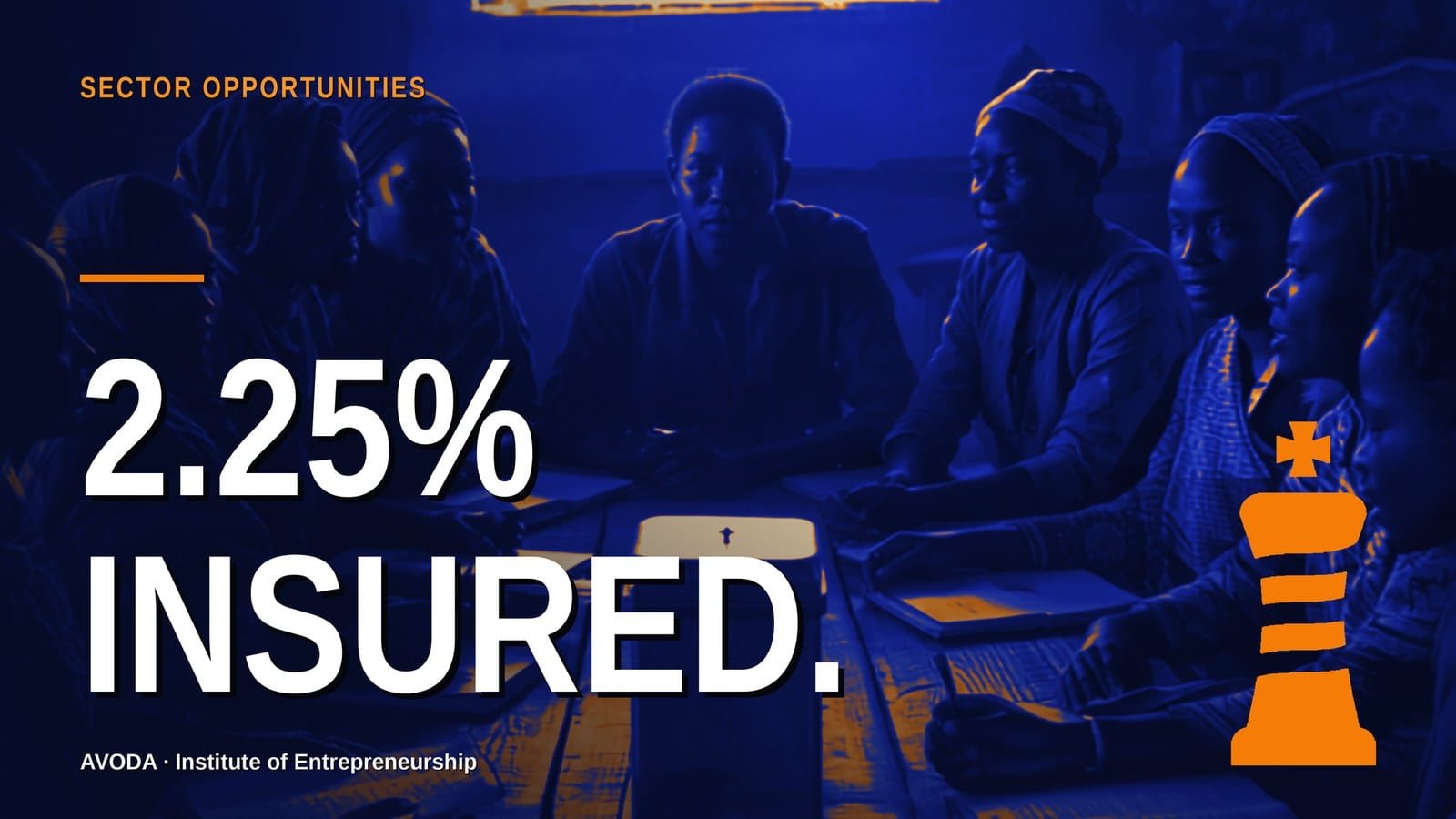
Here is one of the great statistical mismatches in global finance: insurance penetration sits at just 2.25% of GDP in Kenya, 0.87% in Uganda, 0.60% in Tanzania, and 0.30% in Ethiopia — among the lowest ratios on earth, in economies growing 5–7% a year (1). The conventional read is that East Africans do not want insurance. The conventional read is wrong. Every East African already self-insures — through harambees, burial societies, chamas, and church funds. The opportunity is not to teach insurance; it is to formalize the trust structures people already use, at mobile-money cost and through the channels they already trust. Low penetration is a distribution problem, not a demand problem — and distribution problems, as mobile money proved, are solvable.
Key Takeaways
- Insurance penetration is just 2.25% of GDP in Kenya, 0.87% in Uganda, 0.60% in Tanzania, and 0.30% in Ethiopia — among the lowest on earth, in fast-growing economies (1).
- The build-out has begun: Kenya hosts 31 active insurtechs that have raised $51.7 million, and FSD Africa launched a $30 million inclusive insurtech fund to close the protection gap (2)(3).
- Kenya, Uganda, and Tanzania signed a memorandum to harmonize mobile-insurance rules by 2026, lowering the regulatory barrier to cross-border embedded products (2).
- Africa’s microinsurance market is forecast to roughly double, from about $3.9 billion to $7.7 billion by 2032 — the formalization of mass-market protection is already underway (4).
- The core insight: low penetration is a distribution problem, not a demand problem. East Africans already self-insure informally; the opportunity is to formalize that demand through trusted channels at mobile-money cost.
- Embedded products — crop, health, device, transit insurance distributed through telcos, SACCOs, chamas, and agro-dealers — are the proven wedge into the emptiest market in finance.
Why is low penetration a distribution problem, not a demand problem?
Because the assumption that low insurance penetration means low demand for protection collapses the moment you look at how East Africans actually manage risk.
The standard interpretation of a 2.25%-and-falling penetration rate is that East Africans either cannot afford insurance or do not see its value — a demand deficit. But this misreads the society entirely. East Africans manage risk constantly and communally: when a family faces a funeral, a burial society or harambee pools community money to cover it; when a member faces a medical emergency, a chama or church fund steps in; when crops fail or a breadwinner dies, extended networks absorb the shock. These are not charity; they are informal insurance mechanisms — risk-pooling structures built on trust, used by virtually everyone, mobilizing significant sums. The demand for protection is not low. It is enormous, and it is already being met, informally, every day.
What is low is the penetration of formal insurance products — and that is a distribution and trust problem, not a demand problem. East Africans do not buy formal insurance for specific, solvable reasons: the products are sold through channels they do not use or trust (agents, brokers, corporate offices), priced and structured for a formal-sector customer they are not, burdened by claims processes that breed distrust, and disconnected from the trusted community structures through which people already manage risk. The protection demand exists; the formal product fails to reach it through the right channel at the right cost. This is precisely the diagnosis mobile money proved out in payments: the demand to send and store money was always there; what was missing was distribution that fit how people actually lived. M-PESA did not create demand for moving money — it distributed a solution through a channel people trusted. Insurance is waiting for the same move, and the same playbook that worked for the region’s revenue-legible mobile-money economy applies here.
What does the data show is already happening?
It shows a market that is beginning to build — with capital, regulation, and product innovation all moving in the same direction at once.
The capital is arriving. Kenya alone hosts 31 active insurtechs that have collectively raised $51.7 million, and FSD Africa launched a $30 million inclusive insurtech fund specifically to close Africa’s protection gap by backing the companies building inclusive, often climate-resilient products (2)(3). These are not large numbers by global standards — which is exactly the point: a market this empty, this large, and this fast-growing, attracting its first serious wave of dedicated capital, is at the beginning of its build-out, not the middle. The protection-gap funds and the insurtech cohort are the leading indicators of an asset class forming.
The regulation is moving too. Kenya, Uganda, and Tanzania signed a memorandum to harmonize mobile-insurance rules by 2026 (2) — a deliberate lowering of the regulatory barrier to distributing insurance through mobile channels across borders. Regulatory harmonization of this kind is what lets embedded, mobile-distributed products scale regionally rather than being trapped in single-country silos. And the market forecasts confirm the trajectory: Africa’s microinsurance market is projected to roughly double from about $3.9 billion to $7.7 billion by 2032 (4). Microinsurance — small-premium, mass-market protection — is precisely the formalization of the informal risk-pooling East Africans already practise. Capital forming, regulation harmonizing, microinsurance doubling: these are the signs of the emptiest market in finance beginning, finally, to fill.
How do you actually formalize the trust people already use?
By meeting people inside the structures and channels they already trust — embedding protection into existing relationships rather than asking them to come to an insurance office.
The strategic error of traditional insurance in East Africa was to build a parallel, formal system and expect people to migrate to it — to leave the burial society and the chama for an insurance company they had no reason to trust. The winning approach does the opposite: it embeds formal protection into the channels and relationships people already use and trust. This is the “embedded insurance” model, and it works because it solves the trust and distribution problem simultaneously. Instead of selling a standalone policy through an unfamiliar agent, the protection is bundled into a transaction or relationship the customer already has and trusts:
A telco embeds device or life insurance into a mobile subscription, distributed to millions instantly through a channel they use daily. A SACCO or chama offers formal microinsurance to its members, formalizing the risk-pooling the group already does informally, through the trusted group structure. An agro-dealer sells crop insurance bundled with the seeds and inputs a farmer is already buying, at the moment of purchase. A lender embeds credit-life cover into a loan. In each case, the formal product reaches the customer through a relationship they already trust, at the moment of a transaction they are already making, often at mobile-money cost — eliminating the agent, the unfamiliar office, and the friction that killed traditional distribution. This connects directly to the deep cultural infrastructure of risk-sharing the region already runs on: the chama and burial society are already covenant economics, and insurance, understood as formalized communal care, fits naturally into how East Africans already think about protecting one another.
The Embedded Distribution Wedge: four channels into the empty market
Here is the framework I use to map how to actually penetrate the insurance greenfield. Call it the Embedded Distribution Wedge — four existing, trusted channels, each carrying a natural insurance product, that bypass the failed traditional model.
Channel 1 — Telcos and mobile money. The widest reach in the region. Embed device, life, hospital-cash, or funeral cover into mobile subscriptions and mobile-money accounts, distributed instantly to tens of millions at mobile-money cost. The harmonization of mobile-insurance rules by 2026 makes this channel scalable across borders (2). This is the M-PESA-scale wedge.
Channel 2 — SACCOs, chamas, and burial societies. The deepest trust. Formalize the risk-pooling these groups already do — offering microinsurance through the group structure that members already rely on. This converts informal mutual aid into formal, better-funded protection without asking anyone to abandon a trusted institution.
Channel 3 — Agro-dealers and value-chain partners. The moment of need. Bundle crop, weather-index, or livestock insurance with the inputs farmers already buy, sold at the point of purchase by the dealer the farmer already trusts. This reaches the rural majority through the agricultural value chain, pairing naturally with the region’s agribusiness build-out.
Channel 4 — Lenders, pharmacies, and embedded-finance rails. The transaction flow. Embed credit-life into loans, health cover into the pharmacy rails serving 50,000 drug shops, and protection into the digital financial flows mobile money makes legible. Insurance rides the rails other financial services have already built.
The Embedded Distribution Wedge reframes the whole challenge. The traditional model asked, “how do we convince East Africans to buy insurance?” — and failed, because it built a parallel system people did not trust. The embedded model asks, “which trusted channel already touches this customer, and what protection naturally rides it?” — and wins, because it formalizes demand that already exists through relationships that already work. Whoever builds these wedges at scale does not just sell policies; they build the region’s next financial giant.
What should operators, investors, and policymakers do?
The path is clear, and the prize is among the largest in the region’s financial sector.
For founders, the opportunity is to build embedded-insurance products and the agent and group networks that distribute them — partnering with telcos, SACCOs, agro-dealers, and lenders rather than building standalone insurance brands. These are capital-efficient, fast-scaling distribution plays that fit the region’s emerging capital base, and they connect to the mobile-money fraud and credit-scoring infrastructure AI is building and the healthtech and SME-finance rails already reaching the mass market. The protection-gap funds and insurtech capital now forming are actively looking for exactly these models (3).
For investors, the insurance greenfield offers a rare profile: an enormous, fast-growing, under-penetrated market with demand already proven (informally) and the distribution model (embedded) now validated. Closing even half the gap to the African average implies a multi-billion-dollar premium pool in the EAC alone — patient capital backing the distribution build-out captures the formation of a major financial sector. For policymakers, the imperative is to keep lowering the barriers: extend the mobile-insurance harmonization, enable group and embedded distribution, and build the consumer-protection frameworks that earn the trust traditional insurance squandered.
The conclusion reframes the emptiest market as one of the most hopeful. A 2.25%-and-falling penetration rate looks, at first glance, like a society that does not want insurance. Look closer and it is a society that wants protection enormously — and meets that want every day through harambees, burial societies, chamas, and church funds — but that formal insurance has utterly failed to reach. That failure is not a verdict on the demand; it is a verdict on the distribution. The opportunity is not to create a market but to formalize one that already exists, through the trusted channels people already use, at the mobile-money cost they can afford. The region that built the world’s leading mobile-money system from a similar starting point — enormous latent demand, failed traditional distribution — knows exactly how this story goes. The emptiest market in finance is empty only of formal products. The demand, and the trust, are already there, waiting to be met.
FAQ
How low is insurance penetration in East Africa?
Among the lowest on earth: insurance penetration is about 2.25% of GDP in Kenya, 0.87% in Uganda, 0.60% in Tanzania, and 0.30% in Ethiopia — strikingly low for economies growing 5–7% a year. This reflects a failure of formal-product distribution, not an absence of demand for protection (1).
Is low insurance penetration a demand problem?
No — it is a distribution and trust problem. East Africans already manage risk communally through harambees, burial societies, chamas, and church funds, which are informal insurance mechanisms. The demand for protection is enormous and already met informally; formal insurance simply fails to reach it through trusted channels at affordable cost.
What is embedded insurance?
Embedded insurance bundles protection into a transaction or relationship the customer already has and trusts — device cover in a mobile subscription, crop insurance with farm inputs, credit-life in a loan, microinsurance through a chama. It solves the trust and distribution problem by reaching customers through channels they already use, often at mobile-money cost.
Is the East African insurance market actually growing?
Yes. Kenya hosts 31 insurtechs that have raised $51.7 million; FSD Africa launched a $30 million inclusive insurtech fund; Kenya, Uganda, and Tanzania are harmonizing mobile-insurance rules by 2026; and Africa’s microinsurance market is forecast to roughly double from $3.9 billion to $7.7 billion by 2032 (2)(3)(4).
Which distribution channels work for insurance in East Africa?
Existing trusted channels: telcos and mobile money (widest reach), SACCOs/chamas/burial societies (deepest trust), agro-dealers and value-chain partners (point of need), and lenders, pharmacies, and embedded-finance rails (transaction flow). These bypass the unfamiliar agents and offices that made traditional insurance distribution fail.
Related Reading
- The Chama Is Already Church Economics: Covenant and Savings Groups
- From Burial Society to Life Cover: Insurance as Covenant Care
- The Pharmacy Is the Hospital: Healthtech’s Quiet Compounding
- Pay From Revenue, Not Equity: Financing the Distribution Build-Out
Sources and Evidence
- KPMG — “The East African Insurance Industry Overview” (2025) — Source for the penetration figures: Kenya 2.25%, Uganda 0.87%, Tanzania 0.60%, Ethiopia 0.30%.
- Finance in Africa — “Insurance adoption trends in African countries” — Source for Kenya’s 31 insurtechs ($51.7m raised) and the Kenya–Uganda–Tanzania mobile-insurance harmonization memorandum.
- FSD Africa — “FSD Africa launches $30 million inclusive insurtech fund to close Africa’s protection gap” — Primary source for the $30 million inclusive insurtech fund.
- IMARC Group — “Africa Insurance Market” — Source for the microinsurance market forecast (~$3.9bn to $7.7bn by 2032).
- Capital Business — “From Risk to Resilience: Why East Africa Must Rethink Insurance” — Analysis of the region’s protection gap and the distribution-led path to closing it.