
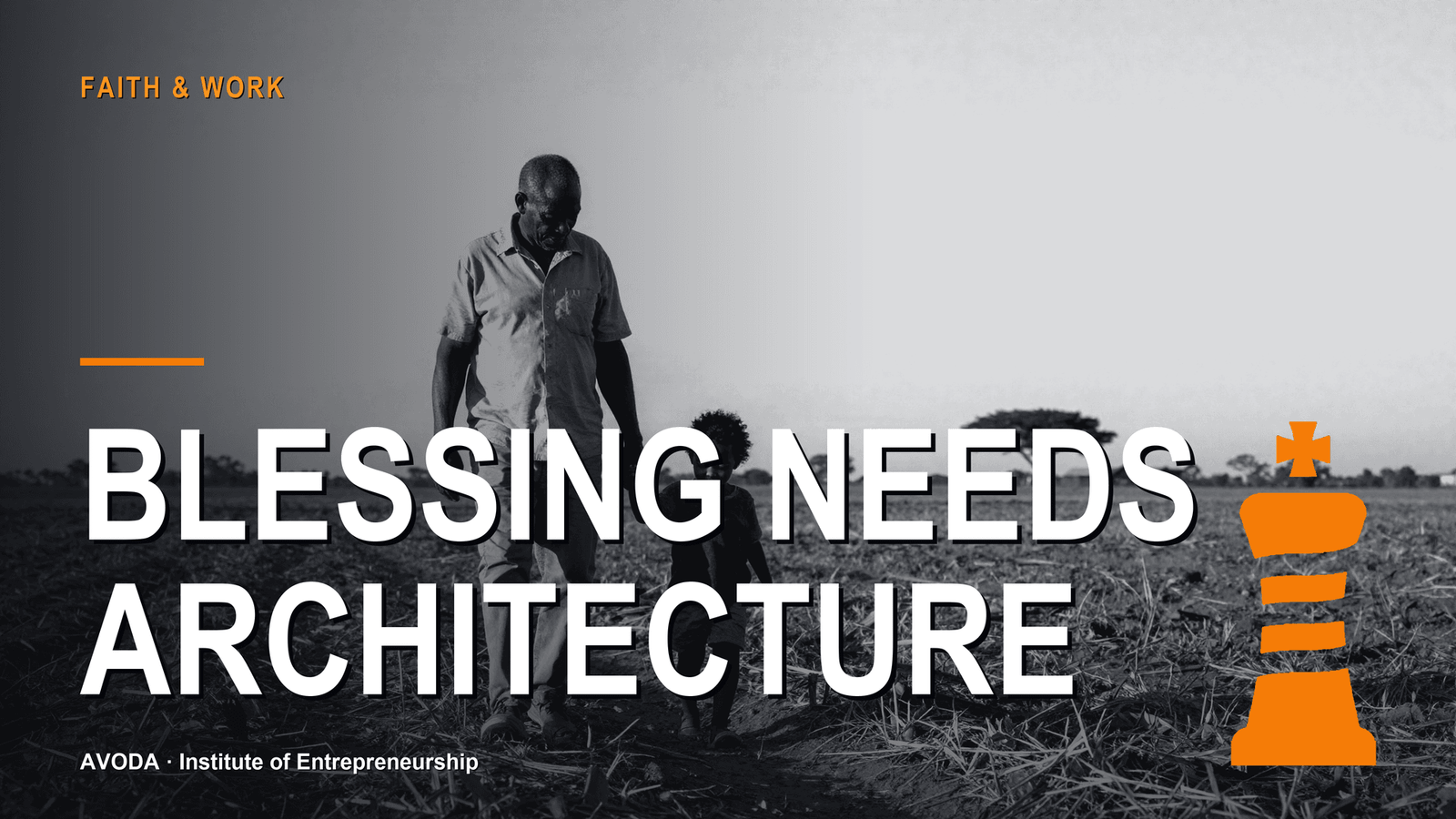
The teaching fills conferences across the continent: declare the Abrahamic blessing over your lineage, break the generational curses in your bloodline, and your children’s children will walk in wealth. Its appeal is not mysterious, it speaks to the deepest regional longing, the family raised, the name established, and it handles real biblical material: God does bind himself to generations, showing steadfast love to thousands, keeping covenant with Abraham’s seed, a good man leaves an inheritance to his children’s children. The critique this essay offers is therefore not the cynic’s, that generational blessing is fantasy, but the steward’s: the conference version has extracted the covenant’s promises and discarded its mechanics. In the texts, blessing crosses generations through taught obedience, structured households, and durable practices, Abraham commanded to direct his children and household after him to keep the way of the Lord, that the Lord may bring what he promised. The declaration without the directing is a check drawn on an account the teaching never funds, and the region’s families deserve the whole doctrine: blessing is covenantal, and covenants have architecture.
Key Takeaways
- The generational texts are real and gracious: God’s faithfulness spans generations, and desiring blessed descendants is biblical, not carnal.
- The conference version fails at the mechanism: in scripture, blessing transmits through commanded households, taught ways, and durable structures, not through declaration alone.
- Genesis 18:19 is the hinge text: chosen so that he will command his children and household to keep the way, so that the Lord may bring the promise, formation as the promise’s ordained carrier.
- The Command-Your-Household framework names four carriers: taught faith and practice, documented and governed assets, transmitted competence, and the family’s covenant rhythms.
- The curse-breaking impulse also has a stewardship form: generational patterns are broken by repentance plus replaced practices, the new liturgy, not by louder declarations over the old one.
What do the generational texts actually promise?
Faithfulness with an architecture attached. The covenant formulas are genuinely multigenerational: steadfast love to thousands of generations of those who love me and keep my commandments, the promise to Abraham explicitly including seed and land and blessing to nations, David’s house held across centuries of failure. But read the operative clauses: the transmission language is saturated with teaching, commanding, and keeping, these words shall be on your heart, you shall teach them diligently to your children, when your son asks you in time to come, and Genesis 18:19 states the mechanism as plainly as scripture states anything: I have chosen him, that he may command his children and his household after him to keep the way of the LORD by doing righteousness and justice, so that the LORD may bring to Abraham what he has promised him. The so-that clauses are the doctrine: election, formation, then fulfillment, in that order. Proverbs’ inheritance verse sits in the same frame, the good man’s legacy to grandchildren appears in a book that is itself a father’s transmitted competence, thirty-one chapters of taught judgment. Nowhere does the canon show blessing crossing generations through proclamation divorced from formation; where the formation lapses, Judges’ generation who knew not the Lord, Eli’s uncommanded sons, the blessing’s human channel visibly fails within one generation, whatever was declared over it.
What does the conference version get wrong, and at what cost?
It sells the harvest without the planting, and the cost lands on the poorest listeners. The extraction error: promises lifted from their covenant mechanics become magic, the prosperity structure applied to lineage, and the household architecture, the actual carrier, goes unbuilt because the declaration was presented as sufficient. The displacement error follows: families invest scarce resources in the declared version, seeds sown into ministries, deliverance sessions purchased, while the funded version’s components, the will unwritten, the land untitled, the children untaught about money, the succession unplanned, remain missing, so the second generation inherits declarations and disputes. And the diagnostic error: generational curse teaching, where it reduces every family pattern to spiritual attack, obscures the observable transmission lines, modeled behavior, unstructured assets, secrets and shame, that repentance-plus-practice could actually interrupt. The pastoral tragedy is that the audience most drawn to the teaching, first-generation builders with everything at stake, is exactly the audience most in need of the mechanics the teaching skips, and a doctrine that could have organized their households into covenant architecture instead organizes another conference.
What is Command-Your-Household?
The named framework of this essay: four carriers through which blessing observably crosses generations, each with scripture’s warrant and a builder’s checklist.
- Taught faith and practice. The Shema’s program: the way of the Lord transmitted through daily words, visible practice, and answered questions, faith formation as the first inheritance, because descendants who inherit assets without the way become Judges’ generation with a portfolio.
- Documented, governed assets. Blessing’s material carrier made durable: titles cleaned, wills written, family governance constituted, succession designed, the unglamorous paperwork that determines whether the third generation litigates or builds, and which no declaration substitutes for.
- Transmitted competence. Proverbs’ own genre: judgment, craft, and money skill taught deliberately, children brought into age-staged responsibility, the apprenticeship run inside the family, because inherited assets without inherited competence are a liquidation schedule.
- Covenant rhythms. The family’s liturgy: meals, sabbaths, remembrance, the annual family meeting, stories of God’s faithfulness told until they are the children’s own, the identity layer that makes the other three carriers meaningful rather than mercenary.
The framework’s relation to declaration is not opposition but ordering: pray the promises, absolutely, Abraham heard promises before he commanded anything, and then build what the promise’s own text names as its channel, faith funding the architecture rather than replacing it.
And what of breaking generational curses?
The impulse honors a truth the method betrays. Families do carry patterns, scripture and observation agree: the fathers’ iniquity visiting generations is in the same commandment as the thousands-of-generations mercy, and everyone has watched drink, violence, or financial chaos run down a lineage. But the canon’s own account of interruption is repentance plus replacement, not exorcism plus continuation: Ezekiel 18’s son who sees his father’s sins and does not do likewise, the pattern broken by different practice; Josiah, hearing the neglected book, rebuilding the abandoned structures; the new covenant’s promise written on hearts that then walk differently. Translated to the family economy: the pattern of secret debts is broken by the household’s open ledger; the pattern of land grabbed from widows by documents and governance that make grabbing impossible; the pattern of favoritism’s wars by a constitution fairer than the founder’s moods. Deliverance without replacement returns swept houses to old tenants; the new liturgy is the exorcism that holds. Which returns the whole doctrine to its stewardship form, and to the conference’s missing altar call: the blessing of Abraham is real, is in Christ extended to all nations, and still travels the way Genesis said it would, through households commanded, in righteousness and justice, so that the Lord may bring what he has promised. Declare it, then build the house it can live in.
FAQ
Is desiring generational blessing unbiblical?
No, it is covenantal: God binds himself across generations, and Proverbs commends the inheritance reaching grandchildren. The critique targets the mechanism, not the desire.
What is wrong with the declaration-focused teaching?
It extracts promises from their transmission mechanics: scripture carries blessing through commanded households, taught ways, and durable structures, and declarations without that architecture leave heirs with disputes.
What is Command-Your-Household?
Four carriers: taught faith and practice, documented and governed assets, transmitted competence, and family covenant rhythms, the architecture Genesis 18:19 names as the promise’s channel.
Do generational curses exist?
Family patterns demonstrably transmit, and scripture acknowledges both visited iniquity and abundant mercy. Interruption comes by repentance plus replaced practice, Ezekiel 18’s different son, not by declaration over unchanged systems.
Where should a first-generation builder start?
With the unglamorous carriers: the will, the titles, the children’s money formation, the family meeting rhythm, prayed over and built, faith funding the architecture the promise travels through.
Related Reading
- Covenantal Succession and Generational Wealth
- First-Generation Wealth With No Playbook
- The Family Constitution for African Business Families
- Teaching Children Money Stewardship
Sources and Evidence
- Genesis 18:19, ESV: chosen to command his household, so that the promise comes.
- Deuteronomy 6:4-9, ESV: the Shema’s transmission program.
- Ezekiel 18:14-17, ESV: the son who sees and does not do likewise.
- Proverbs 13:22, ESV: the good man’s inheritance to children’s children.