
An AI agent can safely do one thing first in a Kampala business: read your lead table each morning and draft the follow-up message for every lead that has gone quiet, while a named person reads each draft and sends it. That is the lowest level of human oversight, and it is where every agent should start. What keeps an agent in line is a one-page brief that says its job, what it may read, which tools it may touch, what it must never do, who checks it, and when it must stop and hand back to a person (1).
This article is for owners and executives of businesses that already sell, in Kampala or anywhere in Uganda, who have heard the word “agent” from a vendor, a nephew or a conference and want to know what is safe. It gives you the four levels of oversight, a way to place your own jobs on them, the brief itself, the data rules, the ways these projects fail, a stop rule and a template you can copy.
Key Takeaways
- An agent is a system where the model decides its own next step and which tool to use. A chat prompt waits for you, and a workflow follows steps you fixed in advance. Anthropic draws the same line between workflows and agents (1).
- Start at “draft only”. Move a job up one level only after a counted record of checked outputs. In a randomised trial, developers who used AI took 19% longer yet believed they had been 20% faster (5).
- Four levels cover almost every small-business job: draft only, draft and approve, act and report, act alone. Anything that moves money, changes a price or touches health, children’s or ID data stays at level 1 or stays out.
- The agent’s first job is the lead table: one row per live lead, a next action and a date. It is money-adjacent, the data is yours, and a draft is easy to undo.
- The brief has eight fields, including a single number you watch. Gartner forecasts that over 40% of agentic AI projects will be canceled by the end of 2027, for “escalating costs, unclear business value or inadequate risk controls”. That is a forecast, not a count (2).
- Uganda’s Data Protection and Privacy Act, 2019 (Cap. 97) section 19 limits sending personal data abroad without equivalent safeguards or consent. Many hosted AI tools process data outside Uganda, so check where yours does (9). This is not legal advice.
- Write the stop rule before the first run: a review date, a threshold, and a return to level 1 if an error reaches a customer.
What is an AI agent, in plain words, and how is it different from a chat prompt or a workflow?
An agent is a program that uses an AI model to decide what to do next, picks from the tools you have given it, does the step, looks at what happened and decides again, until the job is finished or it is told to stop. Anthropic, the maker of Claude, puts the distinction this way: “Workflows are systems where LLMs and tools are orchestrated through predefined code paths. Agents, on the other hand, are systems where LLMs dynamically direct their own processes and tool usage, maintaining control over how they accomplish tasks.” (1)
Take one job: following up a customer who asked for a quote last week and went silent. Three setups can do it.
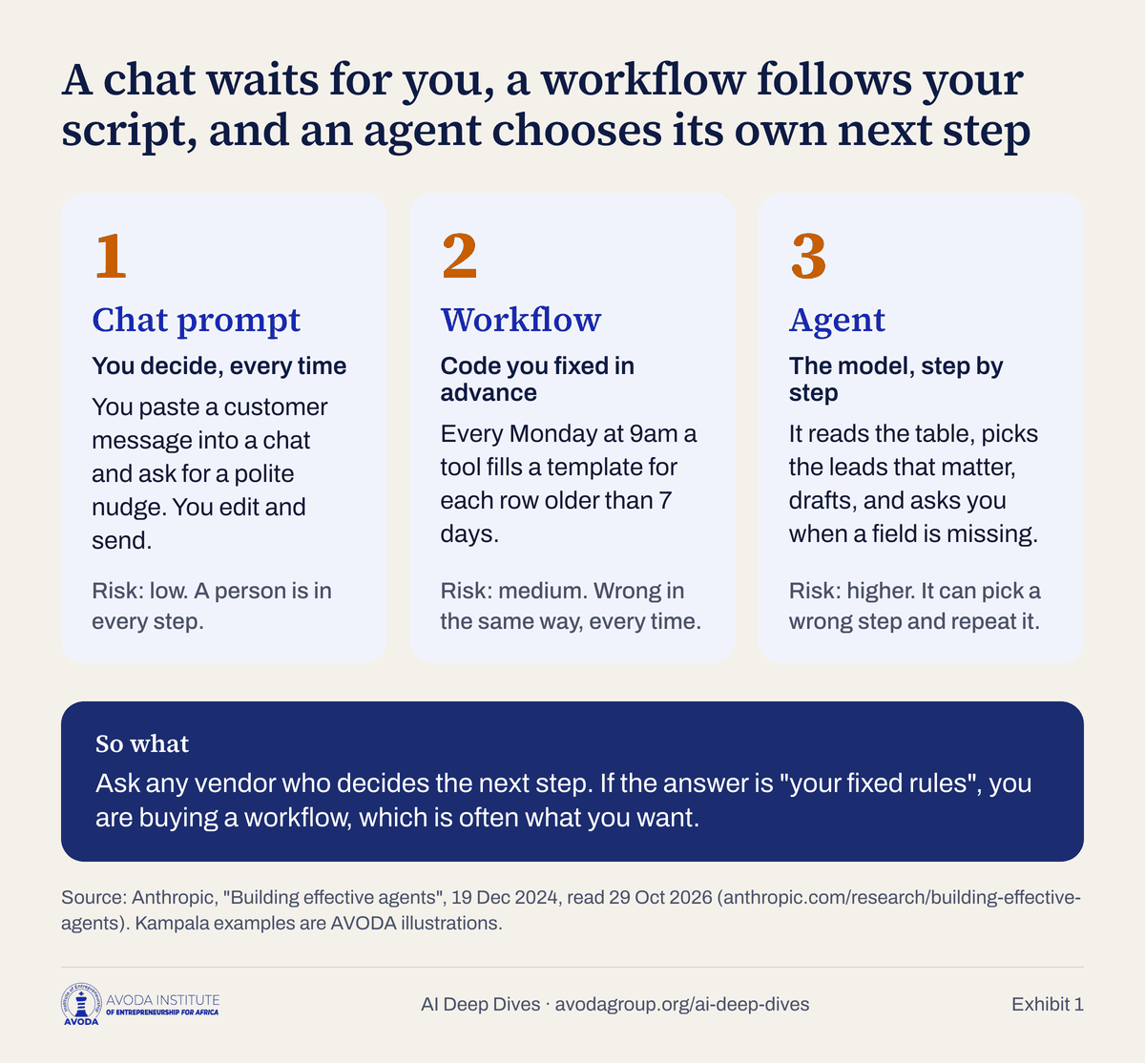
| Setup | Who decides the next step | The quote follow-up, done this way | Where the risk sits |
|---|---|---|---|
| Chat prompt | You, every time | You paste the customer’s name and last message into a chat and ask for a polite nudge. You edit and send. | Low. A person is in every step. The risk is pasting data you should not. |
| Workflow | Code you or a developer wrote | Every Monday at 9am a tool takes each row older than 7 days, fills a fixed template, and puts a draft in your outbox. | Medium. Predictable, but it will send the wrong message the same wrong way every time. |
| Agent | The model, step by step | The agent reads the whole table, decides which leads matter, looks up the last quote, chooses a tone, drafts, notices a missing phone number and asks you. | Higher. It can choose a wrong step you never imagined, and a wrong step can repeat. |
Gartner estimates only about 130 of the thousands of agentic AI vendors are real (2), so many things sold as agents are the first two. A chat window with a clever name is a chat. A scheduled sequence of fixed steps is a workflow, and a workflow is often what you want. Anthropic’s own advice to developers is to find “the simplest solution possible, and only increasing complexity when needed”, and it adds that this “might mean not building agentic systems at all” (1).
Two words from that guide matter for the rest of this article. The first is tools. A tool is anything the agent can act through: reading a spreadsheet, searching your email, writing a draft, sending a message, updating a record. An agent with no tools can only talk. The second is checkpoints. The same guide notes that agents “can then pause for human feedback at checkpoints or when encountering blockers” and that “it is common to include stopping conditions (such as a maximum number of iterations) to maintain control” (1). Everything in the brief below is a way of deciding the tools, checkpoints and stopping conditions in advance, in writing, before the agent runs once.
A note on dates. The Anthropic guide was published on 19 December 2024 and, when I read it on 29 October 2026, carried a notice that much of the tooling it describes has changed since then (1). The definitions of workflow and agent have not been replaced, and the tools have moved on. Treat it as a source for the concepts.
Does a Kampala business need an agent at all?
Often it does not, and the case against is strong enough to state at full strength before going further.
A sceptical owner would argue like this. The people selling agents are the same people who benefit when you adopt them. Gartner, the research firm, says most agentic AI projects “are early stage experiments or proof of concepts that are mostly driven by hype and are often misapplied”, and that “many use cases positioned as agentic today don’t require agentic implementations” (2). Anthropic says the right answer may be no agent at all (1). The MIT NANDA report found that of organisations that evaluated enterprise-grade AI tools, 60% looked, 20% reached pilot and 5% reached production (3). The METR trial found 16 experienced developers took 19% longer with AI allowed, while believing they were faster (5). And a Harvard Business School study of 758 consultants found that on a task outside what the AI handled well, users were 19% less likely to produce a correct answer (6).
Then the Ugandan case. The most recent official census of business establishments, for 2019/20 and released by the Uganda Bureau of Statistics on 14 August 2025, counted 686,700 businesses. Of those, 81.7% were informal and 36.0% used computers in their operations (7). The Ministry of Trade profile says 90% of enterprises are micro, with an average of 2.1 employees (8). An agent needs records to read. If the lead list lives in the owner’s head and a WhatsApp thread, there is nothing to hand it, and a vendor demo that works on a tidy sample will fail on the real data. On this argument, the sensible step is to buy nothing, fix the records and use a chat window.
That argument is mostly right, and we concede the parts that matter.
- For most jobs in a small business, a good prompt kept on a card, or a fixed workflow, does the work with less cost and less risk than an agent. Start there.
- The evidence on results is thin and mixed. The surveys behind these numbers are not samples of Ugandan small firms. The MIT study is small (52 interviews, 153 survey responses) and the METR trial had 16 people, so both are directional only (3)(5). Treat every figure here as a reason for caution.
- Without a kept record, an agent has nothing to work from. Fix that first. It is the reason the lead table comes before the agent in the Deep Dives programme.
What survives the objection is narrower. McKinsey’s 2026 survey found that nearly three-quarters of “high performers”, the 6% of respondents getting significant value from AI, fundamentally redesigned workflows because of AI (4). The value comes from a redesigned job. An agent earns its place when one job has steps you cannot fix in advance (which lead matters today, what this customer asked last time), the output is easy for a person to check, and a wrong output costs little. That job is rare enough that you should pick exactly one and keep the rest as prompts and workflows. The rest of this article is about picking it and fencing it.
What are the four levels of human oversight for an AI agent?
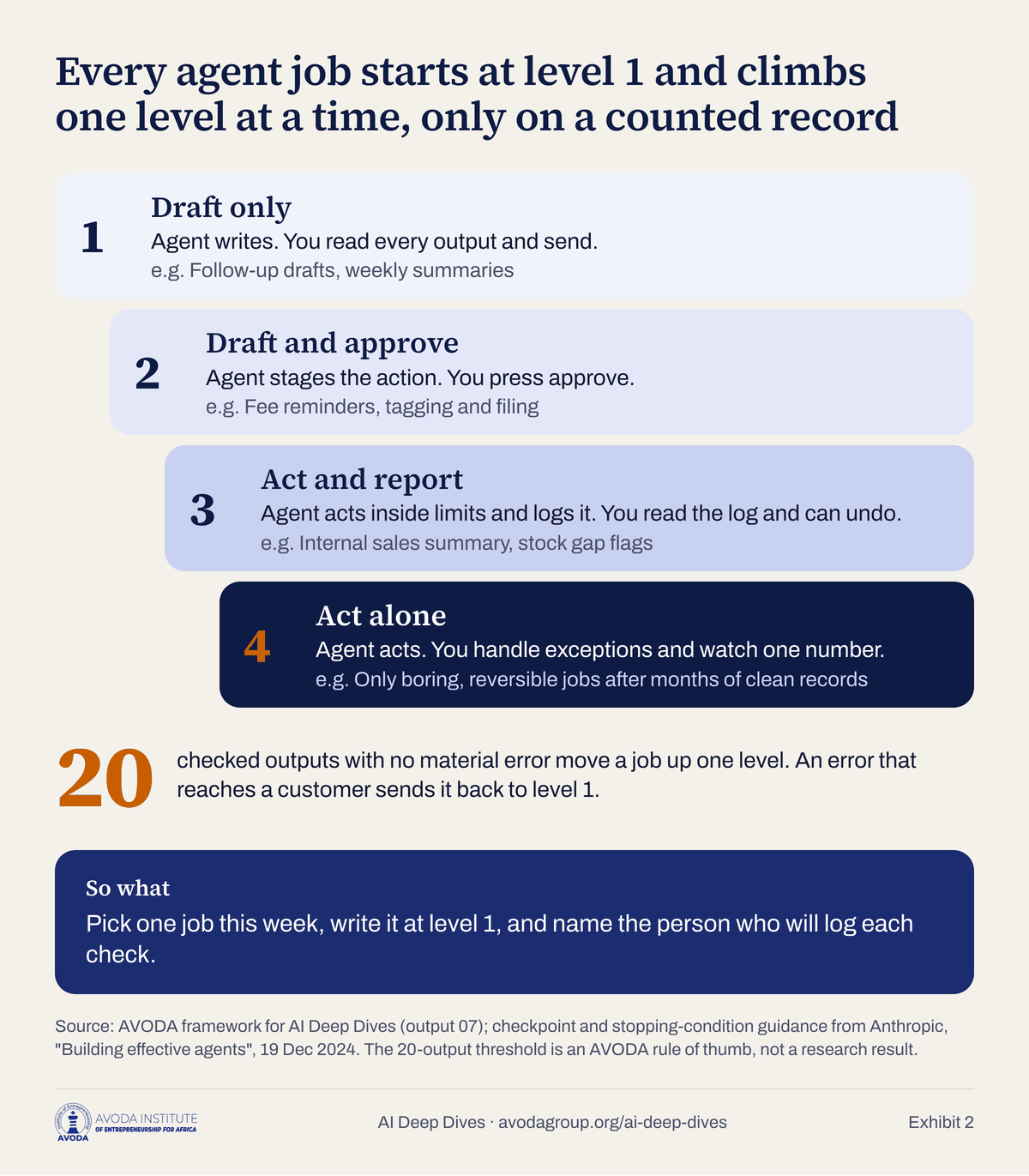
Oversight comes down to one question: how much of what the agent does does a person see before it takes effect? Four answers cover nearly every small-business job. We number them 1 to 4, and the number says how much freedom the agent has.
| Level | Name | What the agent does | What the person does | Undo cost |
|---|---|---|---|---|
| 1 | Draft only | Writes a message, a summary, a table row, a list. Changes nothing anywhere. | Reads every output, edits it, and does the sending or the saving. | None. Nothing has happened yet. |
| 2 | Draft and approve | Prepares the action inside your system: a staged email, a drafted invoice, a proposed record update. | Looks at each staged item and presses approve or reject. | Low. Nothing goes out until approved. |
| 3 | Act and report | Does the action itself, within limits, and logs every action in a report. | Reads the report on a fixed day, samples the actions, and can reverse them. | Medium. Something has happened. It must be reversible. |
| 4 | Act alone | Acts without a per-action record anyone reads. Exceptions only. | Reviews the one number and handles the exceptions it flags. | High if wrong. Reserve for jobs where a wrong action costs almost nothing. |
The levels are about the person’s position in time. At level 1 and 2 the person acts before the effect. At level 3 and 4 the person acts after it. That shift is the whole risk. Before the effect, a mistake is a draft you delete. After it, a mistake is an email in a customer’s inbox or a figure in your books.
Anthropic describes the same trade in its own terms. Agents’ autonomy “means higher costs, and the potential for compounding errors”, which is why it recommends “extensive testing in sandboxed environments, along with the appropriate guardrails” (1). Compounding is the thing to picture. One bad step becomes the input to the next step, and an agent that loops can repeat a small mistake fifty times before anyone looks.
When does a job move up a level?
The rule we teach: a job moves up one level at a time, and only on a count. In the Deep Dives playbook the agent “drafts and a person sends until 20 checked outputs show no material error”, and if an error reaches a customer, the job goes back to the earlier stage. Twenty is our working number for a small, repeated job. It is an AVODA rule of thumb, and you should raise it for anything a customer sees. A material error is one the customer would have noticed or that cost money, such as a wrong amount, a wrong name, a promise you did not make or another customer’s detail. A comma in the wrong place is a minor error and you log it.
Three rules follow.
- Move one level at a time. Never skip from 1 to 3 because the first week went well.
- Move only on a count of checked outputs written in a log, with a named person who did the checking.
- Any material error that reaches a customer sends that job straight back to level 1 until you have found the cause and written it into the brief.
Which jobs in a small Ugandan business belong at which level?
Place a job by asking four questions. A yes to any of the first three caps it low, and a yes to the fourth takes the agent out of that job.
| Question | If yes |
|---|---|
| 1. Does it move money, change a price or make a promise to a customer? | Level 1 only. A person makes every payment, price and promise. |
| 2. Does a customer, student, patient or supplier read or see the output? | Level 1 or 2 until you hold a long checked record. Your name is on it. |
| 3. Can the action be undone within a day, by you, without asking anyone? | If no, stay at level 1 or 2. If yes, level 3 becomes possible for inside-the-business work. |
| 4. Does the job need red data (see the data section below)? | Keep the agent out, or hand it coded data with the key held by a person. |
Applied to a typical small Ugandan firm, with the level a job could reasonably reach once it has earned it:
| Job | Starting level | Highest level worth reaching | Why |
|---|---|---|---|
| Draft follow-ups to leads gone quiet | 1 | 2 | A customer reads it. The draft is cheap to check. |
| Summarise the week’s sales from a sheet | 1 | 3 | Inside the business and easy to verify against the sheet. |
| Turn voice notes and meetings into action lists | 1 | 3 | Internal. A wrong line is caught at the next meeting. |
| Draft replies to common customer questions from your truth file | 1 | 2 | Customer-facing. Prices and hours must always be right. |
| Draft fee or payment reminders | 1 | 2 | Money is mentioned and a wrong amount damages trust. |
| Tidy and rename files, tag records, sort the inbox into folders | 2 | 4 | Reversible and internal. The lowest-stakes place to learn. |
| Reconcile stock counts against a sheet and flag gaps | 1 | 3 | It flags. A person decides what the gap means. |
| Send payments, refunds or Mobile Money transfers | None | None | A person does these. An agent never holds a PIN or a bank login. |
| Change prices or quote a new price | 1 | 1 | A price is a promise. A person approves each one. |
| Hiring, firing, discipline | None | None | Judgement about a person, with their dignity at stake. |
| Advice on a patient’s treatment or a child’s welfare | None | None | Red data and a duty of care only a qualified person can carry. |
At the end of December 2025 the Uganda Communications Commission recorded 36.3 million active mobile money accounts (14). Money moves on a phone in seconds, and in my judgement that is exactly why an agent should never be the one pressing the button. Where a transfer is quick, a mistake is quick too, and a reversal is a negotiation with a mobile network, a bank and a person who may already have spent it.
No job starts at level 4. Level 4 is a place a boring, reversible job arrives at after months of clean records, and plenty of jobs should never leave level 1.
What is a lead table, and why is it the agent’s first job?
A lead table is one sheet with one row for every live lead and, for each, a next action with a date. It is output 05 of the AI Deep Dives on Saturday 21 November and the thing we ask every owner to build before building an agent. A lead is a person or business that has asked, or that you have asked, and has not yet paid.
| Column | What goes in it | Rule |
|---|---|---|
| Lead code | L001, L002 and so on | A code, so the table can be shared with a tool without names (see data rules). |
| Source | Referral, walk-in, WhatsApp, event, website | One word from a fixed list. |
| Stage | Asked, quoted, negotiating, won, lost | Five stages only. |
| Value (UGX) | Your honest estimate | One figure, no ranges. |
| Last contact | Date | The date you last spoke or wrote. |
| Next action | One verb and one object | “Send revised quote.” Not “follow up”. |
| Next action date | Date | No lead without one. |
| Owner | One person | A named human. |
This table is a good first job for an agent for four reasons, and each one maps onto the oversight questions above.
- It is close to money. A lead that goes quiet is revenue that was nearly yours. A follow-up that goes out on time is a use of AI you can connect to a sale.
- The data is yours and already structured. The agent reads eight columns you control. It is not trawling the internet or your whole inbox.
- The output is a draft. It goes to a person at level 1, so a wrong sentence costs you thirty seconds.
- It has a clear start and finish. It begins when the table opens and ends when the drafts are in a folder. Anthropic notes that agents add the most value where tasks have “clear success criteria” and “meaningful human oversight” (1).
The agent’s job, in plain steps: each weekday at 8am it opens the lead table, finds every row whose next action date is today or earlier, and for each one writes a short draft in the owner’s voice using only what the row and the saved quote contain. It saves the drafts in one document, lists rows it could not draft because a field was empty, and stops. Someone reads the document, changes what needs changing and sends. The agent does not send, does not edit the table and does not read anything else.
Nothing else is as easy to check. On Monday morning you count how many leads had an overdue next action. If the number drops across four weeks, the agent earned its place. If it does not, you have lost almost nothing, and the table is still worth having.
What goes in the one-page agent brief?
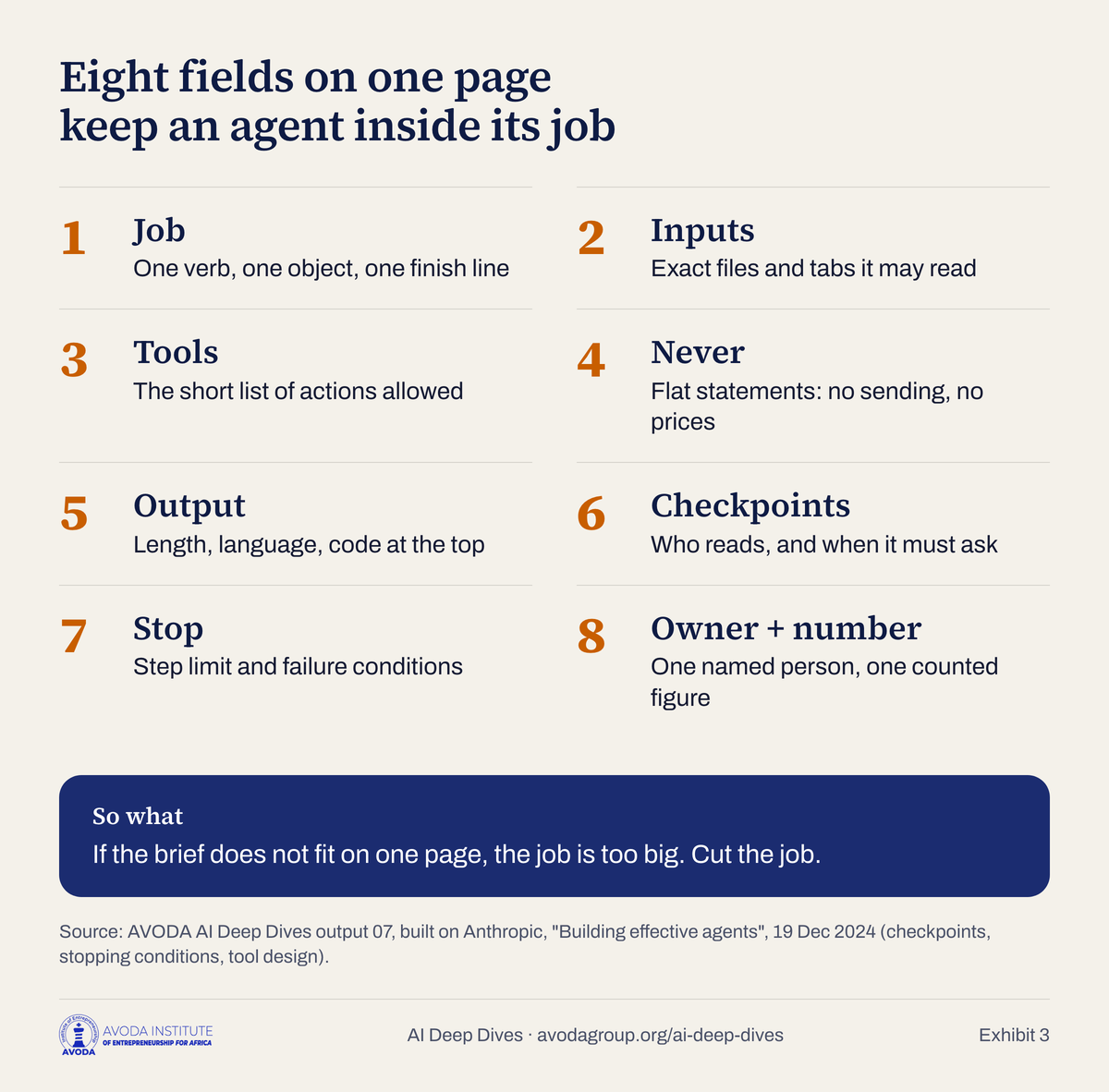
The brief is a single page, written before the agent runs, that answers eight questions. If you cannot fit it on one page the job is too big, and the cure is a smaller job.
1. The job
One sentence with a verb, an object and a finish line. “Each weekday at 8am, draft a follow-up for every lead whose next action date is today or earlier, and stop.” A job that says “help with sales” has no finish line, so the agent will never know it is done.
2. The inputs
The files, sheets or folders the agent may read, named exactly. “The lead table, tab Live, and the saved quote folder for rows in stage Quoted.” Everything else is out of bounds. A common mistake is giving access to a whole mailbox or drive because it was easier than naming a folder.
3. The allowed tools
The short list of actions it may take: read a sheet, write a draft into one document. Keep it short. Anthropic found that tool design deserves as much care as the prompt, and it advises you to make tools hard to misuse by changing the arguments “so that it is harder to make mistakes” (1). A tool that can only write to one folder cannot email a customer by accident.
4. The forbidden actions
Write these as flat statements. “Never send a message. Never change the lead table. Never quote a price that is not in the saved quote. Never mention another customer. Never ask for or store a Mobile Money PIN, ID number or bank login.” This field is the one that is easiest to leave blank, and it does the work when something goes wrong.
5. The output format
What a finished draft looks like: length, language, greeting, sign-off, the lead code at the top. A fixed format makes a wrong draft stand out, because it breaks the pattern.
6. The checkpoints
Where the agent pauses for a human. At level 1 the checkpoint is every output. Write it in: “A dispatcher reads every draft before it leaves the folder.” Add the moments when the agent must stop and ask: a field is empty, two rows conflict, the saved quote is older than 30 days. Anthropic describes the same pattern as pausing “for human feedback at checkpoints or when encountering blockers” (1).
7. The stopping conditions
When the agent must halt, even mid-job. “Stop after 30 rows. Stop if any row has no saved quote. Stop and report if the same step fails twice.” A maximum number of steps is the plainest stopping condition and the one most often missing (1). Without it a confused agent can keep trying, and keep costing.
8. The owner and the one number
One named person owns the agent: reads the output, keeps the log and decides on its level. And one number, defined in a sentence, shows whether the agent is worth keeping. For the follow-up agent it is “leads with an overdue next action at 9am Monday”. The Deep Dives Day 2 output 06 is exactly this: a single figure, a four-week baseline, a target for week 8 (the playbook’s illustrative tailoring-business example counts quotes sent per week, with a four-week baseline averaging 5.5). Pick the number that sits closest to money and that you can count without asking anyone.
Five test cases before the first real run
Write five test inputs and run them with a person watching: three ordinary, one awkward and one the agent should refuse. For the follow-up agent that means three normal rows, one with a missing phone number, and one row whose note says “customer asked us to stop contacting them”. The agent passes if it drafts the three, flags the fourth and refuses the fifth. If it drafts a cheerful nudge to the person who asked to be left alone, the brief is missing a forbidden action. Add it, run the five again, and only then run it on real leads.
What data may an agent see, and what does Ugandan law say?
This section describes the law as published and is not legal advice. Have a Ugandan lawyer review your own policy before you adopt it, especially the data protection part.
The Data Protection and Privacy Act, 2019 (Cap. 97) is the law that matters. I read its text on ULII on 29 October 2026, and four provisions bear on an agent (9).
| Provision | What it says, in short | What it means for an agent |
|---|---|---|
| Section 7(1) | No collecting or processing personal data without the data subject’s prior consent, subject to listed exceptions. | A customer who gave you a number for a delivery has not necessarily agreed to a tool reading it. Know your basis before you hand data to an agent. |
| Section 1(b) | The Act applies to a person outside Uganda who collects, processes, holds or uses personal data relating to Ugandan citizens. | A foreign AI vendor is not outside the Act just because its servers are abroad. |
| Section 19 | Where a controller or processor in Uganda stores or processes personal data outside Uganda, it must ensure the destination has “adequate measures … at least equivalent” to the Act, or that the data subject has consented. | Where a hosted tool processes or stores data outside Uganda, section 19 applies to you. Check the tool’s data terms to find out where it does. |
| Section 35 | Unlawfully obtaining or disclosing personal data carries a fine up to 240 currency points, or 10 years in prison, or both. | One currency point is UGX 20,000, so the fine cap is UGX 4,800,000 (our arithmetic). The reputational cost is larger. |
The regulator has already applied the Act to a very large company. On 18 July 2025 Uganda’s Personal Data Protection Office found Google in breach of section 29 (failure to register) and section 19 (cross-border transfer without safeguards), and ordered it to register and provide evidence within 30 days. It declined to order data localisation “at this stage” (10). A regulator willing to act on Google is unlikely to ignore a Kampala shop that pastes its customer list into a chat window, though that is my judgement. Whether you must register with the Office yourself depends on your business, and you should ask a lawyer rather than assume.
One more point of context. On 20 October 2026 government launched a five-year National Data Strategy “laying the groundwork for Uganda’s upcoming National AI Strategy”, and as of that date no national AI strategy had been published (11). Expect rules to tighten, and write your policy to be easy to tighten.
Green, amber and red data
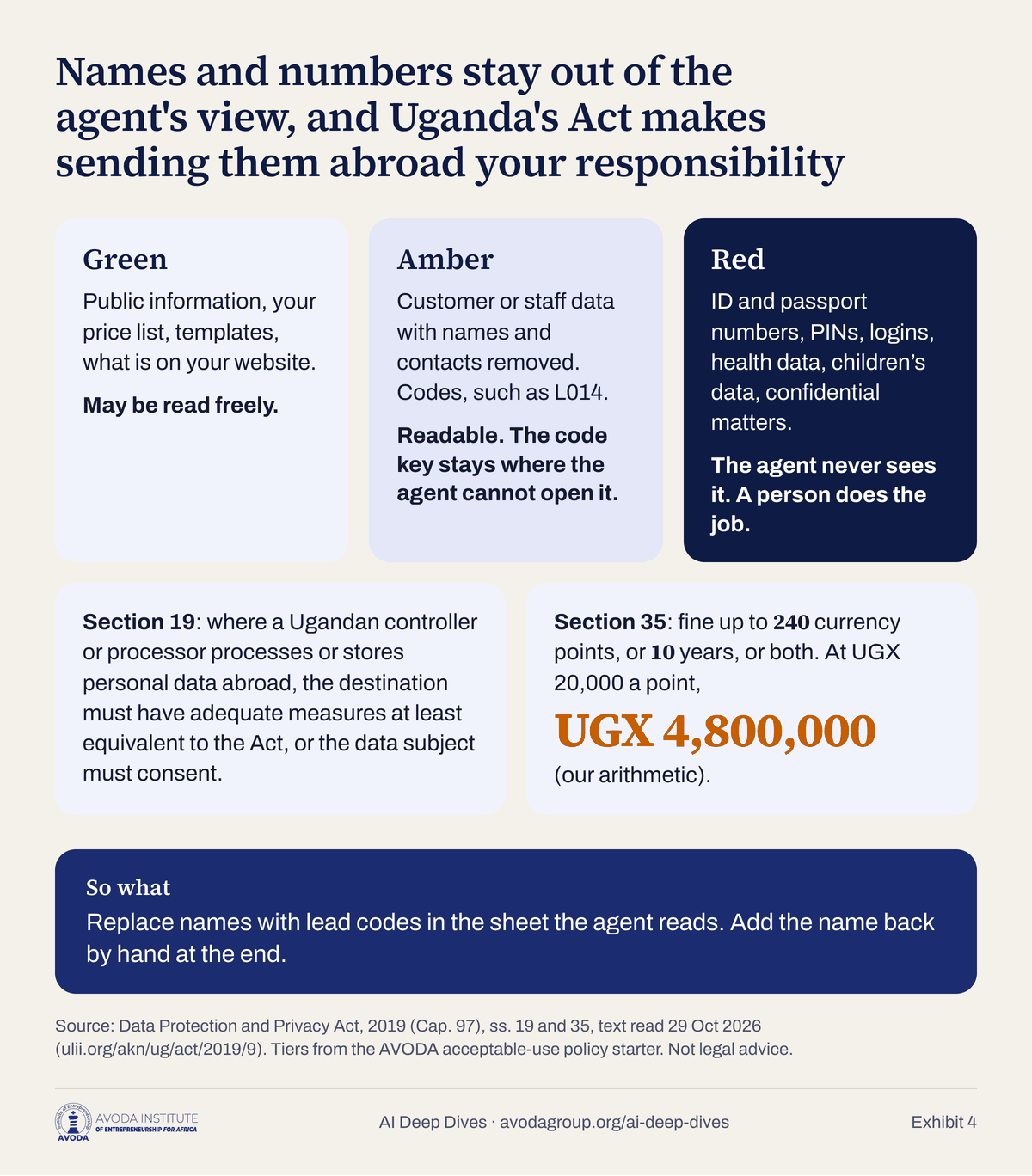
| Tier | What it is | Rule for the agent |
|---|---|---|
| Green | Public information, your own price list, templates, anything already on your website. | May be read and used freely. |
| Amber | Customer or staff information with names and contact details removed. Use codes such as L014, not names. | May be read. Keep the key that links codes to people in a file the agent cannot open. A person puts the name back at the end. |
| Red | National ID and passport numbers, Mobile Money and bank PINs and logins, passwords, health information, children’s information, and anything given under a confidentiality promise. | The agent never sees it. If a job cannot be done without it, a person does the job. |
Tiering is cheap and fast. Go through the columns of your lead table and mark each. Names and phone numbers are personal data, so they stay out of the agent’s view: the agent works from lead codes, and the person who sends adds the name. If the data is already coded, a draft says “Dear [NAME]” and the sender fills it in. That small habit reduces what the tool sees. Whether coded rows still count as personal data is a question for your lawyer.
Where the tool processes data abroad, read its data terms before use: where it processes, whether it keeps your inputs, whether it trains on them. If you cannot tell, treat everything as amber at best.
How do AI agent projects fail, and what is “agent washing”?
Start with the forecast, and keep its label. In June 2025 Gartner predicted that “Over 40% of agentic AI projects will be canceled by the end of 2027, due to escalating costs, unclear business value or inadequate risk controls” (2). That is a forecast by an analyst firm. Gartner does not say how many of the projects are in small firms. It is useful because its three named causes read like a checklist of what your brief should prevent.
The same Gartner release describes “agent washing” as “the rebranding of existing products, such as AI assistants, robotic process automation (RPA) and chatbots, without substantial agentic capabilities”. Gartner estimates only about 130 of the thousands of agentic AI vendors are real (2). For a buyer in Kampala the practical lesson is to ask any vendor four things before paying. What decides the next step: your fixed rules, or the model? What tools can it touch? Where is the human checkpoint? Can I see a log of every action? If the answers are “fixed rules”, you are buying a workflow, which may be fine, but the price should reflect it.
RAND Corporation interviewed 65 practitioners in 2024 and reported that “by some estimates, more than 80 percent of AI projects fail”, twice the rate of non-AI IT projects. That figure is an estimate RAND cites. Its first root cause was that stakeholders misunderstand or miscommunicate what problem the AI is meant to solve, and its third was chasing the latest technology instead of a real user problem (12). Both are failures of the brief.
| Failure mode | What it looks like in a small firm | The brief field that prevents it |
|---|---|---|
| Unclear business value | Nobody can say what the agent is for. It was bought because a competitor mentioned it. | The one number (field 8). |
| Escalating cost | An agent loops, or a subscription grows tier by tier while nobody counts the saving. | Stopping conditions (field 7) and a monthly cost line in the log. |
| Inadequate risk controls | The agent has send access on day one and a wrong message reaches fifty customers. | Allowed tools and forbidden actions (fields 3 and 4). |
| Wrong problem | The agent automates a step that was never the bottleneck. | The job (field 1) taken from your lead path. |
| Agent washing | You pay for an “agent” that is a chatbot or a fixed script. | The four vendor questions above. |
| Compounding errors | One wrong step feeds the next and repeats. | Checkpoints and a step limit (fields 6 and 7). |
| Nobody owns it | The agent runs, the output piles up unread, trust drifts. | A named owner (field 8) and a review date. |
| Staff left behind | The owner uses the tool and the team does not know the rules. | A short staff briefing and a signed acceptable-use policy. |
The last row has numbers behind it. BCG’s 2025 survey of more than 10,600 employees in 11 countries found that only 13% see AI agents deeply embedded in daily workflows and that about one-third understand how agents work. Regular use was sharply higher among staff who had at least five hours of training, and only one-third said they had been properly trained (13). In a six-person firm, one untrained person can undo the whole policy.
Then there is the old failure: believing it works because it feels like it works. The METR trial is the cleanest case. The developers expected a 24% speed-up, took 19% longer, and afterwards still believed AI had made them 20% faster (5). That was a small study of software work. Its lesson carries over because it is about people, and it is why the one number must be counted.
When should you stop an agent? A stop rule that is written first
A stop rule is a decision made on a calm day about what will make you switch the thing off. Make it before the first run, because after the agent has been running a month nobody wants to switch it off.
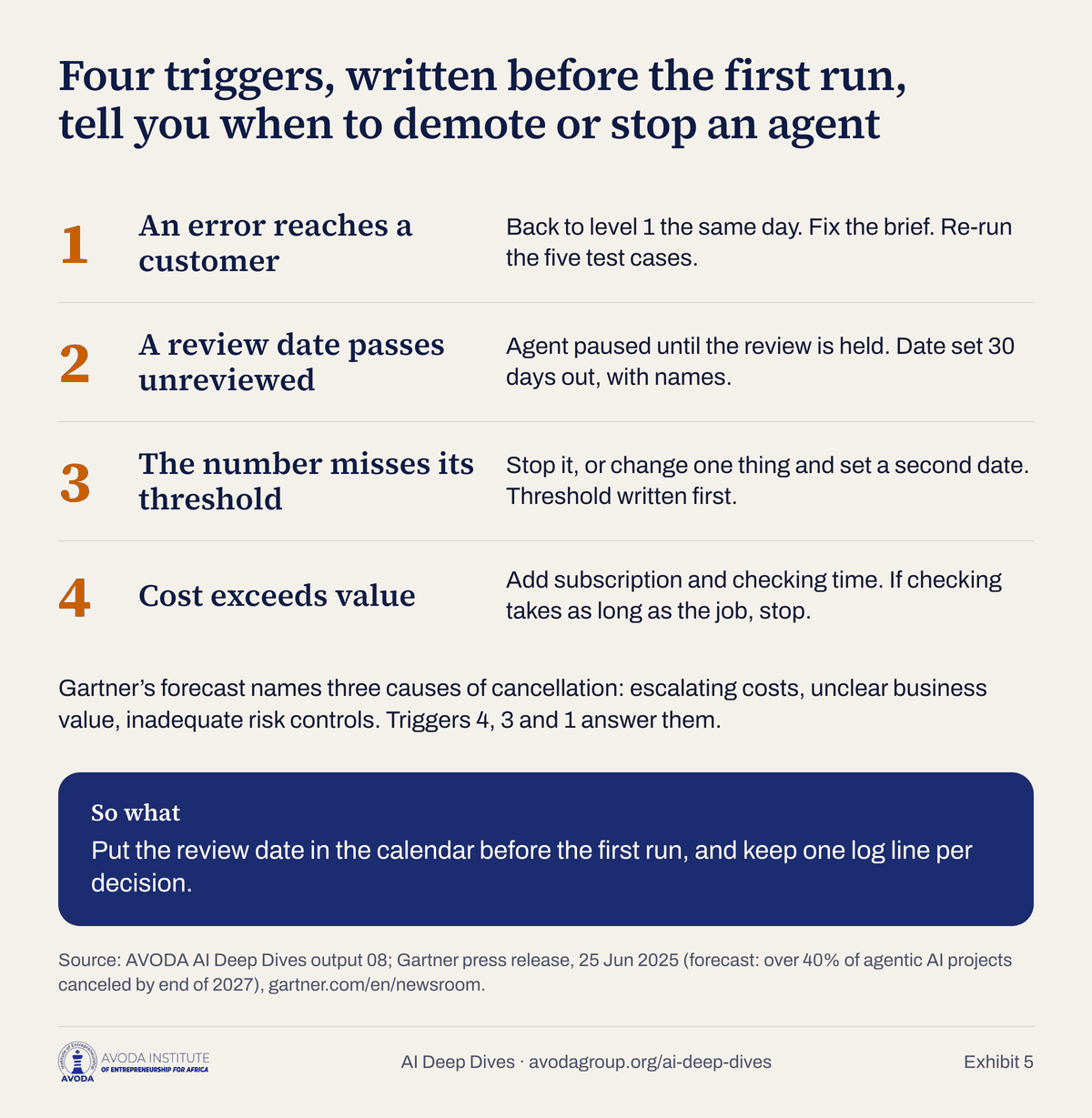
- An error reaches a customer. The job returns to level 1 the same day. You write the cause into the brief and run the five test cases again, including a new one that would have caught this error.
- A review date passes without a review. The agent is paused until the review is held. Put the date in the calendar with a name beside it, 30 days from the first real run.
- The number has not moved. On the review date, read the one number against its baseline. If it met the threshold you set in advance, keep the agent. If not, change one thing and set a second date, or stop it. The threshold is written before the result, never after.
- The cost exceeds the value. Add what the tool costs and what it takes in checking time. If checking takes as long as doing the job yourself, stop. Keeping a tool because the subscription is already paid is the commonest way to keep a bad one.
Keep a log with one line per decision: date, item, number read, decision, reason. After a year the log is worth more than any single tool, because it tells you which kinds of job your business can safely hand over and which it cannot. It is the answer to the Gartner caution, applied to your own firm: the log is your evidence of value and your control on risk.
A tool that failed the stop rule on day 30 cost you one month and a lesson, and the decision log records it. A tool that was never reviewed costs you every month after.
The 30-day review, the five test cases and the four-week count are AVODA rules of thumb, not research results.
What do three worked examples look like?
The three below are generic business types with illustrative figures. They are not clients, and no real firm’s data is used. Their purpose is to show the brief doing its work in three different settings.
Example 1: a courier firm (illustrative)
| Job | Each morning, read the delay sheet and draft a short message to the customer for each delayed parcel. |
|---|---|
| May read | The daily delay sheet only: parcel code, route, reason, original time, new time entered by the dispatcher. |
| Allowed tools | Read the sheet. Write drafts into one document. |
| Never | Send anything. Promise a time that is not in the sheet. Mention another customer. Read customer phone numbers. |
| Checkpoint | The dispatcher reads every draft. If the new time is blank, the agent stops on that row. |
| Level | 1 (draft only). |
| The number | Complaint calls per week about delays. Baseline recorded for four weeks. |
| Stop rule | 20 checked drafts with no material error before any move to level 2. If a draft with a wrong time is sent, back to level 1. |
The weak point is the dispatcher’s habit. After a few clean weeks the temptation is to skim. The remedy is the count: the dispatcher logs each check, and a skipped check is a skipped step toward level 2.
Example 2: a private clinic (illustrative)
| Job | Each afternoon, draft appointment reminders for tomorrow’s bookings. |
|---|---|
| May read | A coded list: booking code, time slot and clinic room. No names, no phone numbers, no reason for the visit. |
| Allowed tools | Read the coded list. Write reminder drafts with a [NAME] placeholder. |
| Never | Read clinical notes, test results or diagnoses. Give any medical advice. Reply to a patient’s question. Send anything. |
| Checkpoint | The receptionist reads each draft, adds the name and number and sends. |
| Level | 1 (draft only), with no plan to go further. |
| The number | Missed appointments per week. |
| Stop rule | Any draft containing a diagnosis, a medicine or a name ends the trial the same day, and the cause is fixed in the brief. |
Health information is red data, and the design keeps the agent a safe distance from it: the list is coded and the person adds the name at the end. Even so, ask your lawyer whether a reminder tool counts as processing personal data under the Act, and read the tool’s data terms first (9).
Example 3: a private school office (illustrative)
| Job | On the first of each month, draft fee reminders for every family whose balance is overdue. |
|---|---|
| May read | A coded balance sheet: family code, term, amount overdue, date of last payment. No pupil names, no marks, no reports. |
| Allowed tools | Read the sheet. Write drafts with a [PARENT] placeholder. |
| Never | Send. Offer a payment plan or waiver. Mention a pupil’s performance or behaviour. Threaten exclusion. Mention other families. |
| Checkpoint | The bursar reads each draft. Any family with a note on the sheet is skipped and handed to the bursar. |
| Level | 1, with level 2 considered after a term of clean checks. |
| The number | Hours the office spends on fee reminders each month, with a keep threshold of 3 hours saved and no parent complaint (the same threshold used in the playbook’s illustrative school example). |
| Stop rule | Any parent complaint about tone sends the job back to the bursar’s own wording for a month. |
Children’s information is red data, and the design excludes it completely. A fee reminder is about money and a family, never about a child’s conduct. A promise of a payment plan is a promise, so it stays with a person.
What does a copyable agent brief look like?
Copy this into a document. Fill every line. If a line is blank, the agent does not run.
AGENT BRIEF (one page)
Business: [name] Date written: [date] Owner: [one named person]
1. JOB (one sentence, a verb, an object, a finish line):
[ ]
2. MAY READ (exact files, tabs, folders; nothing else):
[ ]
3. ALLOWED TOOLS (the short list):
[ ]
4. NEVER (flat statements): Never send. Never change [record]. Never quote a price not in [file]. Never mention another customer. Never see red data: [list].
[ ]
5. OUTPUT FORMAT (length, language, greeting, sign-off, code at the top):
[ ]
6. CHECKPOINTS: [Name] reads every output at level 1. Agent stops and asks when: [list].
[ ]
7. STOP CONDITIONS: Stop after [N] items. Stop if [condition]. Stop and report if the same step fails twice.
[ ]
8. THE ONE NUMBER: [defined in one sentence]. Baseline (4 weeks): [ ]. Target by week 8: [ ].
LEVEL NOW: [1 / 2 / 3 / 4]. Moves up one level after [20] checked outputs with no material error. Material error that reaches a customer returns it to level 1.
REVIEW DATE: [30 days from first real run] with [names]. If the date passes unreviewed, the agent is paused.
TEST CASES (run with a person watching): three normal, one awkward, one it must refuse. Results: [ ]
LOG: [date, item, number read, decision, reason]
A filled-in version for the lead table fits in about 200 words. If yours is longer, cut the job down.
Write this brief on your own business, with a person checking it
AI Deep Dives for Executives and Business Owners runs on Saturday 14 and Saturday 21 November 2026. The group session is 9:30am to 12:00pm and the one-on-one is 12:30pm to 2:30pm, East Africa Time. On Day 2 you leave with a lead table (05), one number you will watch (06), a one-page brief for one agent on your business (07) and a rule for what to keep using and when to stop (08). The fee is UGX 375,000. AVODA Blue alumni and Pearl Business Network members pay UGX 249,000 if the payment is in by 11:59pm Kampala time on Saturday 7 November. There are 30 seats, growing to 34 when 28 are requested. Everyone pays before Saturday 14 November.
What should you do this week?
- Monday: open a sheet and build the lead table with the eight columns. Enter every live lead with a next action and a date. Give each lead a code.
- Tuesday: sort your columns into green, amber and red. Strip names and numbers from anything an AI tool will see.
- Wednesday: write the brief on one page. Name the owner. Pick the one number and record the last four weeks of it.
- Thursday: write the five test cases and run them with a prompt or a tool you already have. Fix the brief where it fails.
- Friday: run it on real leads at level 1. Log every check. Put the 30-day review date in your calendar with a name beside it.
If you only get through the first two, do those. A kept lead table and a sorted set of columns will help your business whether or not an agent ever reads them.
What does it mean to trust an agent with your name?
The analysis above rests on one idea: the business owner answers for every output, whatever produced it. A model cannot apologise to a customer, repay a debt or stand before a regulator. That is why the levels climb on a counted record and the owner’s name sits on the brief.
Scripture holds the same order of trust, and it supplies something the checklist cannot. Luke 16:10 (NIV) says, “Whoever can be trusted with very little can also be trusted with much.” (15) A frame built only on risk management asks whether the agent has earned more freedom. The older teaching asks the owner the harder question: whether the customer on the other end of the draft, who cannot see the brief and will never check the log, is being treated with the integrity you would want for your own family. Stewardship means the person you serve is the reason for the rules. An owner who holds that will keep the agent at level 1 a little longer than the numbers strictly require, and will count that as wisdom.
Frequently asked questions
What is an AI agent in simple terms?
An AI agent is a program in which an AI model chooses its own next step and which tool to use, acts, checks the result and repeats until the job is done or a stopping condition is reached. A chat prompt waits for you at every step. A workflow follows steps that were fixed in advance (1).
What can an AI agent safely do in a small Ugandan business?
Start with draft-only work from a table you own: follow-up drafts for quiet leads, weekly sales summaries, action lists from meeting notes. A person reads and sends. Keep payments, price changes, hiring decisions and health or children’s data away from the agent.
What are the levels of human oversight for an agent?
Four: draft only, draft and approve, act and report, and act alone. A job starts at level 1 and moves up one level at a time after a counted record of checked outputs. Any material error that reaches a customer sends it back to level 1.
What is a one-page agent brief?
A single page written before the agent runs. It gives the job, the inputs it may read, the tools it may use, what it must never do, the output format, the checkpoints, the stopping conditions, and the named owner with the one number being watched.
Can I paste customer details into ChatGPT or Claude under Ugandan law?
Personal data is covered by the Data Protection and Privacy Act, 2019 (Cap. 97). Section 19 requires adequate safeguards, or consent, when a controller in Uganda processes personal data outside Uganda (9). Many hosted AI tools process data outside Uganda, so check where yours does. Use codes instead of names, keep red data out, read the tool’s data terms, and ask a lawyer. This is not legal advice.
Is it true that most AI agent projects get cancelled?
Gartner forecast in June 2025 that over 40% of agentic AI projects will be canceled by the end of 2027. That is a forecast (2). Gartner does not say how many of the projects are in small firms. Use it as a reason to define value, cost and risk controls up front.
What is agent washing?
Agent washing is a vendor relabelling an existing assistant, chatbot or robotic process automation product as an “agent” without real agentic capability. Gartner estimates only about 130 of the thousands of agentic AI vendors are real (2). Ask what decides the next step, which tools it touches, where the human checkpoint is and whether you can see a log.
When should I stop using an agent?
Stop or demote it when an error reaches a customer, when a review date passes unreviewed, when the one number misses the threshold you set in advance, or when checking costs more than the job is worth.
Leave the second Saturday with a brief you can run on Monday
The AI Deep Dives take you from a written picture of the customer you already sell to on Saturday 14 November (Strategy) to a lead table, one number you will watch, a one-page brief for one agent on your business and a rule for what to keep using and when to stop on Saturday 21 November (Implementation). The fee is UGX 375,000, or UGX 249,000 for AVODA Blue alumni and Pearl Business Network members whose payment is in by 11:59pm Kampala time on Saturday 7 November. There are 30 seats, growing to 34 when 28 are requested. Room or online link comes with your payment confirmation.
Read next
- A 30-day method for putting AI pilots into daily work
- The AI tool audit for Uganda, priced in shillings
References
- Anthropic, “Building effective agents” (Erik S. and Barry Zhang), published 19 Dec 2024, read 29 Oct 2026. https://www.anthropic.com/research/building-effective-agents
- Gartner, “Gartner Predicts Over 40% of Agentic AI Projects Will Be Canceled by End of 2027”, press release, 25 Jun 2025, read 29 Oct 2026. https://www.gartner.com/en/newsroom/press-releases/2025-06-25-gartner-predicts-over-40-percent-of-agentic-ai-projects-will-be-canceled-by-end-of-2027
- MIT / Project NANDA, “The GenAI Divide: State of AI in Business 2025”, July 2025 (52 interviews, 153 survey responses; directional). https://mlq.ai/media/quarterly_decks/v0.1_State_of_AI_in_Business_2025_Report.pdf
- McKinsey, “The state of AI” 2026 edition, 25 Aug 2026 (1,719 respondents, 97 nations, fielded 4 May to 8 Jun 2026). https://www.mckinsey.com/capabilities/quantumblack/our-insights/the-state-of-ai
- METR, “Measuring the impact of early-2025 AI on experienced open-source developer productivity”, 10 Jul 2025 (16 developers, 246 tasks). https://metr.org/blog/2025-07-10-early-2025-ai-experienced-os-dev-study/
- Dell’Acqua et al., “Navigating the Jagged Technological Frontier”, Harvard Business School working paper, 2023 (758 consultants). https://www.hbs.edu/faculty/Pages/item.aspx?num=64700
- Uganda Bureau of Statistics, Census of Business Establishments 2019/20 report, released 14 Aug 2025. https://www.ubos.org/wp-content/uploads/publications/2019_20-CENSUS-OF-BUSINESS-ESTABLISHMENTS-REPORT_FINAL.pdf
- Ministry of Trade, Industry and Cooperatives (Uganda), MSME profile, Jan 2025. https://mtic.go.ug/wp-content/uploads/2025/01/MSME-profile.pdf
- Republic of Uganda, Data Protection and Privacy Act, 2019 (Cap. 97), text on ULII, read 29 Oct 2026. https://www.ulii.org/akn/ug/act/2019/9
- CIPESA, “Ugandan regulator finds Google in breach of country’s data protection law, orders local registration”, 21 Jul 2025. https://cipesa.org/2025/07/ugandan-regulator-finds-google-in-breach-of-countrys-data-protection-law-orders-local-registration/
- Daily Monitor, “Government launches five-year data strategy ahead of AI adoption”, 20 Oct 2026. https://www.monitor.co.ug/uganda/news/national/government-launches-five-year-data-strategy-ahead-of-ai-adoption-5639746
- RAND Corporation, “The Root Causes of Failure for Artificial Intelligence Projects and How They Can Succeed”, 13 Aug 2024 (65 practitioner interviews). https://www.rand.org/pubs/research_reports/RRA2680-1.html
- Boston Consulting Group, “AI at Work: Momentum Builds, but Gaps Remain”, 23 Jun 2025 (10,600+ employees, 11 countries). https://www.bcg.com/publications/2025/ai-at-work-momentum-builds-but-gaps-remain
- Uganda Communications Commission, “A snapshot of gains, impact and progress”, Dec 2025 (36.3 million active mobile money accounts). https://www.ucc.co.ug/uganda-communications-commission-a-snapshot-of-gains-impact-and-progress/
- Luke 16:10, New International Version (NIV), read on Bible Gateway 29 Oct 2026. https://www.biblegateway.com/passage/?search=Luke+16%3A10&version=NIV