
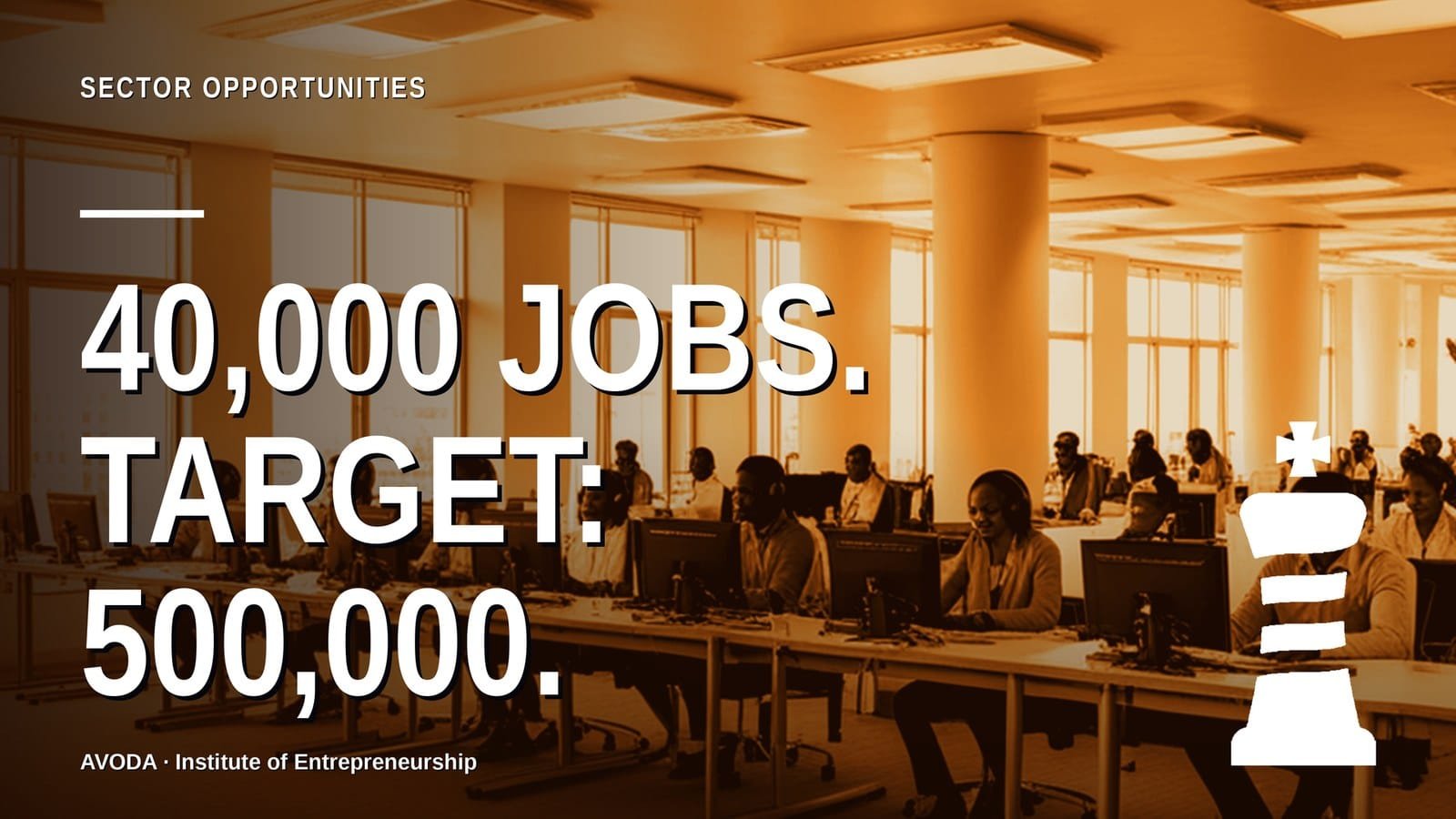
The “AI will kill BPO” panic is colliding with the opposite reality in Nairobi. Kenya’s outsourcing sector has created over 40,000 jobs against a national target of 500,000, and the global AI labs are not fleeing — they are anchoring (1)(2). OpenAI worked through Sama; Meta, Google, and others run human-in-the-loop operations in the region; and Chinese tech firms are now recruiting Kenyan AI trainers (3). AI does not abolish the global-services opportunity — it repositions it. Every model needs human feedback, every automated workflow needs exception handlers, and East Africa — English-speaking, fiber-connected, time-zone-friendly — can become the world’s quality-assurance layer. The bold move is to climb from labeling data to owning AI-enabled service firms.
Key Takeaways
- Kenya’s BPO sector has created over 40,000 jobs, with a national target of 500,000, drawing investors like Teleperformance, CCI, and Samasource under an enabling policy environment (1)(2).
- Far from killing the sector, global AI labs are anchoring human-in-the-loop operations in East Africa: OpenAI partnered with Sama (operating in Kenya since 2011), and Chinese tech firms now recruit Kenyan AI trainers (3).
- Kenya’s National AI Strategy 2025–2030 provides a framework for ethical AI, data sovereignty, and talent — positioning the country as a regulated hub for the data work that trains AI models (3).
- Analysis suggests Kenya’s trusted-data and outsourcing economy could add tens of thousands to hundreds of thousands of jobs a year, worth billions, as global services re-shore to the region (4).
- The structural fit is real: English-speaking, fiber-connected, time-zone-friendly East Africa is positioned for the global-services re-shoring wave, and each BPO job supports an estimated 3–4 indirect jobs.
- The strategic imperative: climb the value ladder from low-margin data labeling to owning AI-enabled service firms — legal, finance, healthcare ops, and AI quality assurance — capturing value rather than renting out hours.
Why isn’t AI killing East African BPO?
Because the “AI kills outsourcing” thesis misunderstands what AI actually needs — and what it needs, East Africa is positioned to supply.
The panic runs like this: AI automates routine cognitive tasks — customer service, data entry, content moderation, transcription — which are exactly the tasks that built the African BPO industry; therefore AI destroys the sector. The first half is true; the second does not follow. AI is automating routine tasks, but in doing so it is creating an enormous new category of work: the human-in-the-loop labor that AI itself requires. Every large AI model must be trained on data that humans label, annotated, and quality-checked. Every model must be evaluated and corrected by humans who judge whether its outputs are good. Every automated workflow throws exceptions that a human must handle. Every AI deployment needs content moderation, red-teaming, and ongoing quality assurance. AI does not eliminate the need for human cognitive labor; it transforms it — from doing the routine task to training, judging, and supervising the machine that does it.
This is why the global AI labs are anchoring in East Africa rather than abandoning it. OpenAI worked through Sama — a BPO provider operating in Kenya since 2011 — for content moderation and data work; Meta, Google, and others run human-in-the-loop operations in the region; and Chinese tech firms are now actively recruiting Kenyan AI trainers (3). The companies building the most advanced AI on earth depend on East African human labor to do it. The sector is not dying; it is moving up the stack from “answer the customer’s call” to “train and supervise the AI that answers the customer’s call.” Kenya’s BPO sector creating 40,000 jobs toward a 500,000 target (1)(2), in the teeth of the AI panic, is the empirical refutation of the doom thesis. The work is changing, not disappearing — and the change runs toward, not away from, the region.
What makes East Africa structurally suited to this?
A specific combination of attributes that, taken together, position the region for the global-services re-shoring wave better than most realize.
The fundamentals are concrete. East Africa is English-speaking at scale, which matters enormously for serving the English-language global market and for the nuanced judgment work — moderation, evaluation, quality assurance — that requires genuine language fluency, not just translation. It is increasingly fiber-connected, with submarine cables and improving domestic infrastructure making reliable, high-bandwidth digital work possible. It is time-zone-friendly to both Europe and Asia, enabling real-time collaboration and follow-the-sun operations. And it has a large, young, increasingly educated workforce at competitive cost — the raw human capital the global-services industry runs on. These attributes are why Kenya in particular has become a magnet for outsourcing investment, and why analysis suggests the trusted-data and outsourcing economy could add tens of thousands to hundreds of thousands of jobs a year, worth billions, as global services re-shore (4).
Policy is reinforcing the fundamentals. Kenya’s National AI Strategy 2025–2030 establishes a framework for ethical AI, data sovereignty, and talent development (3) — which matters because the highest-value AI work (handling sensitive data, content moderation, regulated-industry processes) requires a trusted, regulated environment. A jurisdiction with a credible AI governance framework can win work that an unregulated one cannot. And the multiplier effect amplifies the impact: each BPO job is estimated to support 3–4 indirect jobs in the urban economy — the landlords, transport, food vendors, and services around a growing digital-work sector. The structural fit is not hypothetical; it is being demonstrated by the global labs’ investment decisions and the sector’s job numbers. The question is not whether East Africa can participate in the AI-services economy — it already does — but whether it will participate as a low-margin labor supplier or climb to own higher-value work.
How does East Africa avoid the low-margin trap?
By deliberately climbing the value ladder — from selling hours of data labeling to owning AI-enabled service firms — because the entry-level work, while real, is where value capture is thinnest.
The honest concern about the current model is value capture and labor conditions. Data annotation and content moderation, the entry-level AI-services work, are low-margin and can involve difficult, sometimes traumatic labor — the documented strains of content moderation are real and must be taken seriously. If East Africa remains only a supplier of cheap human hours for the lowest-value tasks, it captures little of the value its labor creates, and the work remains vulnerable to being automated, relocated, or commoditized. Renting out hours at the bottom of the value chain is a fragile position — the same trap as exporting raw commodities instead of processed goods, applied to labor.
The escape is to climb. The same workforce that can label data can, with deliberate skilling and entrepreneurship, do higher-value work: AI model evaluation and quality assurance (judging output quality, which requires real expertise), exception handling in automated workflows, and — the highest rung — owning AI-enabled service firms that deliver complete outcomes in legal, finance, healthcare operations, and professional services. The future is not “East Africans label data for an American AI company”; it is “an East African firm uses AI to deliver legal research, financial analysis, or healthcare-ops services to global clients, capturing the full value.” This climb requires the trusted-signal skilling infrastructure that wires training to these higher-value roles and the judgment-centric capabilities that survive automation, and it turns the region’s workers from suppliers of hours into owners of AI-leveraged businesses — the same reframe at the heart of wielding AI agents rather than competing with them.
The Global-Services Escalator: climbing from labeling to ownership
Here is the framework I use to map the climb. Call it the Global-Services Escalator — four steps from renting hours to owning outcomes, each a higher-value, more defensible position than the last.
Step 1 — Data labeling and annotation (entry). The foundational, high-volume, low-margin work that trains AI models. Real and job-creating, but the weakest value-capture position. It is an entry point and a skills foundation, not a destination — the bottom of the escalator, not the top.
Step 2 — AI evaluation and quality assurance. Judging the quality of AI outputs, red-teaming, and correcting models — work that requires genuine expertise and judgment, commands higher margins, and is far harder to commoditize. This is where East Africa’s English fluency and education become a premium, not just a cost advantage. The region can become the world’s AI quality-assurance layer.
Step 3 — AI-augmented professional services. Human experts using AI to deliver professional work — legal research, financial analysis, healthcare operations, software QA — to global clients. The human provides judgment and accountability; AI provides leverage. This captures professional-services margins, not labor rates.
Step 4 — Owned AI-enabled service firms. East African–owned firms that deliver complete outcomes to global clients using AI leverage, capturing the full value rather than renting labor to a foreign intermediary. This is the top of the escalator — ownership of the value chain, not participation in someone else’s. It connects to the broader frontier of AI letting very small teams deliver what once took twenty people.
The Global-Services Escalator clarifies the strategy. The doom thesis says AI pushes East Africa off the escalator entirely. The reality is that AI raises the escalator — automating the bottom step while creating the higher ones. The imperative is not to cling to the bottom (labeling) but to climb deliberately toward the top (ownership), using skilling, entrepreneurship, and the region’s structural advantages. The work is moving up; East Africa should move up with it.
What should operators, investors, and policymakers do?
The path is clear and the timing — at the start of the AI-services re-shoring wave — is favorable.
For founders, the opportunity is to start service firms that climb the escalator: not just supplying labor to global intermediaries, but building East African–owned AI-augmented service businesses in legal, finance, healthcare-ops, and quality assurance for global clients. These are high-margin, defensible, and exactly the businesses the region’s AI-readiness and small-firm AI adoption and emerging capital base can support. The skilling pipelines feeding them are themselves a business — the employer-paid, outcome-linked training the sector needs.
For investors, the global-services sector offers exposure to the AI economy with a labor-and-services model suited to East Africa’s strengths and a long re-shoring tailwind. For policymakers, the National AI Strategy is the right foundation; the imperative is to build the trusted, regulated environment that wins high-value work, invest in the skilling that lets workers climb the escalator, and protect labor conditions so the sector grows sustainably rather than extractively — and to support East African ownership of service firms, not just employment in foreign ones, as Kenya’s enabling-policy approach is beginning to do (1).
The conclusion turns the panic on its head. “AI will kill BPO” assumes the work disappears. What actually happens is that the work transforms — from routine tasks to training, judging, and supervising AI — and that transformation runs toward East Africa, not away from it, because the human-in-the-loop labor the AI economy needs is exactly what the region can supply. The global AI labs anchoring in Nairobi, the 40,000 jobs toward 500,000, the Chinese firms recruiting Kenyan AI trainers — these are not the death of the sector but its evolution. The opportunity is to ride that evolution all the way up the escalator: from labeling data, to assuring AI quality, to owning the AI-enabled service firms that deliver outcomes to the world. AI does not end East Africa’s global-services moment. It is the reason that moment has finally arrived.
FAQ
Is AI destroying East Africa’s BPO and outsourcing sector?
No — it is transforming it. AI automates routine tasks but creates new human-in-the-loop work: data labeling, model training, AI evaluation, and exception handling. Global AI labs are anchoring operations in East Africa, and Kenya’s BPO sector has created over 40,000 jobs toward a 500,000 target despite the AI disruption (1)(2)(3).
Why are global AI companies working with East Africa?
Because training and supervising AI requires large amounts of skilled human labor — labeling data, judging output quality, moderating content, handling exceptions. East Africa is English-speaking, fiber-connected, time-zone-friendly, and competitively priced. OpenAI worked through Sama in Kenya, and Chinese tech firms now recruit Kenyan AI trainers (3).
What is human-in-the-loop AI work?
It is the human labor AI systems require to function: labeling training data, evaluating and correcting model outputs, red-teaming for safety, moderating content, and handling the exceptions automated workflows throw. As AI scales, this category of work grows — and East Africa is positioned to supply it, ideally at the higher-value end.
How can East Africa capture more value from AI services?
By climbing the value ladder from low-margin data labeling to AI quality assurance, AI-augmented professional services (legal, finance, healthcare ops), and ultimately East African–owned AI-enabled service firms that deliver complete outcomes to global clients — capturing professional-services margins rather than renting out labor hours.
What makes East Africa suited to global services?
A specific combination: large-scale English fluency (vital for judgment work), improving fiber connectivity, a favorable time zone for Europe and Asia, a young competitively priced workforce, and — in Kenya — a National AI Strategy providing the regulated environment high-value AI work requires. Each BPO job also supports an estimated 3–4 indirect jobs.
Related Reading
- Skills Are the New Oil: EdTech and Workforce Training
- Cheap Code, Scarce Judgment: The AI Talent Gap
- AI vs. Africa’s Digital Work Boom: The Arbitrage Window
- AI Agents as Your First Five Employees
Sources and Evidence
- Capital Business — “40,000 jobs created in Kenya’s business process outsourcing sector” — Source for the 40,000 jobs created, the 500,000 national target, and key investors (Teleperformance, CCI, Samasource).
- Customer Service Manager — “40,000 Jobs Created as Kenya’s BPO Sector Thrives” — Corroborating coverage of the sector’s growth and policy environment.
- Rest of World — “Chinese tech companies hire Kenyan workers for AI training” — Documents global AI labs (including Chinese firms and OpenAI via Sama) anchoring human-in-the-loop work in Kenya; Kenya’s National AI Strategy context.
- Digital Dialogues — “From Data to Growth: Driving Kenya’s Outsourcing Boom” — Analysis of the potential job and value creation from Kenya’s trusted-data and outsourcing economy.
- Mastercard Foundation — “Preparing for AI in the BPO and ITES sector in Africa” — Research on AI’s impact on African outsourcing, including automation exposure and the climb to higher-value work.