
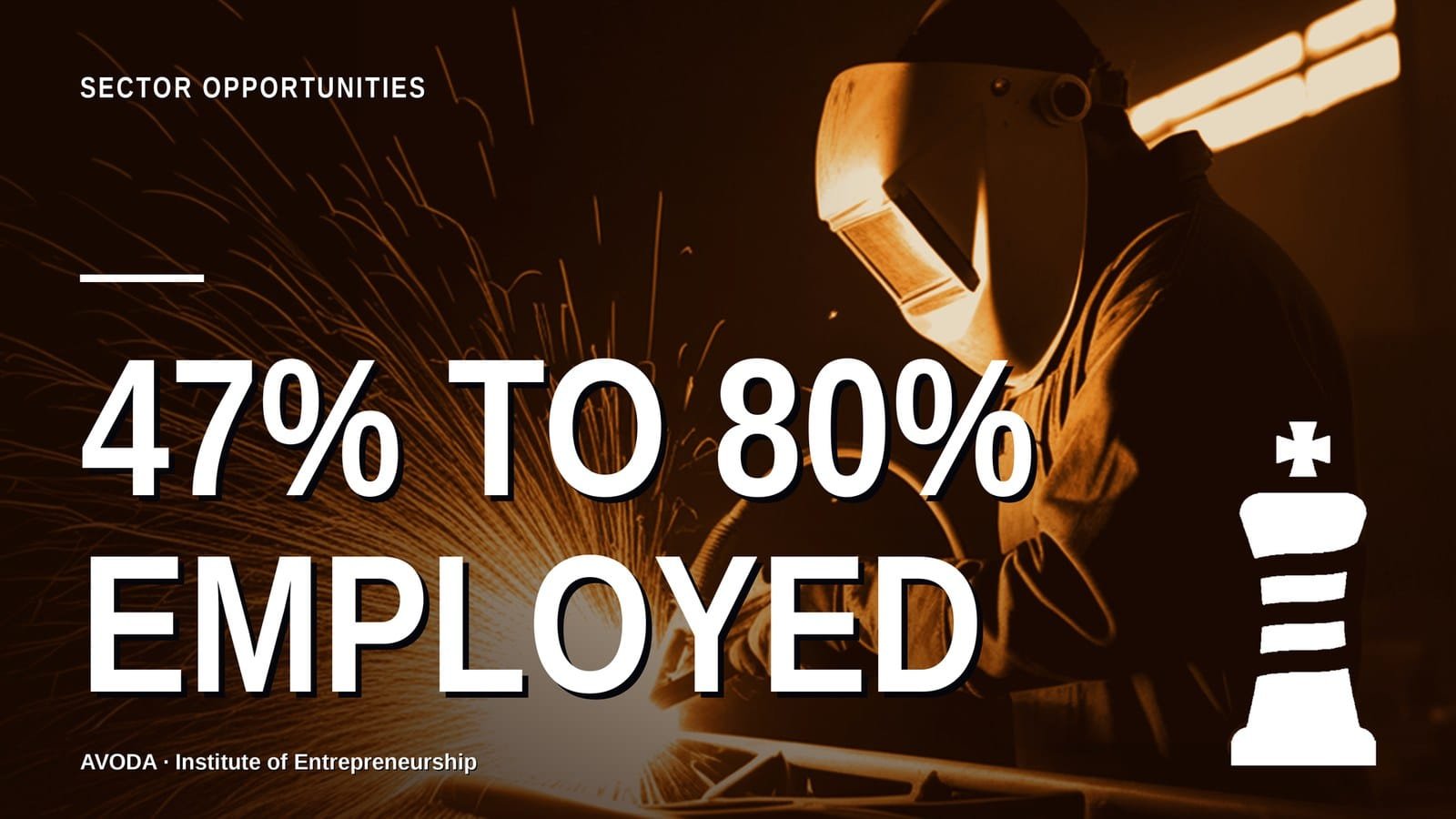
East Africa’s youth bulge is meeting a real training market — and the evidence is striking. The World Bank’s EASTRIP program, partnering vocational institutes with industry across Kenya, Tanzania, and Ethiopia, lifted graduate employment from 47% before the project to 80% — and from 51% to 74% for women graduates (1). That is what happens when training is wired to employment rather than to certificates. The money is shifting accordingly: away from selling content to schools and toward employer-paid, outcome-linked skilling — bootcamps, credentials, and placement. The deepest insight is that East Africa’s unemployment crisis is really a matching and credentialing crisis: the region does not lack jobs or talent so much as trusted signals between them. Build the signal, own the market.
Key Takeaways
- The World Bank’s EASTRIP program lifted TVET graduate employment from 47% to 80% (and from 51% to 74% for women) by partnering 16 flagship institutes with over 300 private-sector companies on curriculum and placement (1).
- Africa’s edtech and e-learning market was valued around $3.7 billion in 2025, with the IFC projecting the continent’s digital-learning market to reach roughly $20 billion by 2030 (2).
- Workforce-skilling solutions make up over a third of the 2025 Africa EdTech 50 — the money is shifting from selling content to schools toward employer-paid, outcome-linked training (3).
- Team Europe launched a €46.85 million TVET digitalization initiative in Kenya, and AI-enabled tools like EIDU have reached hundreds of thousands of Kenyan children — public and philanthropic capital is flowing into the sector (4).
- The persistent gap creates the private opening: Uganda allocates only about 4% of its education budget to TVET, leaving private models to fill the void (5).
- The core insight: unemployment is fundamentally a matching and credentialing crisis. Training-to-employment pipelines that charge employers or share income are among the few edtech models with proven willingness to pay.
Why is unemployment really a matching crisis?
Because the standard framing — “there are no jobs” or “young people lack skills” — misdiagnoses the problem, and the misdiagnosis sends resources to the wrong place.
Look closely at East African labor markets and a paradox appears: employers complain they cannot find suitable workers, while millions of young people complain they cannot find jobs. Both are telling the truth. The jobs exist and the talent exists, but the two cannot reliably find and trust each other. An employer faced with a stack of certificates from unknown institutions has no way to know which candidate can actually do the work — the credential carries no trustworthy signal. A capable young person has no way to prove their ability to an employer who has never heard of their school. The result is not a pure shortage of jobs or of talent; it is a failure of matching and credentialing — a missing trusted signal between supply and demand. This is why so much skilling effort underperforms: it produces more credentials in a system where credentials are not trusted, adding to the noise rather than solving the matching problem.
The EASTRIP results prove the point by solving it. The reason graduate employment jumped from 47% to 80% was not that the training suddenly taught different skills; it was that the program wired the training directly to industry — 16 institutes partnering with over 300 companies on curriculum design and placement (1). When the employer co-designs the training and is connected to the graduate, the trust gap closes: the employer knows the skills are relevant because they helped define them, and the placement link means the matching happens by design rather than by chance. The 47%-to-80% jump is the value of solving the matching and credentialing problem, made visible. The lesson for anyone building in this sector is decisive: the product is not content or credentials; it is the trusted signal that connects talent to employment.
What does the market data show?
It shows real capital flowing, a market growing, and — crucially — the money concentrating on exactly the model the matching insight predicts: workforce skilling tied to employment.
The market is substantial and growing. Africa’s edtech and e-learning market was valued around $3.7 billion in 2025, and the IFC projects the continent’s digital-learning market to reach roughly $20 billion by 2030 (2) — a multiyear growth runway driven by the largest and youngest population entering the workforce anywhere on earth. But the more important signal is where the action is concentrating. Workforce-skilling solutions make up over a third of the 2025 Africa EdTech 50 (3) — a disproportionate share, reflecting that this is where both demand and willingness-to-pay are strongest. The market is voting, with its capital and its attention, for skilling-to-employment over content-to-schools.
Public and philanthropic capital is reinforcing the trend. Team Europe launched a €46.85 million TVET digitalization initiative in Kenya (4), and AI-enabled learning tools like EIDU have reached hundreds of thousands of Kenyan children, while the EASTRIP institutes built their 300-plus industry partnerships (1)(4). This matters because it de-risks the sector and builds the infrastructure (digitized TVET, foundational skills) on which private, employment-focused models can build. And the gap is as important as the investment: Uganda allocates only about 4% of its education budget to TVET (5), a chronic underinvestment in vocational and workforce training that leaves an enormous void for private models to fill. Underfunded public TVET plus rising demand plus proven willingness-to-pay for employment outcomes is precisely the condition that creates a private market — the void is the opportunity.
Why is the employer-paid, outcome-linked model the breakthrough?
Because it solves edtech’s oldest and hardest problem — who actually pays — by aligning payment with the outcome everyone actually wants: a job.
Most edtech has struggled with monetization for a structural reason: the learner who benefits often cannot pay, and the institution that could pay (a school or government) is budget-constrained and slow. Selling content to schools means selling to the most cash-strapped buyer in the system, which is why so much African edtech has high impact and low revenue. The breakthrough models invert this by charging the party with both the money and the clearest incentive: the employer who needs the skilled worker, or the learner who can pay from the income the training generates. Two structures dominate:
Employer-paid skilling. Companies that need workers with specific skills pay the training provider to produce them — funding bootcamps, apprenticeships, and credential programs that feed directly into their hiring. The employer pays because the alternative (unfilled roles, expensive mis-hires) is more costly. This is willingness-to-pay at its clearest, and it aligns the provider’s incentive with producing genuinely employable graduates, not just enrolled students.
Income-share and outcome-linked models. The learner pays little or nothing upfront and instead shares a portion of the income the training enables, or pays upon placement. This ties the provider’s revenue to the learner’s actual employment outcome — the provider only wins if the graduate gets a job — which forces the entire program toward the employment result rather than the enrollment number. It is the measurement-and-outcomes discipline that distinguishes the best programs in every field, applied to skilling.
Both models work because they attach payment to the employment outcome, which is the thing of real value. They are also the models the data rewards — the workforce-skilling concentration in the Africa EdTech 50 (3) reflects exactly this monetization logic winning out. The provider that owns the trusted signal and charges the party who values it most has found the business model African edtech spent a decade searching for.
The Trusted-Signal Stack: building the layer between talent and jobs
Here is the framework I use to map how an edtech or skilling business actually wins in East Africa. Call it the Trusted-Signal Stack — four layers that together produce the trusted signal employers will pay for and learners will cross a market for.
Layer 1 — Employer-defined skills. Start from what employers actually need, co-designed with them — the EASTRIP move (1). This guarantees relevance and begins building the employer relationship that funds the model. Training designed in a vacuum produces untrusted credentials; training designed with employers produces trusted ones.
Layer 2 — Verifiable competence, not just completion. The credential must certify demonstrated ability — assessed, project-based, verifiable — not mere attendance. This is what makes the signal trustworthy: an employer can rely on it because it certifies what the graduate can do, closing the credentialing gap that makes ordinary certificates worthless.
Layer 3 — Placement and matching. Actively connect graduates to employers — the link that converts training into jobs and makes the 47%-to-80% jump possible. Owning the placement layer is owning the matching function, which is the scarce, valuable thing. This is the heart of the business.
Layer 4 — Outcome-aligned payment. Charge the employer who needs the worker, or the learner who shares the income — so revenue tracks employment outcomes. This both monetizes the stack and disciplines it toward producing employable graduates, completing the alignment.
The Trusted-Signal Stack reframes what an edtech business is. It is not a content company or a course provider; it is the trusted intermediary that solves the matching and credentialing failure at the heart of the unemployment crisis — defining the skills with employers, certifying real competence, placing graduates, and getting paid for the outcome. Build all four layers and you own the signal between talent and jobs, which in a region with the world’s largest youth workforce is one of the most valuable positions there is.
What should founders, investors, and policymakers do?
The agenda is clear, and it sits at the intersection of opportunity and need.
For founders, the build is the signal, not the syllabus: employer-co-designed, competence-verifying, placement-linked, outcome-paid skilling in the sectors where demand and willingness-to-pay are highest — digital and AI services, the skilled trades, healthcare, agribusiness. This connects directly to the region’s other employment engines: the BPO and AI-services boom that needs trained workers climbing from data labeling to higher-value roles, the judgment-and-AI-operator skills that survive automation, and the broader reframe of the region’s “brain drain” as a talent-circulation and skilling opportunity.
For investors, employer-paid and income-share skilling offers the rare edtech profile of proven willingness-to-pay and measurable outcomes — the kind of evidence-rich model that the region’s maturing, outcome-focused capital is built to back. For policymakers, the EASTRIP result is the playbook: wire public TVET to industry, fund the matching and placement infrastructure, and the employment numbers follow. Uganda’s 4% TVET allocation (5) is the gap to close — and the private models filling it should be enabled, not crowded out.
The conclusion captures why this sector deserves the “new oil” framing. East Africa’s most abundant resource is its young people — the largest, youngest workforce entering the global economy this century. Like oil, that resource is enormously valuable but worthless until it is refined and connected to demand. The refining is skilling; the connection is the trusted signal between talent and jobs. The EASTRIP numbers prove the refining works — 47% to 80% employment when training is wired to industry — and the market data shows where the value is concentrating: employer-paid, outcome-linked, placement-driven skilling. The unemployment crisis was never really a shortage of jobs or talent. It was a missing signal. Build that signal, charge the party who values it, and you do more than build a business — you turn the region’s greatest resource into its greatest asset. Skills are the new oil, and the refineries are still being built.
FAQ
Is East Africa’s unemployment a shortage of jobs or skills?
Primarily neither — it is a matching and credentialing crisis. Jobs and talent both exist, but employers cannot trust unknown credentials and capable young people cannot prove their ability. The missing element is a trusted signal between supply and demand, which is why wiring training to industry (as EASTRIP did) lifts employment so sharply.
What were the EASTRIP program’s results?
The World Bank’s EASTRIP program lifted TVET graduate employment from 47% before the project to 80%, and from 51% to 74% for women graduates, by partnering 16 flagship vocational institutes with over 300 private-sector companies on curriculum design and placement across Kenya, Tanzania, and Ethiopia (1).
How big is the African edtech market?
Africa’s edtech and e-learning market was valued around $3.7 billion in 2025, and the IFC projects the continent’s digital-learning market to reach roughly $20 billion by 2030 — driven by the world’s largest and youngest workforce. Workforce-skilling solutions make up over a third of the 2025 Africa EdTech 50 (2)(3).
Why is employer-paid skilling a better business model?
Because it charges the party with both the money and the clearest incentive — the employer who needs the skilled worker — rather than cash-strapped schools or learners. Income-share models similarly tie payment to the learner’s employment outcome. Both align the provider’s revenue with producing genuinely employable graduates, solving edtech’s monetization problem.
What is the opportunity gap in workforce training?
Chronic public underinvestment: Uganda, for example, allocates only about 4% of its education budget to TVET. This leaves a large void for private, employment-focused models to fill, precisely as demand for skilled workers and proven willingness-to-pay for employment outcomes are rising (5).
Related Reading
- From Call Centers to AI Factories: East Africa’s Global Services Moment
- Cheap Code, Scarce Judgment: The AI Talent Gap
- The Talent Double Bind: Brain Drain and the Jobs Paradox
- The Creative Economy’s Global Moment
Sources and Evidence
- The Star — “World Bank: TVET-industry partnerships see employment rise by 80%” — Source for the EASTRIP results: graduate employment 47%→80%, women 51%→74%, 16 institutes and 300+ company partnerships.
- IMARC Group — “Africa E-Learning Market” — Source for the ~$3.7 billion 2025 market size; IFC’s ~$20 billion-by-2030 digital-learning projection corroborated across sector analyses.
- HolonIQ — “2025 Africa EdTech 50” — Source for workforce-skilling solutions making up over a third of the list, evidencing the shift toward employment-focused models.
- AFD — “Team Europe: Kenya advances high-quality technical and vocational training (TVET)” — Documents the €46.85 million TVET digitalization initiative in Kenya.
- ACET — “Financing Africa’s TVET Systems for a Future-Ready Workforce” — Source for Uganda’s ~4% TVET budget allocation and the public-funding gap.