
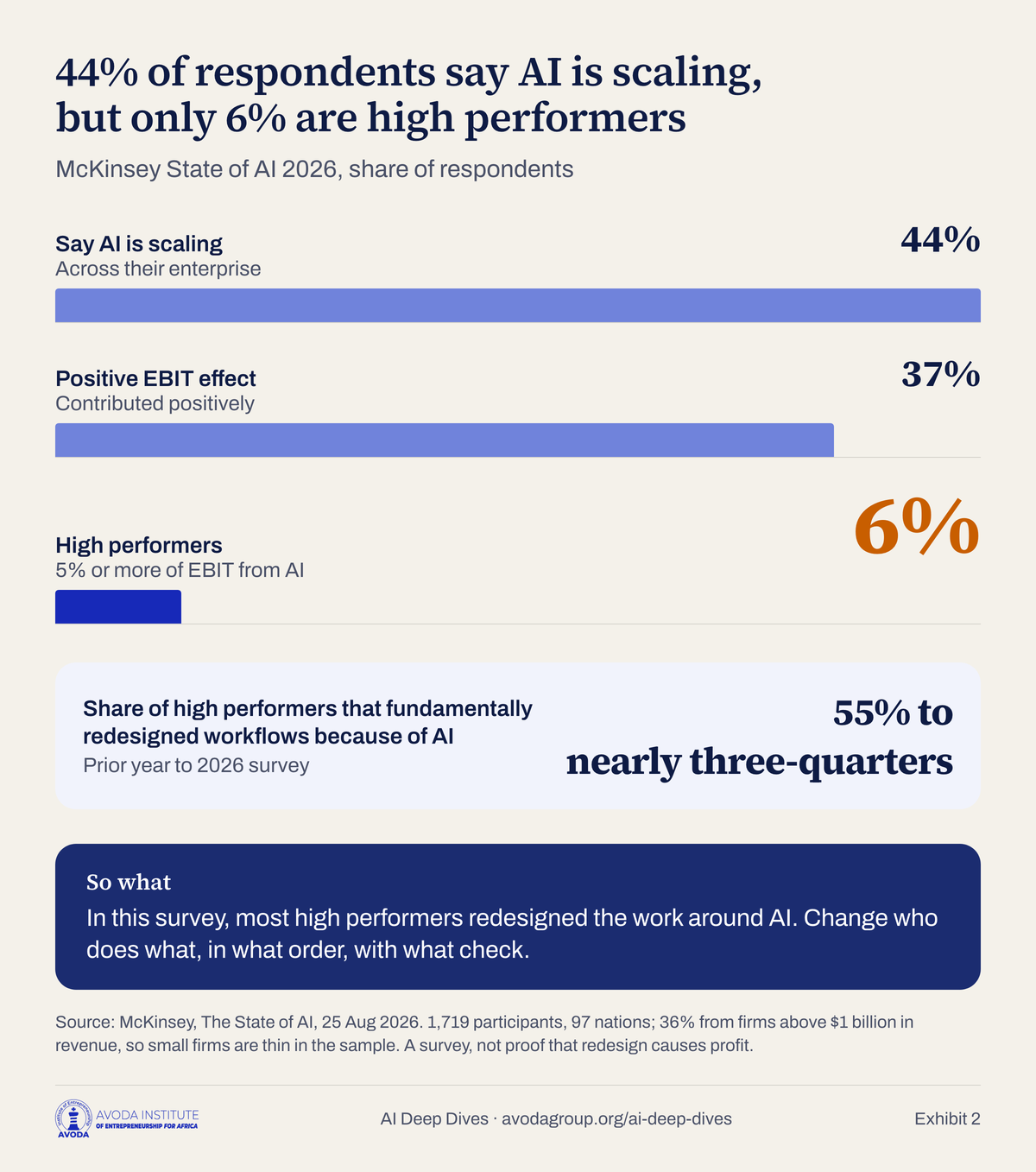
In surveys, AI use is wide and profit is narrow, and the firms that profit are the ones that redesigned their work. In McKinsey’s 2026 survey, 44% of respondents said AI is scaling across their enterprise, yet only 37% reported a positive effect on EBIT, and only 6% qualified as “high performers” (1). Nearly three-quarters of those high performers had fundamentally redesigned workflows because of AI (1). For a Ugandan business that already sells, the practical version of that finding is small and specific: one workflow, one owner, one number, one written brief and one rule for when to stop, run for 30 days. This article sets out the method, the evidence under each step, the places where that evidence is thin, and what to do on Monday.
Key Takeaways
- In McKinsey’s 2026 survey of 1,719 respondents, 44% said AI is scaling across their enterprise, 37% reported a positive effect on EBIT and 6% were high performers. Use is wide and profit is narrow (1).
- Nearly three-quarters of the high performers fundamentally redesigned workflows because of AI, up from 55% a year earlier (1). Adding a tool to an unchanged workflow is our reading of the pattern; the survey itself reports the redesign.
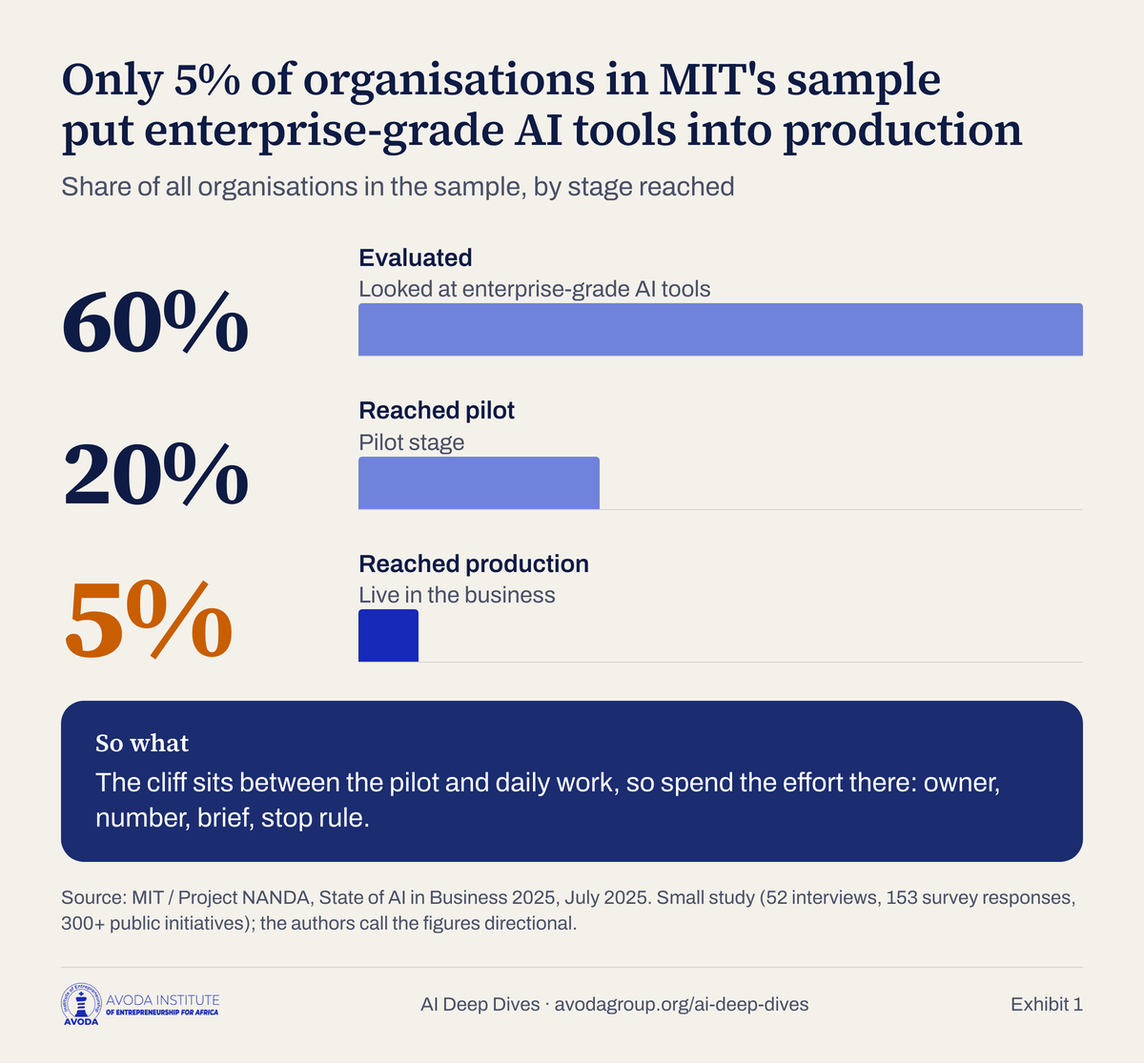
- MIT’s NANDA study, a small and directional one, found that in its sample 60% of organisations evaluated enterprise-grade AI tools, 20% reached pilot stage and 5% reached production. Its authors named learning as the core barrier (2).
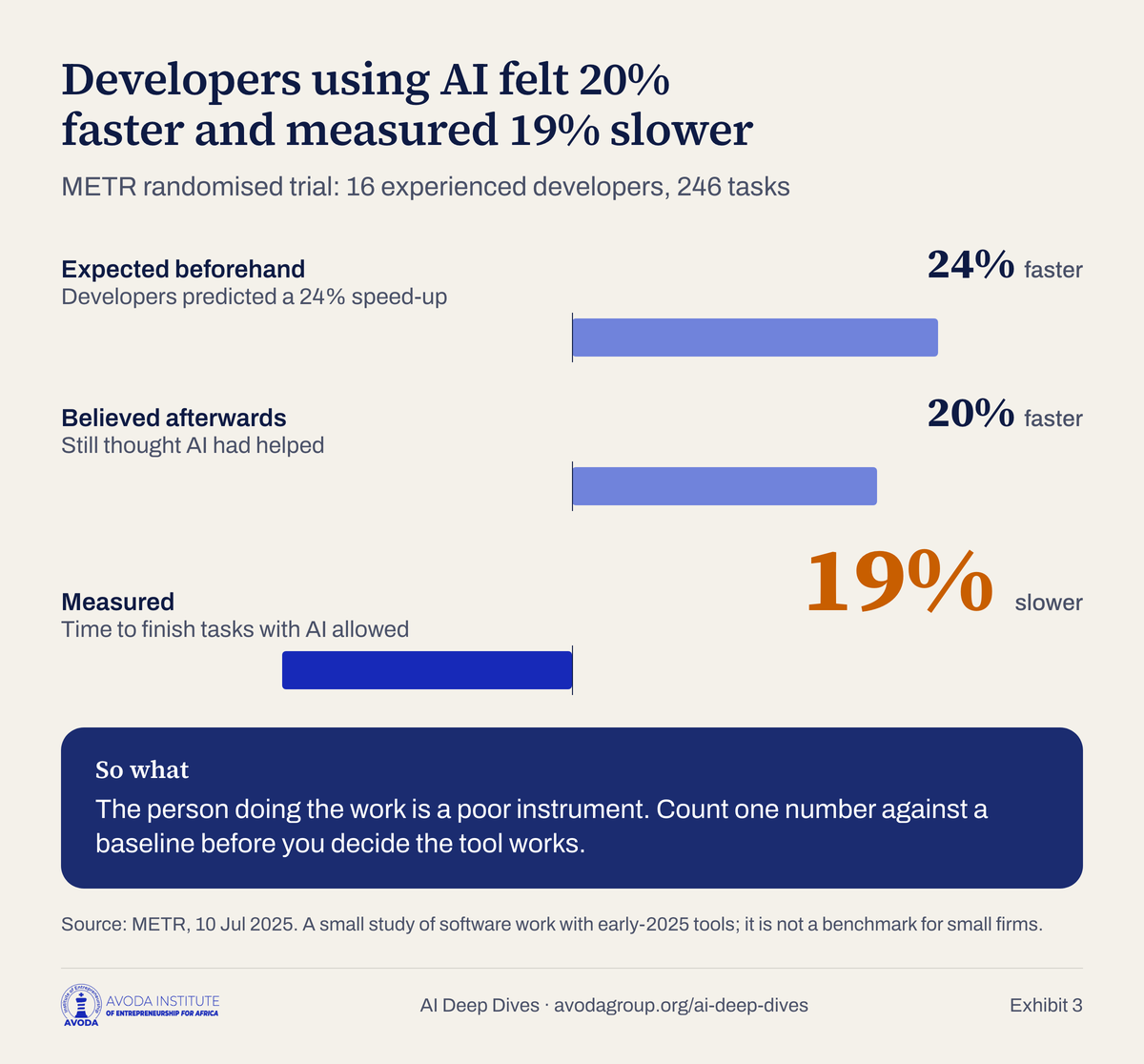
- A randomised trial by METR found experienced developers took 19% longer with AI, believed they were 20% faster, and had expected a 24% speed-up. Their own impression of speed pointed the opposite way from the clock (4).
- Uganda has no official figure for AI adoption among small firms. What we do have is a phone-first economy (36.3 million active mobile money accounts (accounts, not people)), a 686,700-business baseline from before the AI tools arrived, and a data-protection law that reaches personal data sent abroad (10)(11)(13).
- The method: pick one workflow that already earns or protects money, record a baseline, write a one-page brief, let a person check every output, and decide keep, change or stop on a date set in advance. Each move is supported by evidence. The assembled method is practitioner craft that no study has tested as a whole, and this article says where.
Why do most AI pilots never reach daily work?
A pilot is a trial of a tool. Daily work is a changed way of doing a job: who does which step, in what order, with what check, and what number tells you it is working. Most pilots test the first and never touch the second. The tool gets a demonstration, three people try it for a fortnight, a few outputs look impressive, and the job goes back to being done the old way because nothing about the job was ever rearranged to include the tool.
The large studies describe this gap from different angles. McKinsey’s 2026 State of AI, fielded between 4 May and 8 June 2026 with 1,719 participants in 97 nations, reports that 44% of respondents say AI is scaling across their enterprise, up from 38% a year ago, and that 56% use AI in three or more functions, up from 51% (1). Stanford’s AI Index 2026 puts organisational adoption at 88% (19). Yet the share reporting a positive contribution to EBIT was 37%, essentially unchanged from 2025, and the share of high performers, defined as organisations getting 5% or more of EBIT from AI and reporting significant value, was 6%, also unchanged (1). Use grew. Profit did not move.
MIT’s Project NANDA study, published in July 2025, gives the most quoted version of the pattern and also needs the most careful quoting. Its headline reads “95% of organizations are getting zero return” (2). Its sample is 52 interviews, 153 survey responses and a review of more than 300 public initiatives, and the authors describe the figures as directionally accurate. Press coverage repeated the number as if it were a census. We use it as a direction. The funnel inside the study is easier to hold on to: in MIT’s sample, 60% of organisations evaluated enterprise-grade AI tools, 20% reached pilot stage and 5% reached production (2). The cliff sits between the pilot and the production line.
RAND’s 2024 report, based on 65 interviews with practitioners, cites an estimate that “more than 80 percent of AI projects fail”, about twice the failure rate of non-AI IT projects (6). RAND quotes that estimate from elsewhere and did not count it itself. What RAND did measure, through interviews, is more useful: the first root cause is that stakeholders misunderstand or miscommunicate what problem the AI is meant to solve, and the third is chasing the latest technology instead of a real user problem (6). Gartner’s June 2025 forecast says over 40% of agentic AI projects will be cancelled by the end of 2027 because of “escalating costs, unclear business value or inadequate risk controls”, and describes most current agentic projects as early-stage experiments “mostly driven by hype and are often misapplied” (5). That is a forecast.
Put the four sources side by side and the same four gaps appear. Nobody owns the result. Nobody watches one number. Nobody wrote down what the tool may and may not do. Nobody decided in advance when to stop. We offer that list as our reading of these studies. None of them tested it. It does match their root causes, and it is a list an owner can act on this week without a budget.
What do the high performers do that the rest do not?
The one practice McKinsey singles out is redesign. Nearly three-quarters of high performers fundamentally redesigned workflows because of AI, up from 55% a year earlier (1). The survey cannot tell us which way the arrow runs: firms that profit from AI may redesign because they have the money and the staff to do it. Still, the finding agrees with MIT’s explanation for why pilots stall. The NANDA authors write that “the core barrier to scaling is not infrastructure, regulation, or talent. It is learning”, meaning tools that do not retain feedback, adapt to context or fit the workflow they sit in (2).
Redesign sounds like a consulting word, so here is what it means in a Kampala shop. Take quoting. Before: a customer sends a WhatsApp message asking for a price on cement, iron sheets and nails. The owner reads it between customers, works out the price on a calculator from memory, types a reply that evening. After: staff copy the enquiry into a standard form with codes instead of names, a drafting tool produces a quote from the shop’s price sheet, a second person checks the three prices that change most often, and the owner sees one number on Friday, the share of enquiries quoted the same day. The AI step is one box in that picture. The redesign is the other four boxes.
Three other findings in the same studies bear on a small firm.
- Speed. MIT reports that top-performing mid-market firms went from pilot to full implementation in about 90 days, while large enterprises took nine months or longer (2). A firm where the owner can walk to the person doing the job has a structural advantage on speed. The same study is a small sample, so read it as permission to try.
- Buy or build. Purchased or partnered tools reached deployment about 67% of the time against about 33% for internal builds. The figures are self-reported, may not account for confounders, and the authors caution against a causal reading (2). For a firm with no developer, the finding points the same way as common sense: start with a tool someone else maintains.
- People. BCG’s 2025 survey of more than 10,600 employees in 11 countries found that only 51% of frontline employees use generative AI regularly, against more than three-quarters of leaders and managers. Strong leadership support lifts employees’ positive view of AI from 15% to 55%, and regular use is sharply higher for staff with at least five hours of training, though only about one-third say they have been properly trained (7). In your business, the leader is the owner. If the owner never uses the tool in front of staff, the staff read that correctly.
BCG also reports that 5% of companies are “future-built” for AI and show 1.7 times the revenue growth, while 60% report minimal gains (3). BCG sells consulting on this framing, and its base is 1,250 senior executives, so treat it as one more survey that points the same direction as McKinsey’s.
What does the evidence not tell us?
A method taught to owners should come with the limits of its evidence, because the owner is the one who pays if the evidence does not travel. Five limits matter.
The samples are large firms. In McKinsey’s 2026 sample, 36% of respondents came from firms above $1 billion in revenue, so small firms are thin in the data. The survey itself says that AI deployment by larger organisations continues to outpace deployment by smaller ones (1). PwC’s 2026 findings, drawn from 1,217 executives of whom 76% were in firms above $1 billion in revenue, report that 82% of organisations are running AI pilots but few have scaled, and that a small number of African firms inside that global executive survey invest on average 2% of revenue in AI against 5% for global leaders (20). It is no national or SME sample. Read both as large-firm evidence.
The failure numbers are estimates and forecasts. The MIT 95% comes from a small sample. The RAND 80% is an estimate RAND cites. The Gartner 40% is a forecast. Each one is evidence of a pattern. None is a count of failed projects in Uganda, and no such count exists.
Gains are not uniform. A study of 758 consultants found that on tasks inside the AI’s capability, users finished 12.2% more tasks and 25.1% faster with better quality. On a complex task outside that frontier, the same users were 19% less likely to produce a correct solution (8). A customer-support study found that AI access raised issues resolved per hour by 14% on average and by 34% for novice and low-skilled workers, with minimal effect on experienced workers (21). Gains depend on the task and the person. That is why the method tests the tool on your own tasks and your own staff.
METR ran a randomised trial with 16 experienced developers on 246 tasks. With AI allowed, they took 19% longer. They had expected a 24% speed-up beforehand, and afterwards still believed AI had made them 20% faster (4). It is a small study of software work with early-2025 tools. METR measured a small group of software developers, and its result cannot be applied to a Kampala bakery. What it does show is that the person doing the work misjudged the speed, which is why the method asks for a baseline and a weekly count. The developers overestimated the benefit both before and after the work.
We have no official Ugandan adoption figure. We searched for an adoption rate for small firms from UBOS, UCC and NITA-U and did not find one. The closest official anchor is a pre-AI baseline: UBOS’s Census of Business Establishments 2019/20, released on 14 August 2025, counted 686,700 businesses, 81.7% of them informal, and 36.0% using computers in their operations (11). Anyone quoting a percentage of Ugandan SMEs “using AI” is quoting a figure we could not trace to UBOS, UCC or NITA-U.
Is one workflow just a smaller pilot?
The strongest objection to this method comes from the same studies it relies on, and it deserves to be stated at full strength. It runs like this. McKinsey’s high performers did not run a tidy 30-day experiment on one workflow. They fundamentally redesigned workflows, plural, and the share doing so is rising (1). BCG’s future-built firms reshape how the whole company operates and report 1.7 times the revenue growth (3). A speaker at the AmCham Uganda AI CEO Table Talks in December 2025 told businesses to “start with strategy, not hype” and to “integrate AI where it solves real pain points, like inventory optimisation or customer personalisation” (16). The second half supports starting at a real pain point, which is where this method starts; the first half is the warning this objection builds on. On this view, a one-workflow start is a pilot with better manners: it feels like progress, it protects the owner from deciding anything large, and it produces a small saving that distracts from the strategic question of where the business should be in three years. Add that smaller firms are already behind larger ones in deployment (1), and a patient strategy-first approach looks safer than a quick win.
That objection holds on one point and we concede it plainly: one workflow is not a strategy. A firm that fixes its quote follow-up and never asks which customers it wants more of has improved a step in a business whose direction it has not examined. If a pilot is defined as a trial that never has to answer to the rest of the business, this method can be run as one, and it will stall like one.
Three features of the method are there to prevent that outcome.
- Strategy comes first, in small form. The first week produces a written picture of the customer you already sell to, a cost-and-use audit of every tool you pay for, and a map of the path a lead takes to a sale. Those three pages are the strategic work for a business that is already selling. The workflow is chosen from them.
- The unit of change is a workflow, and the test is a number. A pilot ends when the demonstration ends. This method ends with a decision on a date: keep, change or stop, read from a number defined before the work began. A stalled pilot has no such date.
- The second workflow reuses the first. Redesign one workflow at a time is how a business with ten staff does what McKinsey’s high performers do with ten thousand. By the third workflow the owner has a template for choosing, briefing, checking and stopping, which is a capability, and capabilities are what the strategy-first camp is right to want.
We should also say what we cannot show. No study we found compares “one workflow at a time” with “many at once” for small firms. The case rests on the evidence under each step, and the pattern in the failure studies. That is craft, and it should be judged by whether your number moves.
What is different about starting from Uganda?
We write this from Kampala, about our own market, so the section is short on comparison and long on facts we can check.
The phone is the office. As of December 2025, the Uganda Communications Commission reports 47.1 million active mobile subscriptions, 36.3 million active mobile money accounts and 18.5 million internet subscriptions. These are counts of SIM cards and accounts (10). A third-party estimate puts the number of people using the internet at 11.4 million at the end of 2025, 22.0% of the population (DataReportal, a third party). The practical point: a large part of a Ugandan business’s customer trail already exists in a form AI tools can read once you remove the names: WhatsApp threads, Mobile Money statements, a till book, a delivery sheet.
Businesses are small and mostly informal. Beyond the UBOS census figures above (11), the Ministry of Trade’s MSME profile says 90% of enterprises are micro with an average of 2.1 employees, and that MSMEs employ over 2.5 million people. The ministry does not state the underlying survey year (12). A method built for a 5,000-person company with a data team does not fit an owner with two employees and an exercise book. The method here asks for a spreadsheet, a phone and one hour on Monday.
Tool use is early, and it leans toward study and drafting. The Anthropic Economic Index measures Claude chat use only; it says nothing about national AI adoption or other tools. For April and May 2026 it puts Uganda at an index of 0.11, rank 116 of 121 countries, 0.07% of usage, against Kenya at 0.34, Rwanda at 0.20 and Tanzania at 0.07. Of Uganda’s Claude conversations, 33.12% were coursework against 16.45% globally, 42.06% were for work against 43.36% globally, and management accounted for 6.23% of job-category matches (17). A larger share of Uganda’s Claude conversations than the global average were coursework and automation-style, so an owner most needs a review step between the tool and the customer.
Cost is a decision in shillings. Published prices on 29 October 2026 are $20 a month for ChatGPT Plus, $20 monthly or $17 billed annually for Claude Pro, and $25 monthly or $20 annual for a Claude Team standard seat (18). At a planning rate of UGX 3,700 per US dollar, a $20 plan is about UGX 74,000 a month (our arithmetic; third-party quotes ran from 3,661 to 3,744 between June and August 2026, so recheck the rate on the day). A five-person team on a $20 plan is about UGX 370,000 a month before card charges. That figure belongs next to the number you will watch.
The law is real, and the national strategy is not yet written. The Data Protection and Privacy Act reaches personal data held outside Uganda and carries concrete penalties (13). The section on data below covers it. On 20 October 2026 the government launched a five-year National Data Strategy described as groundwork for “Uganda’s upcoming National AI Strategy”, which means no national AI strategy has been published (15). Owners are working without a national playbook, which is a reason to keep their own rules short and written down.
None of this is a reason to wait for permission or for a better-resourced country to go first. The evidence is large-firm evidence, and it tells us what to look for. The measurement has to be ours. That is the argument for a baseline and one weekly number in every business that tries this.
Which workflow should you start with?
The choice matters more than the tool. Choose a workflow that already earns money or protects it, has a named person who runs it today, happens at least weekly, produces something you can count, and carries limited harm if the first drafts are wrong. MIT found that about half of the generative AI budgets in its sample went to sales and marketing, while back-office automation often paid back faster (agency spend down 30% in the best cases). The authors link that bias to the fact that sales results are easier to attribute (2). Choose by the evidence in your own books.
Score three to five candidate workflows with this table. Give each criterion 0, 1 or 2. Pick the highest total, and break a tie by choosing the one nearer to money.
| Test | 0 points | 1 point | 2 points |
|---|---|---|---|
| Money | No link to revenue or cost | Indirect link | A delay or error here costs you money this month |
| Owner | Nobody runs it | Shared by several people | One named person runs it |
| Volume | Monthly or less | Weekly | Daily, or 10 or more times a week |
| Countable | No record exists | Record exists but is scattered | You can count it from existing messages or books |
| Harm if wrong | A wrong output reaches a customer unseen and cannot be undone | A wrong output is costly but a person sees it first | A person always sees it first and a mistake is cheap to fix |
A worked scoring of three generic candidates follows. These are illustrative business types with illustrative scores.
| Candidate workflow (illustrative) | Money | Owner | Volume | Countable | Harm | Total |
|---|---|---|---|---|---|---|
| Hardware shop: quotes sent to WhatsApp enquiries | 2 | 2 | 2 | 2 | 1 | 9 |
| Catering firm: follow-up to office clients after a tasting | 2 | 1 | 1 | 2 | 2 | 8 |
| Clinic: monthly stock re-order list from the dispensing book | 1 | 1 | 0 | 1 | 1 | 4 |
The hardware shop scores 9 and starts with quotes. The clinic’s re-order list scores 4 because it happens monthly and sits in a book nobody has typed up, so the clinic would look at a different workflow, such as appointment reminders. One rule helps when two candidates tie: choose the workflow where a delay already costs you a customer, because the evidence of value is in your own records and the owner is already unhappy about it.
What is the 30-day method?
The method has five moves. Each ends with something an owner can show another person. The names are plain on purpose, because staff will repeat them.
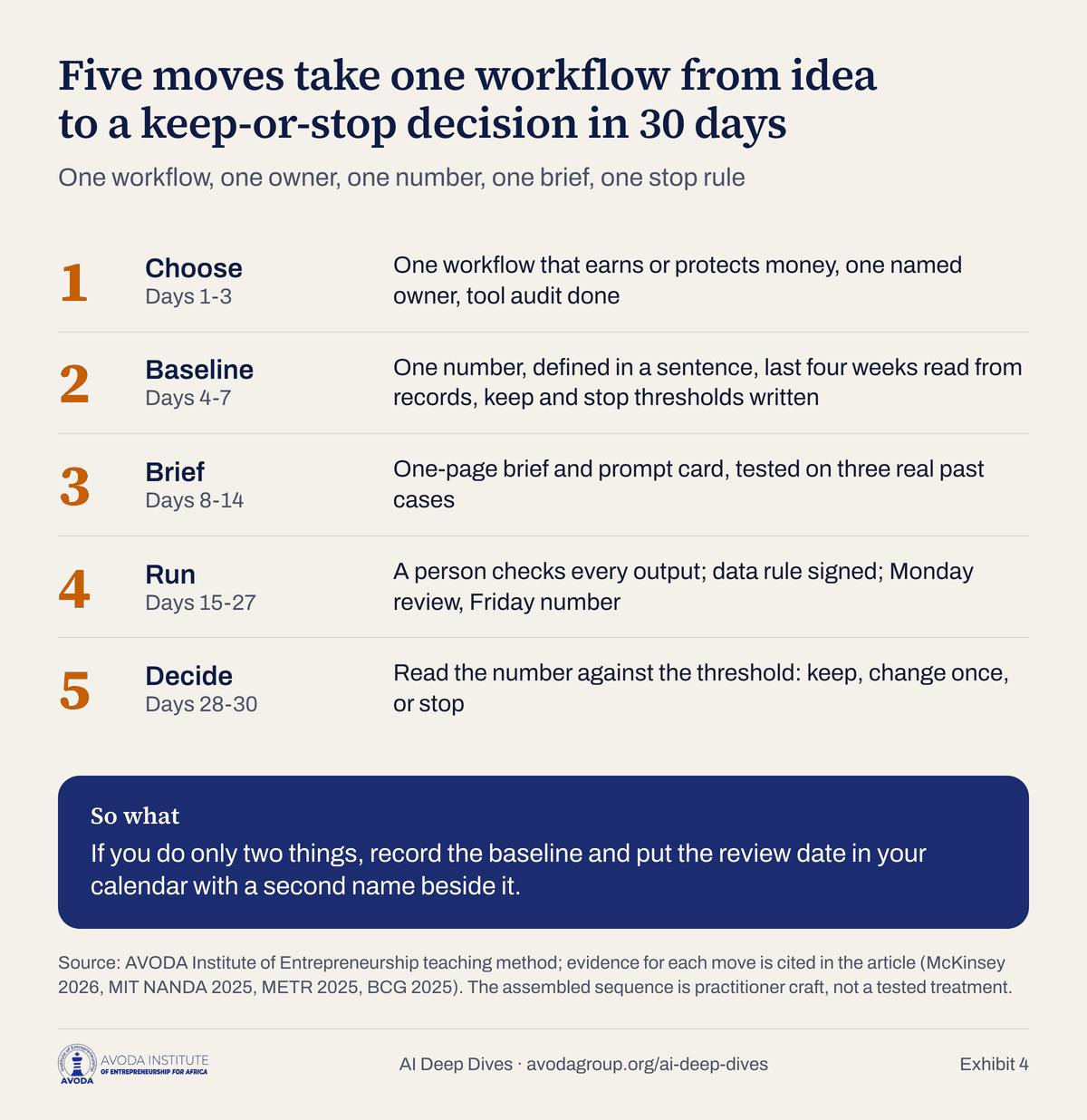
Move 1 (days 1 to 3): Choose and write the workflow card
Pick the workflow using the scoring table. Then write one card for it. The card is a single page the owner can read in a minute.
WORKFLOW CARD
Workflow name:
Who runs it today (one name):
What starts it (the trigger):
What finishes it (the output a customer or colleague receives):
How often it happens (per week):
What it costs us now (hours per week, UGX lost per month, or customers lost):
Who checks the output before it leaves:
The tool I will test (one, already available to us):
Date I will decide keep, change or stop (day 30):
Before touching a tool, do the tool audit that belongs to this move. Open three months of bank, card and Mobile Money statements and list every software or online charge, including annual renewals. Write the monthly cost in UGX, who uses it, when it was last used and the one job it does. Mark each KEEP, TRIAL or CANCEL. Cancel on the same day. MIT found that workers at over 90% of surveyed companies use personal AI tools for work while only 40% of companies bought an official subscription (2). In a small firm the same gap shows up as three people paying for three overlapping tools on three personal cards. The audit finds them. Do not add a new tool until the audit is complete.
Move 2 (days 4 to 7): Record the baseline
Choose one number that sits closest to money and that you can count without asking anyone. Define it in one sentence so that two people would count it the same way. Then fill in the last four weeks from records that already exist: WhatsApp message times, till book, invoices, delivery sheet. You are reading the past, so there is no four-week wait.
NUMBER CARD
The number (one sentence, countable by two people the same way):
Unit (per week, per customer, per order):
Where the count comes from:
Counted by (name) every (day) at (time):
Last four weeks (baseline): week -4 ___  week -3 ___  week -2 ___  week -1 ___
Baseline average:
Target by week 8:
The threshold that means KEEP at day 30:
The threshold that means STOP at day 30:
Examples of good numbers: the share of enquiries that receive a quote the same day; days from first contact to payment; quotes sent per week; repeat orders per month; hours per week spent on a named job. Examples of bad numbers: “customer satisfaction”, “productivity”, anything that needs a survey to read. METR’s result, where the people doing the work misjudged their own speed in both directions of time, is the reason the number is counted (4). Write the keep and stop thresholds now. A threshold written after the result is a decoration.
The baseline also contains the test of whether the problem is real. If the same-day quote rate is already 90%, your quoting does not need AI. Go back to the scoring table and choose again. That is a cheap outcome.
Move 3 (days 8 to 14): Write the brief and test the prompt on three real cases
For a text task, such as drafting quotes, follow-ups or summaries, write a prompt card with six parts: the role, the context, the data with names removed, the task, the format and a check the tool must run on its own answer. Then test it on three real past cases and score each result 0, 1 or 2 on accuracy, tone and time saved. Change the prompt and run the same three cases again. If three rounds still give unusable output, change the task or the data. Do not shop for a different tool yet.
PROMPT CARD (example for a quote draft; illustrative)
Role: You draft price quotes for [shop name], a hardware shop in Kampala.
Context: Customers send enquiries by WhatsApp. Our price sheet is pasted below. Prices are in UGX and include VAT unless the sheet says otherwise.
Data: [enquiry text with names and phone numbers removed, written as customer code C-014] + [price sheet]
Task: Draft a quote for the items requested. If an item is not on the price sheet, write "price to confirm" and do not guess.
Format: A list of item, quantity, unit price in UGX, line total in UGX, and a total. Then two short sentences in plain English offering delivery or pickup. Under 120 words.
Check: Before answering, recalculate every line total and the final total. List any item where you used "price to confirm".
Owner of this card:       Version:       Date:       Privacy note: no names, phone numbers or Mobile Money details pasted.
Score the three test cases against the actual quotes the shop sent. A tool that produces a polished wrong price has failed the test, however good the paragraph reads. The 758-consultant study found that on tasks outside the AI’s frontier, users were 19% less likely to produce a correct solution, which is the reason for testing on your own cases before you rely on anything (8).
If you want to go one step further than a prompt card, write a one-page brief for an assistant or agent. Anthropic’s own guide to building agents advises “finding the simplest solution possible, and only increasing complexity when needed”, describes agents that “pause for human feedback at checkpoints or when encountering blockers”, and notes that “it is common to include stopping conditions (such as a maximum number of iterations)” (9). In a first month, the simplest solution is a prompt card and a person. A brief is worth writing only when the job has a clear start and finish and you have already run the prompt card successfully.
ONE-PAGE BRIEF FOR AN ASSISTANT
Job (one sentence):
It may read (list the files or sheets, nothing else):
It may use (tools, nothing else):
Output format:
It must never: send anything, promise a price, date or refund, mention another customer, or use red data.
Checked by (name), before anything leaves:
It stops and hands back to a person when: an item is missing from the sheet, a customer is upset, the request is outside the job, or it is unsure.
Five test cases: three normal, one tricky, one it should refuse.
Maximum steps or attempts before it stops:
Date reviewed:
Move 4 (days 15 to 27): Run it with a person checking every output
Run the workflow for real, with the owner of the workflow using the tool and a person checking before anything leaves the business. Use one of four levels of human check, and choose the level for each step.
| Level | What happens | Use it when |
|---|---|---|
| 1. Person does it | AI not involved | Red data, legal commitments, refunds, anything involving a complaint |
| 2. AI drafts, person approves and sends | Every output is read before it leaves | Where the whole month starts, and where most small firms should stay |
| 3. AI drafts, person samples | The person reads one in five and all of the unusual ones | After 20 checked outputs with no material error, for low-harm steps |
| 4. AI acts alone, with alerts | The tool sends or posts on its own | Not in the first 30 days. Few small firms need it. |
The levels are our working scale for teaching, in the tradition of “levels of automation” thinking. Stay at level 2 for the whole first month. Move to level 3 only after 20 checked outputs show no material error, and drop back to level 2 the day an error reaches a customer.
During these 13 days the owner does three more things. First, hold a 10-minute review every Monday to read the number and clear anything overdue. Second, update the number card every Friday with one line on why it moved. Third, brief staff for 30 minutes on what the tool may do, what data may go into it and who to tell if something goes wrong. BCG found that 46% of employees in firms that are reshaping workflows worry about job security, against 34% elsewhere (7). Say plainly what the workflow change means for each person’s job. Silence is read as bad news.
Move 5 (days 28 to 30): Decide keep, change or stop
On the date you set in Move 1, read the number. Compare it to the thresholds you wrote in Move 2. There are three outcomes.
- Keep. The number met the keep threshold and no serious error reached a customer. Write the decision and the reason in the log. Set the next review for 30 days out. Start choosing the second workflow.
- Change. The number moved toward the threshold but did not meet it, or an error taught you something. Change exactly one thing, write what it is, and set a second date no more than 14 days out.
- Stop. The number did not move, or the check cost more minutes than the draft saved. Stop, write down why and move on. Stopping on a date is a result.
DECISION LOG
Date:
Workflow / tool / prompt / agent:
Number at baseline:       Number at day 30:       Threshold:
Errors that reached a customer (count and what):
Hours saved per week (owner's estimate)  and  checking minutes per week:
Monthly cost in UGX:
Decision (KEEP / CHANGE / STOP):
Reason in one sentence:
Next review date and who attends:
If the date passes without a review, the item stops until a review happens. That sounds harsh. It is the cheapest way to prevent the pattern the failure studies describe, where a pilot carries on for a year because nobody was asked to end it. Gartner lists unclear business value and escalating costs among the reasons projects are cancelled (5). A rule written in advance cancels them on your terms.
If you would rather build this with a facilitator and your own numbers
AI Deep Dives for Executives and Business Owners puts the first two moves and the setup for the rest into two Saturdays, on your business. Saturday 14 November is Strategy: a written picture of the customer you already sell to, the tools you keep and the ones you cancel, the path a lead takes to a sale, and one prompt you will use on the business. Saturday 21 November is Implementation: a lead table, one number you will watch, a one-page brief for one agent, and a rule for what to keep using and when to stop. Both days run 9:30am to 12:00pm as a group, followed by a one-on-one session from 12:30pm to 2:30pm on your business, East Africa Time. There are 30 seats at UGX 375,000. AVODA Blue alumni and Pearl Business Network members pay UGX 249,000 if payment is in by 11:59pm Kampala time on Saturday 7 November. Everyone pays before Saturday 14 November, and the room or online link comes with your payment confirmation.
What does a worked month look like?
The following example is a composite for teaching: a generic hardware shop in Kampala with illustrative figures. It is a teaching composite and is labelled as one. The shop sells building materials, takes most enquiries by WhatsApp and has four staff plus the owner.
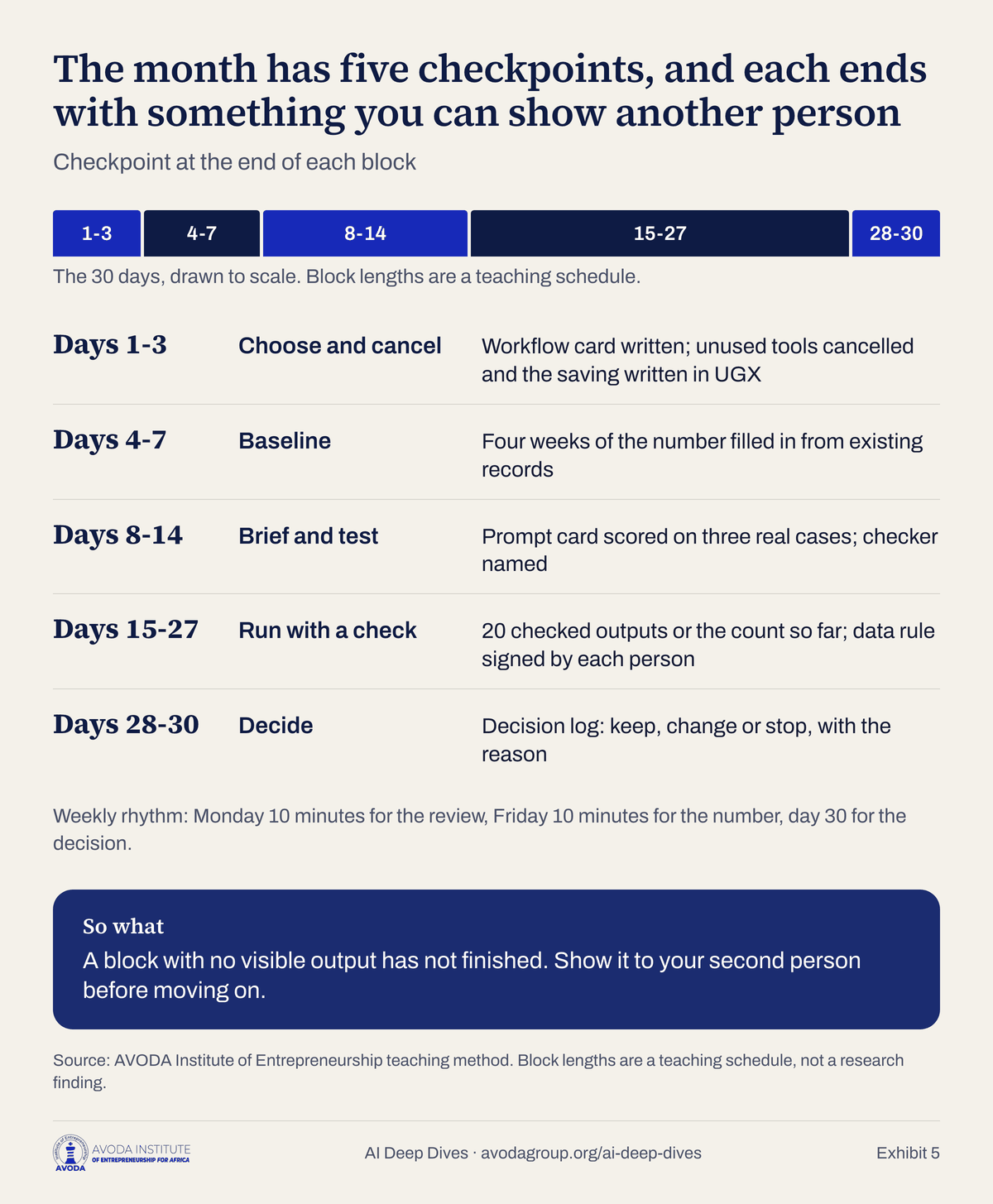
Days 1 to 3. The owner scores three candidates and picks quotes. The workflow card says: the person who runs it today is the owner, the trigger is a WhatsApp enquiry, the output is a priced quote, about 25 enquiries arrive a week, and each quote takes the owner about 10 minutes by hand. The tool audit finds two overlapping subscriptions paid on separate cards, and the owner cancels one. The saving is written down in UGX on the card.
Days 4 to 7. The number is “the share of enquiries that receive a quote on the same day”. Counting back through four weeks of WhatsApp history, the shares are 31%, 28%, 35% and 30%, an average of about 31%. Target by week 8: 60%. Keep threshold at day 30: 55% or more for the last two weeks, with no wrong price sent to a customer. Stop threshold: below 40%, or checking takes longer than writing.
Days 8 to 14. The price sheet is cleaned up, with duplicate entries removed and the 15 items whose prices change weekly marked. The prompt card is written and tested on three past enquiries. The first test scores 3 out of 6: one total is wrong, one item is guessed, and the tone is stiff. The prompt gains the line “if an item is not on the sheet, write ‘price to confirm'” and the instruction to recalculate totals. The second test scores 5 out of 6.
Days 15 to 27. A shop assistant drafts quotes with the tool and the owner checks every draft, at level 2. In week 3, the same-day quote rate is 58%. Checking takes about 4 minutes per quote against 10 minutes of writing by hand. On day 19 the owner finds that a draft used last month’s price for one item of roofing sheet. The error did not reach the customer. The price sheet gets a “last updated” column, and the assistant is told to flag any item older than 14 days. In the last week of the period, the staff sign a one-page data rule that lists what may and may not be pasted into the tool.
Days 28 to 30. Week 4 shows a same-day quote rate of 64%. The last two weeks are 58% and 64%, above the 55% keep threshold, with one error caught before sending. The arithmetic: 25 quotes a week at 10 minutes is 250 minutes; with the tool and a check at 4 minutes each it is 100 minutes. The saving is 150 minutes, or 2.5 hours, a week. Over four weeks that is 10 hours. At a $20 plan of about UGX 74,000 a month (planning rate UGX 3,700 per USD; our arithmetic), the tool cost per hour saved is about UGX 7,400. The owner compares that figure with what an hour of their own time is worth, and with the quotes that would otherwise have gone cold. Decision: KEEP, with one change, a Friday price-sheet refresh by a named person. The owner then schedules the second workflow, follow-up to quotes that went quiet, and uses the same cards.
Two shorter examples show how the method flexes. They are also generic and illustrative.
A catering firm in Kampala chooses follow-up after a tasting for office clients. The number is “the share of tastings that lead to a booking within 14 days”. Baseline: 5 of 18 tastings over four weeks, about 28%. The prompt card drafts a follow-up at day 2 and day 6 in under 50 words, adds something useful such as the menu for the client’s headcount, never guilts the client, and the last message allows a no. A person edits and sends each one. At day 30 the booking share is 8 of 20, or 40%. The owner keeps the draft, and stops a second experiment on automated reminders because it added work without moving the number.
A private clinic chooses appointment reminders. The number is “the share of booked appointments missed without notice”. The clinic holds health information, which the data rule treats as red data. The prompt card therefore works only from a template and a code, such as “patient 0417, Tuesday 10:30, review visit”, never a name, a phone number or a diagnosis. Reminders go from the clinic’s usual line after a person approves them. The lesson of this example is the boundary, since the saving varies by clinic: a workflow can be worth doing and still need a smaller version of itself to stay inside the rule. Where the version that fits the rule saves too little, the right decision is to stop and say so.
What data can go into the tool?
An acceptable-use rule has to exist before the staff briefing, because the same MIT study found shadow use is already the norm (2). Pasting a customer list or phone numbers into a tool hosted overseas is a decision, whether or not anyone thought of it as one.
Uganda’s Data Protection and Privacy Act, Cap. 97, applies to a person collecting, processing, holding or using personal data in Uganda, and to a person outside Uganda who does so for data relating to Ugandan citizens (section 1). Section 7(1) bars collecting or processing personal data without the data subject’s prior consent, subject to listed exceptions. Section 19 says that where a controller or processor in Uganda stores or processes personal data outside Uganda, it must ensure the destination has “adequate measures … at least equivalent” to the Act, or that the data subject has consented (13). Section 35 sets a fine of up to 240 currency points for unlawfully obtaining or disclosing personal data, or 10 years in prison, or both. One currency point is UGX 20,000, so the fine cap is UGX 4,800,000 (our arithmetic) (13). In July 2025 the Personal Data Protection Office found Google in breach of section 29 on registration and section 19 on cross-border transfer without safeguards, ordered registration with evidence within 30 days and declined a data-localisation order “at this stage” (14).
This is not legal advice. Whether your business must register with the Personal Data Protection Office, and how section 19 applies to a particular tool, are questions for a Ugandan advocate who has read your actual contracts and data flows. What follows is a working rule.
| Colour | What it is | Rule |
|---|---|---|
| Green | Public information, your own price lists, templates, text already on your website | May go into approved tools |
| Amber | Customer or staff information with names, phone numbers and addresses removed and replaced by codes | May go in, with the code key kept in a separate file that never enters the tool |
| Red | National ID and passport numbers, Mobile Money PINs and logins, health information, children’s information, passwords, anything given under a confidentiality promise | Never goes in. The step stays at level 1, a person does it. |
Add three more lines to the rule: a person reads and approves anything an AI tool writes before it reaches a customer, a funder or the public; nobody presents AI output as fact without checking it or invents quotes and testimonials; and if red data is pasted by mistake, the person tells the owner the same day, and the owner records what happened and who was told. Stripping names does not by itself make data anonymous in law, because a purchase list with an unusual order can still identify a person. That is another reason to take the rule to your advocate.
What breaks the method?
These are the failure patterns the cited studies describe, written as early signals you can check, each tied to a published root cause.
| Failure | Early signal | Fix |
|---|---|---|
| Wrong problem (RAND’s first root cause) (6) | You cannot say what the tool is meant to change in one sentence | Rewrite the workflow card until the output and the number fit in one line each |
| Tool first, problem second (RAND, Gartner) (5)(6) | The first thing you did was sign up | Do the audit and the scoring table before any new subscription |
| The pilot never enters the workflow (MIT) (2) | The tool is used by one person on the side, and the old process carries on | Write who does which step with the tool inside it, and retire the old step |
| The owner does not use it (BCG) (7) | Staff ask, “Does he really use this?” | The owner runs the Monday review in front of staff, with the tool open |
| Staff untrained (BCG) (7) | Outputs vary by who typed the request | Share the prompt card; give staff paid time to practise on past cases |
| Gain judged by feel (METR) (4) | People say “it’s much faster” but the number card is blank | Count first; refuse to discuss the tool until the Friday number is entered |
| Used outside its frontier (Dell’Acqua) (8) | The tool is trusted on pricing, tax or legal wording | Keep those steps at level 1 or 2, and test on your own cases first |
| Ungoverned data (MIT; DPPA) (2)(13) | Staff paste a customer list “just to sort it” | The green, amber, red rule, signed by each person |
| Cost and value unclear (Gartner) (5) | Nobody can say what the tool costs per month in UGX | Compute cost per hour saved, as in the hardware example |
| Agent too soon (Gartner, BCG) (5)(7) | You are asked to give a tool “access to everything” | Drafts only until 20 checked outputs show no material error; no permission to send |
On the last row, the numbers are modest. BCG found that only 13% of employees see AI agents deeply embedded in daily workflows and that about one-third understand how agents work (7). Gartner estimates only about 130 of the thousands of agentic AI vendors are real, the rest being relabelled assistants, RPA and chatbots (5). An agent is a legitimate third step after a prompt card and a fixed workflow. It is a poor first step. The companion article on agents for Kampala businesses (linked at the end) covers that decision at length.
When should you stop?
The stop rule is the part owners are likely to resist. Money and staff time are held in trust, so a stop rule is a way of being honest about them. It has three layers.
- Stop a step. If an error reaches a customer, drop the step back one level of checking immediately. If it happens twice in a month, return that step to a person.
- Stop a prompt or tool. At the day-30 review, anything that missed its threshold is changed once or stopped. The tool you tried that saved no time is cancelled on the same day. A subscription already paid is not a reason to keep using a tool.
- Stop the programme. If two workflows in a row miss their thresholds, pause new experiments for 60 days and ask a different question: is the problem the tool, the data, or the choice of workflow? Often it is the baseline. Many small firms cannot count a number because they record nothing, and for those firms the first useful AI project is a lead table or a till book that someone fills in every day.
Three more rules keep the work honest. A threshold is written before the result and not changed afterward, unless you write down why. An agent’s stopping condition, such as a maximum number of attempts, is in its brief before it runs (9). And a project that has not been reviewed on its date is stopped until it is reviewed.
What are the numbers for?
Everything above is a way of counting before you commit, and it has a premise that a careful owner already holds: money entrusted to a business, and the time of the people who work in it, are not ours to spend on enthusiasm. A stop rule and a baseline are ways of being honest about that. Luke 14:28 (ESV) puts the same discipline in a builder’s mouth: “For which of you, desiring to build a tower, does not first sit down and count the cost, whether he has enough to complete it?” That covers the cost side well. It does not tell the owner what to do with the hours the tool saves, and the secular method stops there. A saved hour can go to a longer lunch, to another customer or to a pay rise, and the spreadsheet is silent on which. If the business is understood as stewardship, the hours return to the people the business exists to serve: the customer who waited three days for a quote now gets one by evening, and the staff member whose job the workflow touched is told the truth about it, and trained, before the tool arrives. Counting the cost then becomes an act of care as well as prudence, and an owner who has told her team what is changing, and why, has kept the one commitment no number can check.
What should you do this week?
Begin with what you have: about five hours across seven days, no budget and no new tool.
- Monday, 60 minutes. List the three workflows where a delay already costs you a customer or a payment. Score them with the table. Pick one.
- Tuesday, 60 minutes. Fill in the workflow card. Name the one person who runs it. Open three months of bank, card and Mobile Money statements and mark every software charge KEEP, TRIAL or CANCEL.
- Wednesday, 45 minutes. Write the number card. Define the number in one sentence. Fill in the last four weeks from existing records.
- Thursday, 60 minutes. Write the green, amber and red data rule on one page. Show it to one other person in the business and ask what is unclear.
- Friday, 45 minutes. Write the prompt card and test it on one past case with names removed. Score the result 0, 1 or 2 on accuracy, tone and time saved.
- Saturday or Sunday, 30 minutes. Put the day-30 review in your calendar with a second person’s name beside it. Write the keep and stop thresholds on the number card. Tell your staff what you are testing and what it does not change.
If you do only two things, do the baseline and the review date. A business with a counted number and a date will learn from any tool. A business with neither will not learn from the best one.
Build it on your own business with two Saturdays and a one-on-one
The method above is yours to use without us. AI Deep Dives for Executives and Business Owners runs it with you: Saturday 14 November (Strategy) and Saturday 21 November (Implementation), 9:30am to 12:00pm in a group, then a one-on-one from 12:30pm to 2:30pm on your business, East Africa Time. There are 30 seats at UGX 375,000. AVODA Blue alumni and Pearl Business Network members pay UGX 249,000 if payment is in by 11:59pm Kampala time on Saturday 7 November. Everyone pays before Saturday 14 November.
Frequently Asked Questions
Is it true that 95% of AI projects fail?
No source we opened supports that sentence as a count. MIT’s Project NANDA study wrote that 95% of organisations are getting zero return and that 5% of integrated AI pilots are extracting millions in value, from 52 interviews, 153 survey responses and a review of 300 or more public initiatives, and called its figures directional (2). RAND cites an estimate that more than 80% of AI projects fail, which it did not measure itself (6). Both point to a pattern of stalled pilots. Neither counts failed projects in Uganda.
How long does it take to get one AI workflow into daily use?
The method here is built around 30 days: three days to choose, four to baseline, seven to write and test the brief, 13 to run with a person checking, and three to decide. MIT reports that top-performing mid-market firms took about 90 days from pilot to full implementation, which is a small-sample figure (2). Thirty days gets one workflow to a keep, change or stop decision. It does not mean the whole business is transformed in a month.
Do I need a developer or a data team to start?
No. The first workflow needs a phone or laptop, a spreadsheet, an existing tool you already pay for or can trial, a person who runs the workflow today and a second person to check outputs. MIT found that purchased or partnered tools reached deployment about 67% of the time against about 33% for internal builds, though the figures are self-reported and may not account for confounders (2). If a task needs a developer in the first month, it is probably the wrong first workflow.
What number should I watch?
Choose the number closest to money that you can count without help and define in one sentence: the share of enquiries quoted the same day, days from first contact to payment, quotes sent per week, repeat orders per month, or hours per week on a named job. Record the last four weeks from existing records as the baseline, set keep and stop thresholds before you start, and read it every Friday. Avoid numbers that need a survey to read.
Can I paste customer information into ChatGPT or Claude?
Treat customer names, phone numbers, Mobile Money numbers, identity documents and health information as data that stays out. Use codes instead of names and keep the code key in a separate file. Uganda’s Data Protection and Privacy Act, section 19, requires a controller or processor in Uganda that processes personal data outside Uganda to ensure equivalent protection or obtain the data subject’s consent, and section 35 sets a fine cap of UGX 4,800,000 (our arithmetic from 240 currency points) for unlawfully obtaining or disclosing personal data (13). This is not legal advice. Ask a Ugandan advocate how it applies to your tools and contracts.
How much does it cost to run a first month?
The tool is the smaller part. A $20 plan is about UGX 74,000 a month at a planning rate of UGX 3,700 per US dollar (our arithmetic; prices checked on 29 October 2026, and the rate should be rechecked on the day) (18). The larger cost is the owner’s and checker’s time, roughly five hours in the first week, then the checking time plus about 20 minutes of review each week. In the hardware shop example, checking is about 100 minutes a week. Compare the monthly tool cost to the number you are watching, and compute the cost per hour saved, as in the hardware shop example.
When should I use an AI agent instead of a prompt?
Later. Anthropic’s guide to building agents advises finding “the simplest solution possible” and increasing complexity only when needed (9). Gartner forecasts that over 40% of agentic AI projects will be cancelled by the end of 2027 (5). Start with a prompt card and a person, move to a fixed workflow, and consider an agent only for a job whose steps cannot be known in advance, with a one-page brief, a named checker, no permission to send and a stopping condition.
What does AI Deep Dives teach that this article does not?
The article gives the method. The two Saturdays, 14 and 21 November 2026, have you build the outputs on your own business with a facilitator: the customer picture, the tool audit, the lead path, a prompt, a lead table, your one number, an agent brief and your keep-or-stop rule, followed by a one-on-one on your business. Seats and dates are on the AI Deep Dives page.
Read next: The AI tool audit for a Ugandan business, in shillings and AI agents for a Kampala business: the one-page brief.
References
All sources were opened or checked for the lines cited. Dates are the as-of date of the source. Figures marked “our arithmetic” are derived by AVODA from the cited inputs.
- McKinsey & Company, QuantumBlack, “The State of AI” (2026 edition), 25 August 2026. 1,719 participants, 97 nations, fielded 4 May to 8 June 2026. https://www.mckinsey.com/capabilities/quantumblack/our-insights/the-state-of-ai
- MIT / Project NANDA, “State of AI in Business 2025”, July 2025 (52 interviews, 153 survey responses, 300+ public initiatives; directional). https://mlq.ai/media/quarterly_decks/v0.1_State_of_AI_in_Business_2025_Report.pdf
- Boston Consulting Group, “AI Leaders Outpace Laggards on Revenue Growth and Cost Savings”, press release, 30 September 2025 (1,250 senior executives). https://www.bcg.com/press/30september2025-ai-leaders-outpace-laggards-revenue-growth-cost-savings
- METR, “Measuring the Impact of Early-2025 AI on Experienced Open-Source Developer Productivity”, 10 July 2025 (16 developers, 246 tasks). https://metr.org/blog/2025-07-10-early-2025-ai-experienced-os-dev-study/
- Gartner, “Gartner Predicts Over 40% of Agentic AI Projects Will Be Canceled by End of 2027”, 25 June 2025 (poll of 3,412 webinar attendees, January 2025). https://www.gartner.com/en/newsroom/press-releases/2025-06-25-gartner-predicts-over-40-percent-of-agentic-ai-projects-will-be-canceled-by-end-of-2027
- RAND Corporation, “The Root Causes of Failure for Artificial Intelligence Projects and How They Can Succeed” (RRA2680-1), 13 August 2024 (65 practitioner interviews). https://www.rand.org/pubs/research_reports/RRA2680-1.html
- Boston Consulting Group, “AI at Work: Momentum Builds, but Gaps Remain”, 23 June 2025 (10,600+ employees, 11 countries). https://www.bcg.com/publications/2025/ai-at-work-momentum-builds-but-gaps-remain
- Dell’Acqua, F., et al., “Navigating the Jagged Technological Frontier”, Harvard Business School working paper, 2023 (758 consultants). https://www.hbs.edu/faculty/Pages/item.aspx?num=64700
- Anthropic, “Building effective agents”, December 2024. https://www.anthropic.com/research/building-effective-agents
- Uganda Communications Commission, “A snapshot of gains, impact and progress”, December 2025 data (47.1 million active mobile subscriptions, 36.3 million active mobile money accounts, 18.5 million internet subscriptions). https://www.ucc.co.ug/uganda-communications-commission-a-snapshot-of-gains-impact-and-progress/. Internet user estimate (11.4 million, 22.0%) from DataReportal, “Digital 2026: Uganda”, 8 November 2025, third party, not UCC: https://datareportal.com/reports/digital-2026-uganda
- Uganda Bureau of Statistics, “Census of Business Establishments 2019/20”, released 14 August 2025 (reference year 2019/20; a pre-AI baseline). https://www.ubos.org/wp-content/uploads/publications/2019_20-CENSUS-OF-BUSINESS-ESTABLISHMENTS-REPORT_FINAL.pdf
- Ministry of Trade, Industry and Cooperatives (Uganda), “MSME profile”, January 2025 (survey year not stated). https://mtic.go.ug/wp-content/uploads/2025/01/MSME-profile.pdf
- Republic of Uganda, Data Protection and Privacy Act, 2019 (Cap. 97), sections 1, 7, 19, 29 and 35; text read 29 October 2026. https://www.ulii.org/akn/ug/act/2019/9
- CIPESA, Report on the Personal Data Protection Office finding against Google, 21 July 2025 (finding dated 18 July 2025). https://cipesa.org/2025/07/ugandan-regulator-finds-google-in-breach-of-countrys-data-protection-law-orders-local-registration/
- Daily Monitor, Report on the five-year National Data Strategy launch, 20 October 2026. https://www.monitor.co.ug/uganda/news/national/government-launches-five-year-data-strategy-ahead-of-ai-adoption-5639746
- Nile Post via allAfrica, report on AmCham Uganda AI CEO Table Talks, 10 December 2025 (speaker advice; claims not independently verified). https://allafrica.com/stories/202512100240.html
- Anthropic Economic Index, usage by country, April to May 2026 data, 24 June 2026. Measures Claude chat use per working-age population, not national AI adoption. https://www.anthropic.com/economic-index
- ChatGPT pricing, https://chatgpt.com/pricing/, and Claude pricing, https://claude.com/pricing, both checked 29 October 2026. UGX conversion at a planning rate of UGX 3,700 per USD is our arithmetic; third-party quotes ran 3,661 to 3,744 from June to August 2026 (https://www.valutafx.com/history/usd-ugx-2026-07-31).
- Stanford Institute for Human-Centered AI, “AI Index Report 2026”, April 2026. https://hai.stanford.edu/ai-index/2026-ai-index-report
- PwC, AI performance findings (Africa release), 18 May 2026 (1,217 executives, 76% of firms above $1 billion in revenue; fieldwork October to November 2025). https://www.pwc.com/ng/en/press-room/pwc-ai-performance-findings.html
- Brynjolfsson, E., Li, D. and Raymond, L., “Generative AI at Work”, Quarterly Journal of Economics, 2025 (NBER working paper 31161). https://www.nber.org/papers/w31161