
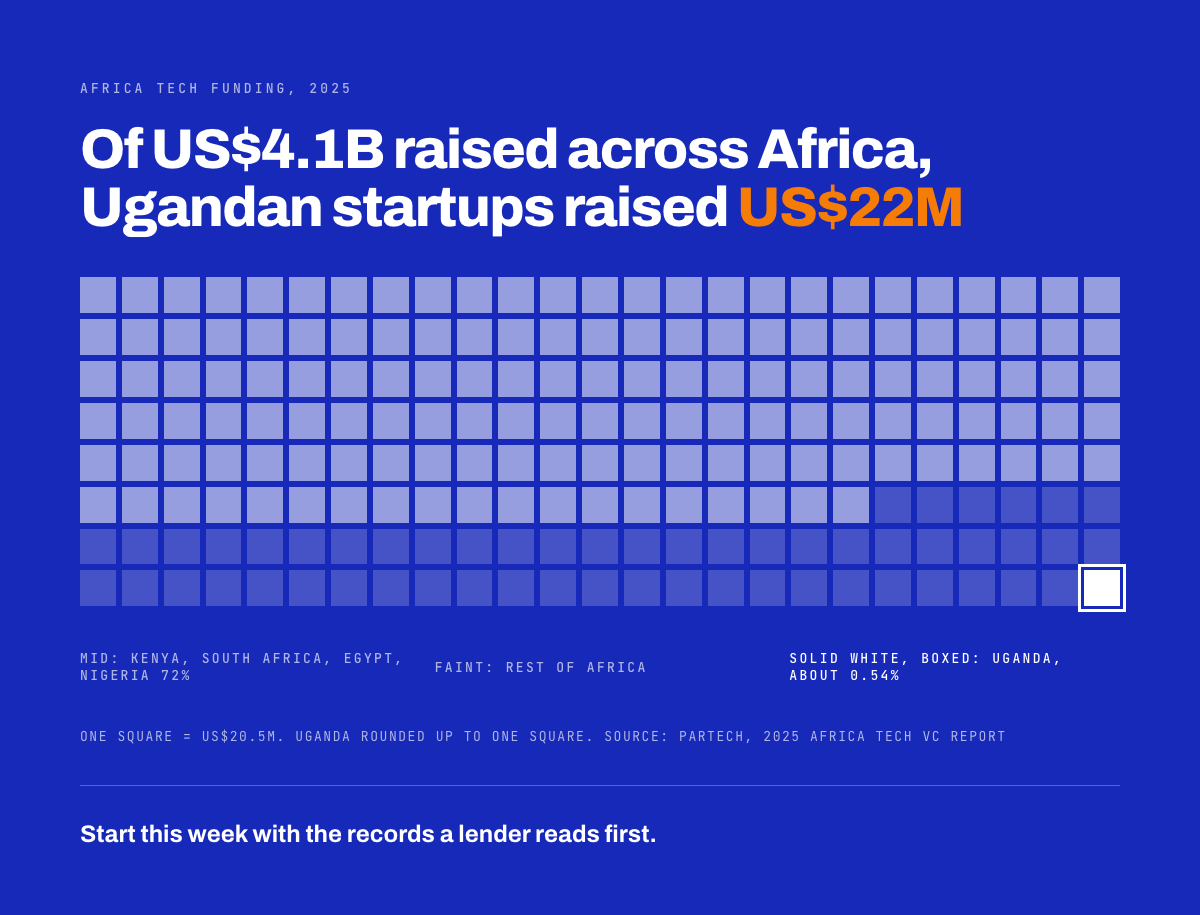
In 2025, African tech startups raised US$4.1B in equity and debt, by Partech’s annual count, and Ugandan startups raised US$22M of it. That is about half of one percent of the continent’s total. This piece puts the numbers behind readiness in one place, sets out three convictions we hold about capital at AVODA, and includes the evidence that cuts against what we teach.
Key Takeaways
- Kenya, South Africa, Egypt and Nigeria took 72% of 2025 startup funding in Africa, and seed funding fell for a third straight year, to US$462M.
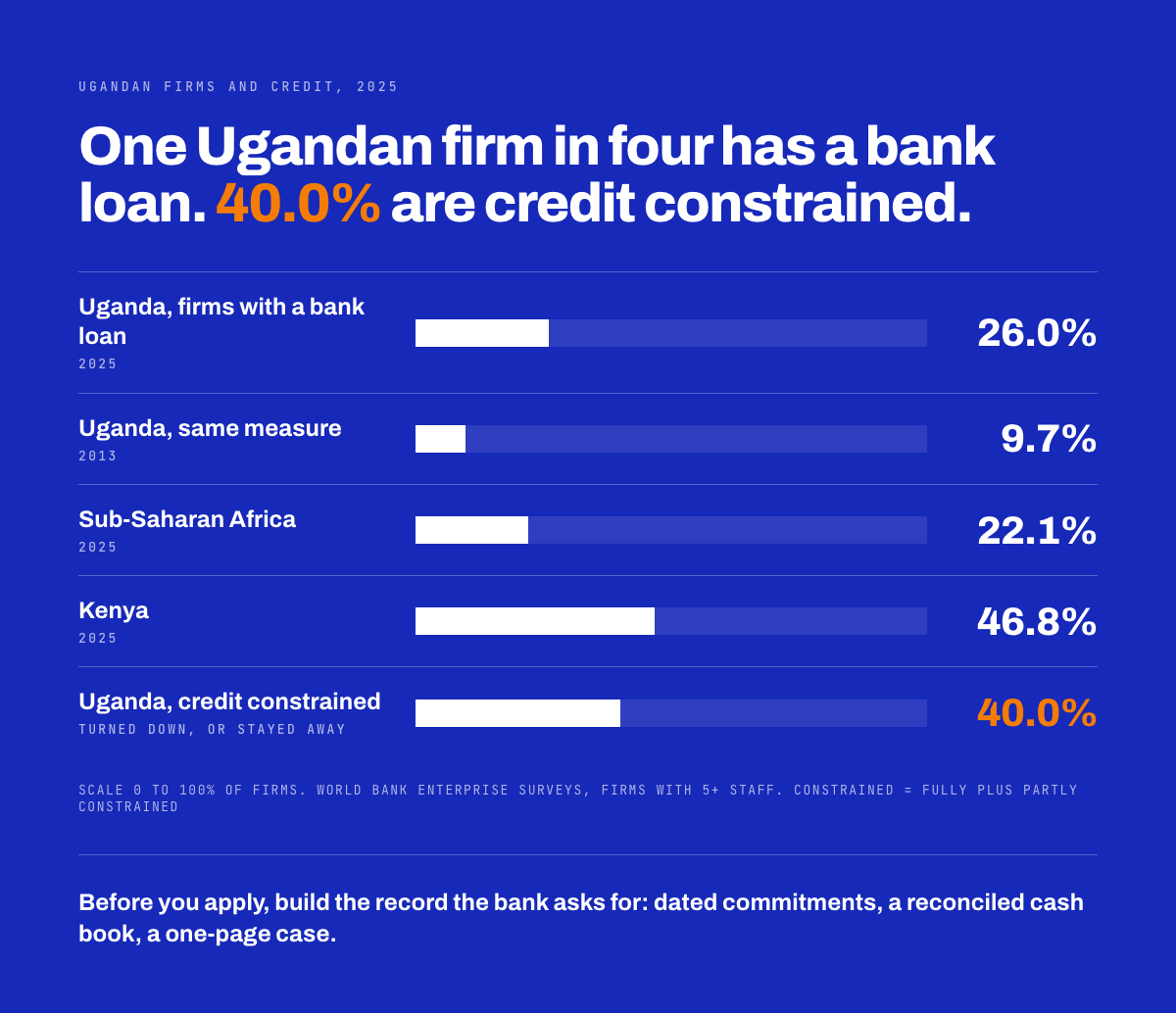
- In the World Bank’s 2025 survey, 26.0% of Ugandan firms had a bank loan or line of credit, up from 9.7% in 2013, and 40.0% were credit constrained.
- An impact investor that receives about a thousand proposals a year reports that over 75% are far from ready for investment.
- In the best randomized test, readiness training raised readiness scores and moved deals by 5 percentage points, too little to call, with a 15 point gain for smaller firms.
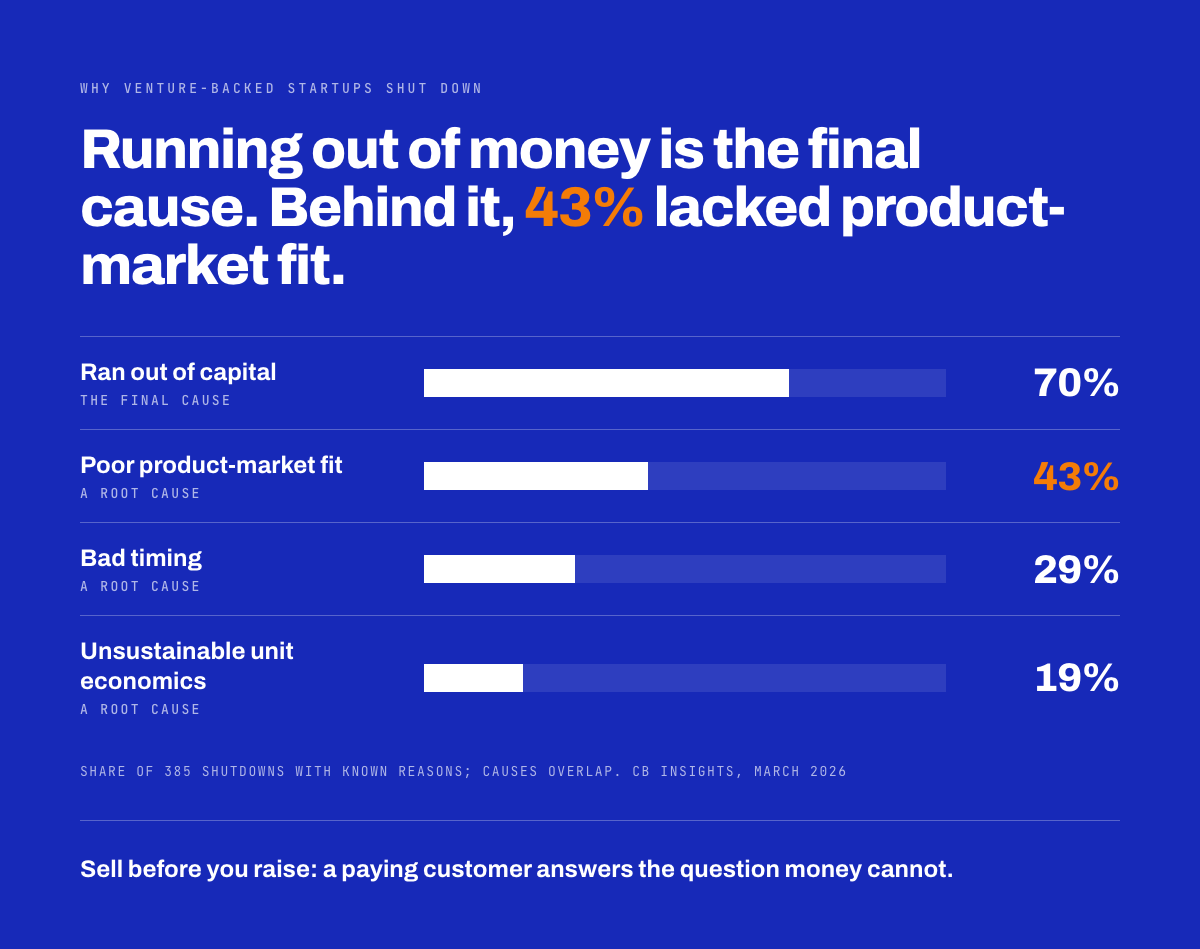
- CB Insights found that running out of capital is usually the final cause of a startup’s death; poor product-market fit sat underneath in 43% of 385 shutdowns.
- In a survey of 885 venture capitalists, 47% named the team as the most important factor, and only 10% of deals came in cold from founders.
- Time and judgment, two of the three records a lender reads, cost a founder almost nothing to start.
The capital that reached Africa in 2025
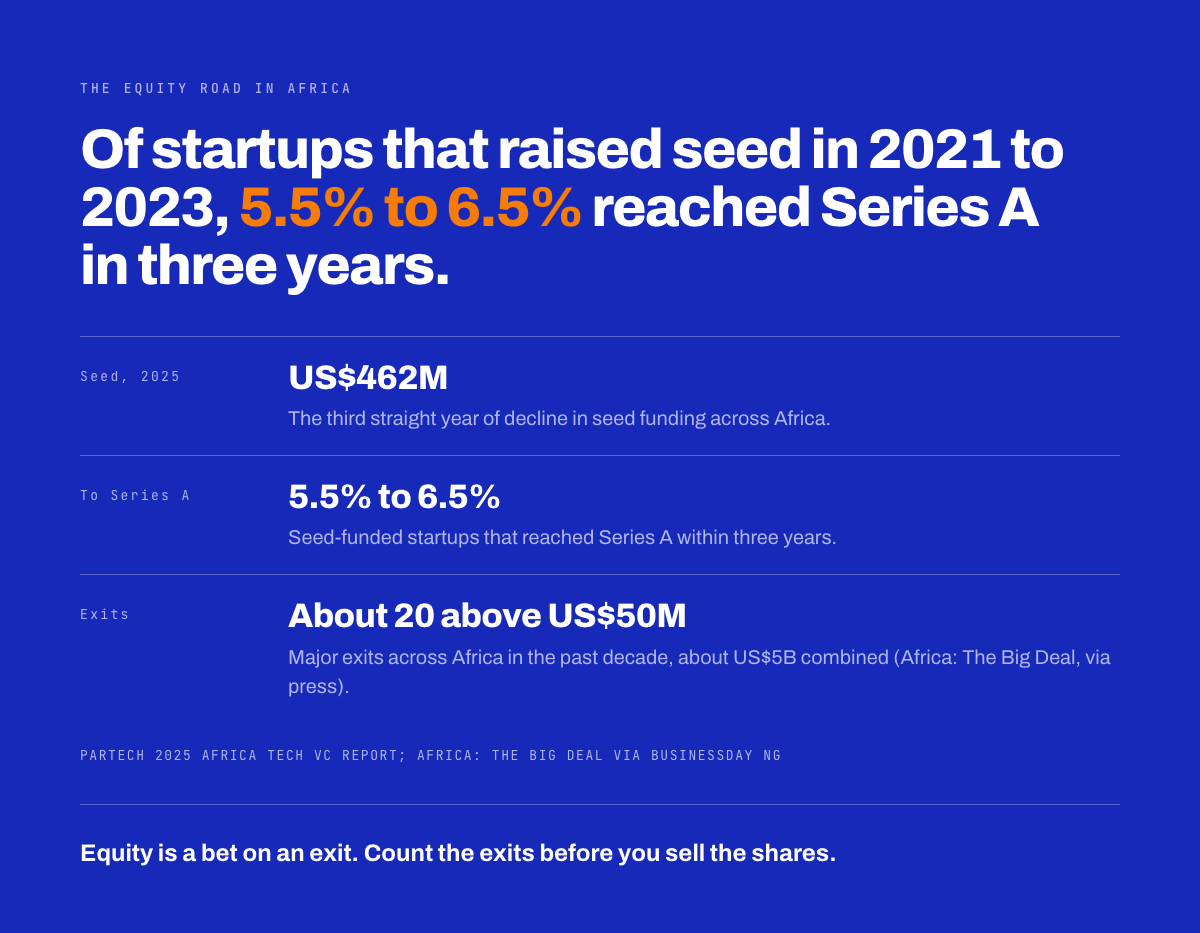
Partech counted US$4.1B raised by African tech startups in 2025, with debt at a record US$1.64B. Kenya, South Africa, Egypt and Nigeria accounted for 72% of the total. Seed funding, the round most of our founders are raising, came to US$462M, its third straight year of decline. Of the startups that raised a seed round between 2021 and 2023, only 5.5% to 6.5% reached a Series A within three years.
| Measure | Figure | Source and year |
|---|---|---|
| Startup funding, Africa | US$4.1B | Partech, 2025 |
| Raised by Ugandan startups | US$22M, about 0.54% | Partech, 2025 |
| Share to the Big Four | 72% | Partech, 2025 |
| Ugandan firms with a bank loan | 26.0% (9.7% in 2013) | World Bank Enterprise Surveys, 2025 |
| Ugandan firms credit constrained | 40.0% | World Bank Enterprise Surveys, 2025 |
| Loan value approved, all borrowers | 63.2% | Ministry of Finance, June 2026 |
The 0.54% and the 40.0% are our arithmetic on the sources’ own figures. The 40.0% adds the survey’s 6.0% of firms fully constrained to its 34.0% partly constrained.
What lenders ask for
The picture at home is better than the venture numbers suggest. Bank lending to Ugandan firms with five or more employees has nearly tripled as a share of firms since 2013, and Uganda now sits above the Sub-Saharan average of 22.1%, though behind Kenya at 46.8%. In June 2026, lenders approved 63.2% of the value of loan applications, by the Ministry of Finance’s count, which covers every kind of borrower.
The older survey shows what lenders ask for. In 2013, 86.7% of loans to Ugandan firms needed collateral, and that collateral averaged 161.8% of the loan. Firms paid for 80.3% of their investment from their own funds. The 2025 release has yet to publish those measures, so read them as the shape of the problem.
The firms themselves describe the same constraint from the inside. In the 2013 survey, 42% of Ugandan firms said they did not need a loan, and 9.2% of firms had their most recent application rejected. A founder who keeps records is better placed on both counts: she knows whether she needs the money, and she can show a lender why.
Bank of Uganda’s Agricultural Credit Facility had disbursed 59.5% of the applications it received by the end of 2025, a count that includes applications still in review. Its progress report lists “limited financial literacy and record-keeping” among the challenges borrowers face. I&P, which invests in African small businesses, wrote in 2018 that over 75% of the roughly thousand proposals it receives each year “are far from ready for investment.”
Customers before capital
Our first conviction is that the best evidence a business will work is a customer who pays for it. CB Insights studied 385 venture-backed startups that shut down since 2023 and whose reasons could be identified. “Ran out of capital” appeared in 70% of them, and the analysts call it “almost always the final cause of death, not the root problem.” Poor product-market fit sat underneath in 43% of cases. These companies had raised money.
Most businesses grow on their own money anyway. In the World Bank’s 2013 survey of Ugandan firms, 80.3% of investment came from the firm’s own funds and banks financed 3.1%. Uganda’s GEM survey of 2012 found a business discontinuation rate of 26%, and a third of those who closed said the business was unprofitable. In our own MVP module this month, founders logged 69 customer conversations by the fourth evening, and 14 had ended in a payment.
If you must raise, investors buy the founder and the record
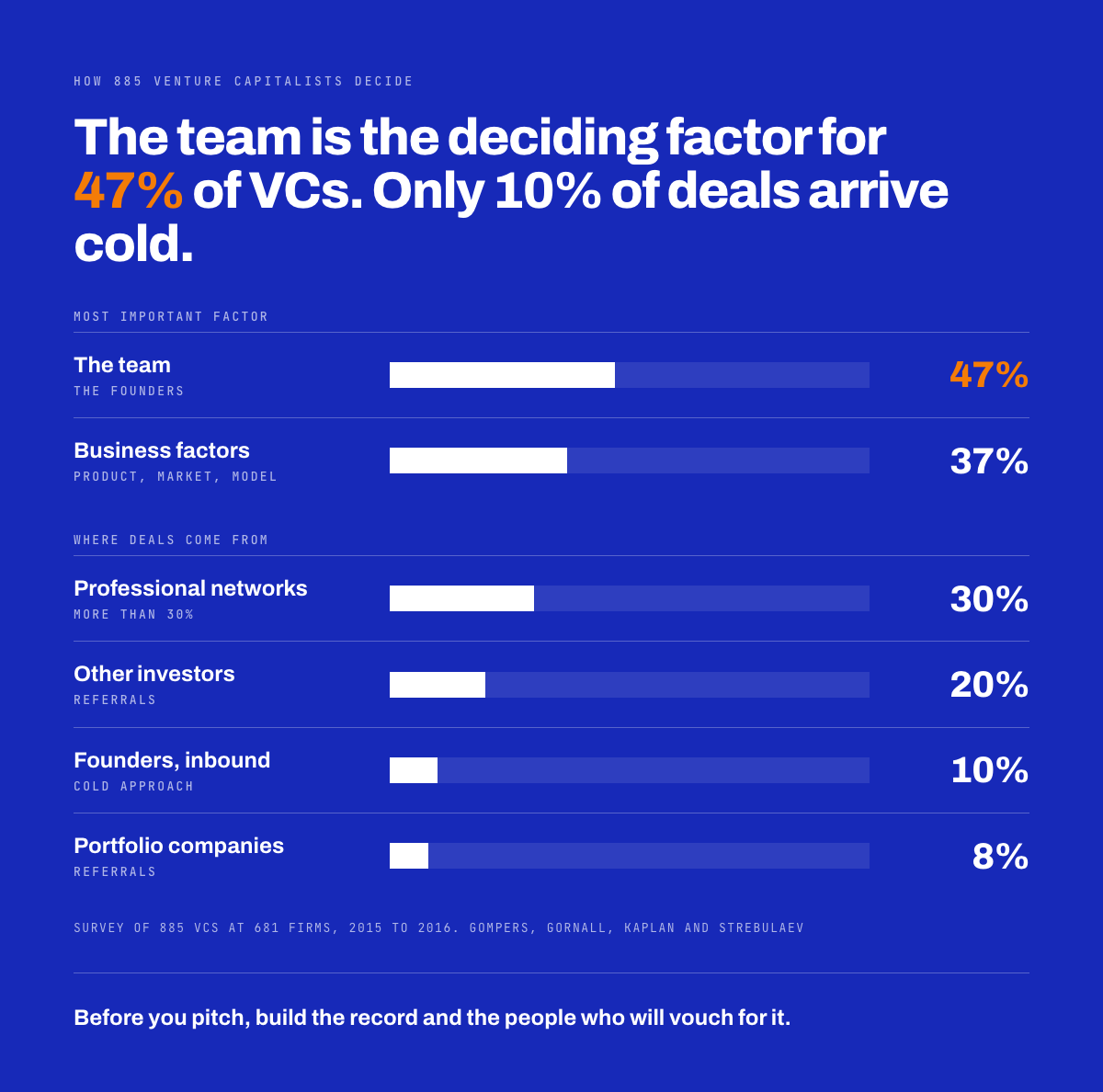
When a business does need outside money, the idea matters less than most founders expect. In a survey of 885 venture capitalists at 681 firms, 47% named the management team as the most important factor and 37% named business factors. Over 30% of deals came through professional networks and only 10% came inbound from founders. That survey is American, and Africa-focused investors report the same order. In a VC4A survey of 111 Africa-focused investors, “the quality of the management team was identified as the most important factor for financiers when deciding in which companies to invest.” An investor who cannot verify a founder’s record leans on people who can vouch for her. AVICS exists to give founders a dated, structured record that an institution stands behind.
The second thing a funder reads is traction, and two numbers carry most of it: customer numbers and purchase volume. Partech describes the startups now raising debt as those with “operational maturity, cash flow visibility and governance.” Village Capital’s VIRAL pathway marks progress by sales and repeat customers.
Why we lean toward debt
For most African founders who need outside money, we believe well-priced debt fits better than equity. Equity is paid at an exit, and Africa: The Big Deal counts about 20 exits above $50 million across the continent in a decade, as BusinessDay reported. Of the startups that raised seed between 2021 and 2023, 5.5% to 6.5% reached a Series A within three years.
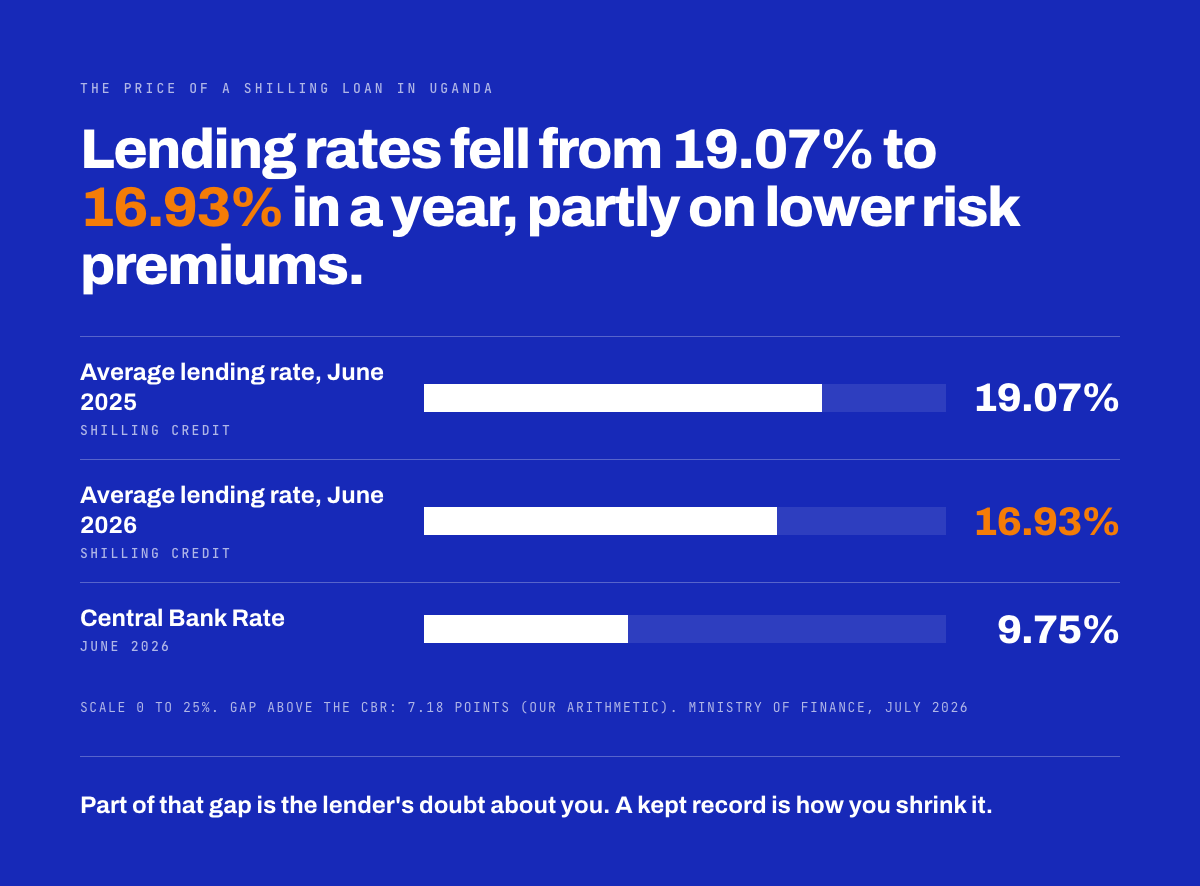
Part of the price of debt is the lender’s doubt. Uganda’s average shilling lending rate was 16.93% in June 2026 and 17.32% in July, down from 19.65% a year earlier, against a Central Bank Rate of 9.75%. Across 63 countries, the arrival of a credit bureau was associated with a 7 percentage point rise in access to credit and a 5 point fall in interest rates. In Peru, a psychometric score used alongside a bank’s own checks screened out borrowers who were 8.6 percentage points more likely to fall more than 90 days behind. AVICS is built to lower the cost of debt in the same way, and it has yet to be tested against repayment, so we will publish that test before we claim it works.
The case has limits. Partech found that dollar debt against local-currency revenue led to “a substantial increase in the number of defaults,” and venture-backed firms in the United States were less likely to fail in their first five years. So borrow in the currency you earn, match repayments to your cash cycle, size the loan to sales you have proven, and keep equity for businesses that need years of building before a customer can pay.
What readiness training changes
The cleanest test of readiness training on its own is a randomized trial in the Western Balkans by Ana Paula Cusolito, Ernest Dautovic and David McKenzie. A sample of 346 small firms was split at random. The program raised investment-readiness scores by 0.3 standard deviations. Two years later, treated firms were 5 percentage points more likely to have done a deal with an outside investor, against 24.4% of the control group, a gap too small to be statistically significant. For smaller firms the effect was 15 percentage points, and it held. The program cost about US$4,000 per firm.
Nigeria’s YouWiN competition drew 729 winners at random from 1,841 semi-finalists. Grant winners were 37 percentage points more likely to still be running a business, while the business-plan training on its own showed no significant effect on starting a business or on jobs. In Start-Up Chile, founders who went through the program’s entrepreneurship schooling were 21.0% more likely to raise further financing.
We take two things from this. Readiness work moves a founder up the queue and makes money usable once it arrives. The money itself still has to exist, and for some businesses capital is the binding constraint, where another month of preparation only costs sales. A readiness score that never tells anyone a founder is ready now has become a holding pen, and we hold AVICS to that standard.
What our own records show
AVICS scores founders on three records a careful lender tries to rebuild: time, money and judgment. Across 99 AVICS alumni records, drop-out ran at 15% for founders with registered businesses, 25% for informal businesses and 45% for founders yet to start one, from our own completion records. Finishing a program is a different outcome from repaying a loan, so we read the split as a hint. Our score has yet to be tested against what borrowers later repay, and we will publish that test when we have run it.
The Three-Ledger Readiness Test

The time ledger is a list of what you committed to and when, with each date marked met or missed. A loan schedule is a long list of appointments with money attached, and your list is the lender’s forecast.
The money ledger is a cash book you reconcile every Friday against your bank and mobile money statements. Small, steady, reconciled numbers carry more weight than a large figure that appears once in a pitch deck, which is the logic behind the five-number dashboard.
The judgment ledger is one written page explaining how the money you want will earn more than it costs, with the margin and the date it pays back.
A lender’s logic is sound as far as it goes: behavior recorded over time is the best forecast of behavior to come. The evidence above shows where it runs out, because readiness scores rose in the trial and the money only partly followed, and a record kept for an audience tends to lapse once the audience looks away. The parable of the talents in Matthew 25 opens with a master who hands out money to each servant according to his ability, a readiness judgment made before a single coin moves, and it closes by setting over much those who were faithful over a little. That gives a founder a reason to keep the Friday cash book when nobody is checking, and a ledger kept that way is the record a lender was trying to predict.
Frequently Asked Questions
How much startup funding reached Uganda in 2025?
Partech counted US$22M raised by Ugandan startups in 2025, US$21M in equity and US$1M in debt, out of US$4.1B for Africa as a whole.
What share of Ugandan firms have a bank loan?
In the World Bank’s 2025 Enterprise Survey, 26.0% of Ugandan firms with five or more employees had a bank loan or line of credit, against 9.7% in 2013.
Does investment-readiness training lead to funding?
It raises readiness, and its effect on deals is smaller and less certain. In the best randomized trial, deals rose 5 percentage points, too little to call, with a 15 point gain for smaller firms.
Is debt or equity better for an African startup?
For most early founders we believe well-priced debt is the better fit, because equity is paid at an exit and exits are rare. Borrow in the currency you earn and size the loan to sales you have proven.
What can a founder do this week without money?
Open a dated commitments list and write one page on how a loan would pay back. Those are the time and judgment ledgers, and both start with a notebook.
Next Step
Find out which of the three ledgers is weakest in your business with our 8-minute Business Capability Assessment. If you are weighing a raise or a loan in the next 90 days, book a strategy call for a second read on your numbers.
Related Reading
- Should Christians Borrow for Business?
- AI for SACCOs: credit decisions a lender can defend
- The five-number dashboard for a small firm
- The missing middle as a management problem
Sources and Evidence
- Partech, 2025 Africa Tech Venture Capital Report: 2025 totals, debt, the Big Four share, Uganda, seed and Series A conversion.
- World Bank Enterprise Surveys, firms with a bank loan or line of credit: Uganda 2025 and 2013, Sub-Saharan Africa and Kenya; credit-constrained and 2013 collateral measures from the same survey.
- Ministry of Finance, Planning and Economic Development, Performance of the Economy, July 2026: June 2026 loan approvals.
- Bank of Uganda, Agricultural Credit Facility Progress Report to 31 December 2025: disbursement share and borrower challenges.
- I&P, Fifteen Lessons (2018): proposals far from ready.
- Cusolito, Dautovic and McKenzie, Can government intervention make firms more investment-ready? (ECB Working Paper 2391): the randomized readiness trial.
- McKenzie, Identifying and Spurring High-Growth Entrepreneurship (YouWiN): grants and business-plan training in Nigeria.
- Gonzalez-Uribe and Leatherbee, The Effects of Business Accelerators on Venture Performance: Evidence from Start-Up Chile: entrepreneurship schooling and follow-on financing.
- CB Insights, The top 9 reasons startups fail (March 2026): shutdown causes.
- Gompers, Gornall, Kaplan and Strebulaev, How Do Venture Capitalists Make Decisions? (NBER Working Paper 22587): what VCs weigh and where deals come from.
- Ministry of Finance, Planning and Economic Development, Performance of the Economy, August 2026: July 2026 lending rates and the Central Bank Rate.
- World Bank, credit information sharing reforms and firm financing: credit bureau effects across 63 countries.
- VC4A annual investor survey, as reported by Business Daily Africa: what Africa-focused investors weigh.