
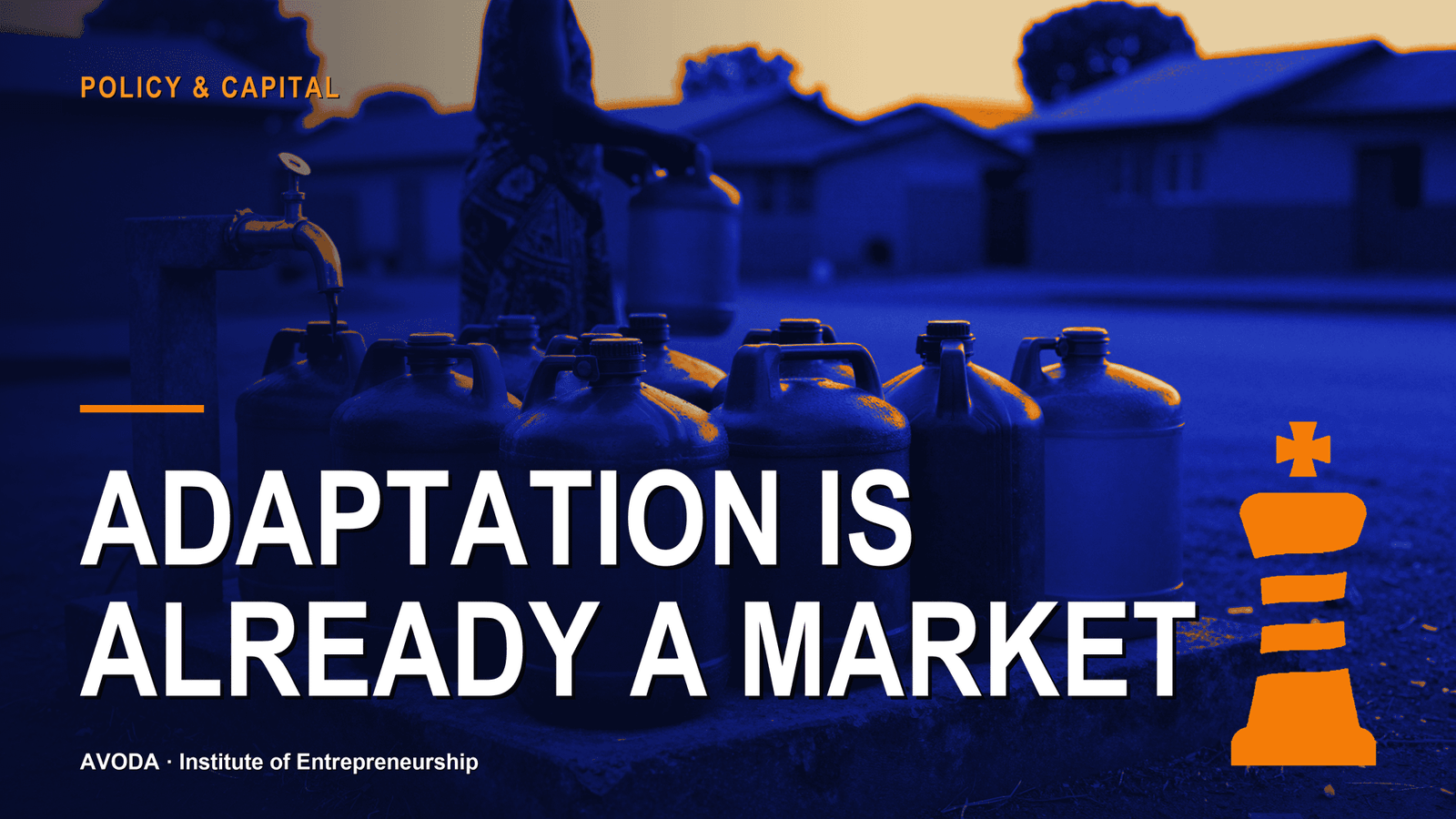
Mitigation got markets. Adaptation got committees. A tonne of avoided carbon became a tradeable instrument with buyers, brokers, price discovery and a verification industry, while adaptation, the work of surviving a climate that has already changed, remained a line in a donor budget and a recurring disappointment at the annual conference. The usual explanation is that mitigation produces a countable global good and adaptation produces a local one, which is true and insufficient. The deeper reason is an accounting habit: adaptation’s benefit is an avoided loss, and nobody issues an invoice for a loss that did not happen. So the spending gets classified as cost, the sector gets classified as charity, and everyone waits for a pledge. Walk through Kampala during a bad week and the habit looks absurd. Households are buying water because the tap failed. Traders are replacing stock spoiled by heat. Farmers are switching varieties, paying for boreholes, and eating losses from a season that came late. Landlords are repairing after floods that arrive more often than they used to. That is adaptation, it is being paid for in cash today, and almost none of it appears in the adaptation finance conversation because it is filed as ordinary household and business consumption. The market is not absent. It is unlabelled, and therefore uninvested.
Key Takeaways
- Adaptation’s financing problem is partly a classification problem. Avoided loss generates no invoice, so real spending gets recorded as consumption and the sector reads as a cost centre.
- The coping spend is already large and already private. Water purchase, heat losses, crop substitution, repeated repair, and stock spoilage are adaptation payments made in cash, every season, by people nobody counts as customers.
- A business converts avoided loss into revenue by substituting for spending that is already happening, which is far easier than persuading someone to buy protection they have never priced.
- Risk transfer is the second conversion, and it is why thin insurance markets matter more to adaptation than another grant facility does.
- The Adaptation Invoice names the four ways the bill actually gets paid. A venture that fits none of them is a programme, and should be funded and judged as one.
Why did mitigation get a market and adaptation get a committee?
Because mitigation produced a unit and adaptation produced a story. A tonne of carbon dioxide is fungible, countable, and equivalent wherever it is avoided, which is exactly what a tradeable instrument requires, and once the unit existed the machinery followed: registries, verifiers, brokers, and eventually carbon documentation appearing as an asset on a Kenyan firm’s balance sheet. Adaptation has no such unit. A drought-resistant seed variety in Karamoja and a raised warehouse floor in Jinja both reduce climate loss, and no accounting standard makes them comparable. That absence pushed adaptation towards the only funder comfortable with incomparable local goods, which is aid, and aid brought its logic with it: proposals, cycles, reporting, and the quiet assumption that the beneficiary is a recipient rather than a customer. The consequence is visible in who builds. Mitigation attracted founders because there was a buyer at the end. Adaptation attracted implementers because there was a grant at the end, and implementers optimise for the next disbursement rather than the next sale, which is a rational response to how the money arrives and not a criticism of anyone in the field. The interesting development is that the unit problem is eroding from an unexpected direction. Insurers, lenders, and exporters have begun pricing climate exposure on their own books because their own losses forced them to, and a priced exposure is halfway to a tradeable one. When a lender charges differently for a flood-exposed borrower, adaptation acquires a number, and numbers attract capital in a way that narratives never have.
Where is the money already being spent?
On coping, which is adaptation bought retail and at the worst possible price. The household that buys water by the jerrycan when the supply fails is paying a premium per litre that no piped connection would ever charge, and it pays it repeatedly, in small amounts, which is precisely the pattern that hides spending from anyone measuring markets. The trader whose produce spoils in unusual heat is paying for the absence of cold chain, in inventory rather than in invoices. The farmer who replants after a failed rain is paying for the absence of forecasting and resilient inputs, in a lost season rather than a subscription. The manufacturer running a generator through longer outages is paying for grid fragility that weather is worsening, in fuel. Add these together across a district and the figure is substantial, continuous, and entirely private, and it is the single most under-examined number in African climate finance. It matters because it reframes the sales problem completely. A venture selling adaptation is usually told it must persuade poor customers to buy insurance against a future they discount, which is genuinely hard. A venture selling a substitute for coping spend is doing something much easier: offering the same household a cheaper way to solve a problem it is already paying to solve this month. Water storage against jerrycan purchase. Cold chain against spoilage. Resilient seed against replanting cost. Repair-resistant construction against annual repair. The willingness to pay does not need to be created. It needs to be redirected, and redirection is the most reliable business in any market.
What is the Adaptation Invoice?
The named framework of this essay: the four ways an avoided loss turns into a bill somebody actually pays. Every durable adaptation business runs on at least one, and the ones that run on none are programmes wearing a pitch deck.
- Substitution. The customer is already spending on coping and you offer a cheaper solution to the same problem. This is the strongest position because the budget exists and the pain is current, not projected.
- Risk transfer. An insurer or lender carries the loss and pays to reduce or price it. This converts a household’s un-payable future risk into an institution’s present, priceable one, and it depends on measurement, which is why satellite-derived indices have quietly become adaptation infrastructure.
- Obligation. A regulation, a buyer requirement, or a lender covenant compels spending. Carbon border rules and supply-chain due diligence are already doing this to exporters, and obligation is the fastest demand engine in any category because it removes the decision entirely.
- Asset protection. Somebody owns something expensive that climate threatens: a warehouse, a plantation, a road, a portfolio. Owners of large exposed assets pay to protect them without needing to be convinced adaptation is a category, and their spending is the most reliable in the sector.
The verdict this framework usually produces: substitution businesses are underbuilt relative to their opportunity, obligation businesses are the fastest growing, risk transfer is the biggest long-term pool but depends on measurement maturing, and asset protection is where the money already is but the customers are few and institutional.
What should founders, financiers, and district governments do?
Sell the substitute, price the exposure, and count the coping. Founders should look hardest at the substitution quadrant, because it is where demand exists today without anyone having to be educated about climate at all, and the pitch is commercial rather than moral: this costs less than what you are already spending. That framing also survives contact with a customer who is sceptical of climate language, which many are, and it keeps the business honest, since a substitute that is not actually cheaper will fail quickly and visibly. Financiers should notice that adaptation’s unit problem is being solved from the risk side rather than the standards side, and that the institutions building climate pricing into lending and underwriting are creating the measurement layer the sector has waited a decade for a committee to produce. That is where a capital allocator can move first, and it connects adaptation to insurance market development more usefully than to another facility. District governments hold the most neglected lever, which is measurement of the coping spend itself: a district that counts what its residents and businesses already pay for water, spoilage, outage, and repair converts an invisible burden into a documented market, and a documented market attracts private investment in a way that a vulnerability assessment never will. That is local economic development work with a climate lens rather than climate work with a development budget, and the difference is not semantic. Adaptation will stop being a grant category the day somebody produces the invoice. The spending is already happening. What is missing is the accounting that lets it be seen, and therefore financed, as the market it has been all along.
FAQ
Why does adaptation get less finance than mitigation?
Mitigation has a fungible unit, the tonne of carbon, which made trading possible. Adaptation’s benefit is a locally specific avoided loss with no comparable unit, so it defaulted to aid financing.
What is coping spend?
The money households and firms already pay because of climate stress: buying water when supply fails, replacing spoiled stock, replanting after failed rains, running generators through longer outages, repeated repair after floods.
What is the easiest adaptation business model?
Substitution. Offer a cheaper solution to a problem the customer is already paying to solve. The budget and the urgency both already exist, so nothing has to be created.
Do customers need to believe in climate change to buy?
No, and designing as if they must is a common mistake. A substitution pitch is about cost this month. The climate framing matters to funders and regulators, not usually to the buyer.
What unlocks the large pools of capital?
Measurement. Once exposure is priced on lender and insurer books, adaptation acquires numbers, and numbers move capital in a way narratives have not.
Related Reading
- Carbon Credits as an SME Asset in Kenya
- Insurance as a Greenfield Market in East Africa
- Satellite Data as an Agricultural Input
- CBAM and the Carbon Border in East Africa
Sources and Evidence
- UNEP Adaptation Gap Report: the recurring estimate of adaptation finance against need.
- Global Center on Adaptation: programme and investment evidence on African adaptation.
- World Bank climate and development country reports: country-level exposure and adaptation cost analysis.
- Climate Policy Initiative landscape of climate finance: tracking of adaptation versus mitigation flows and their sources.