
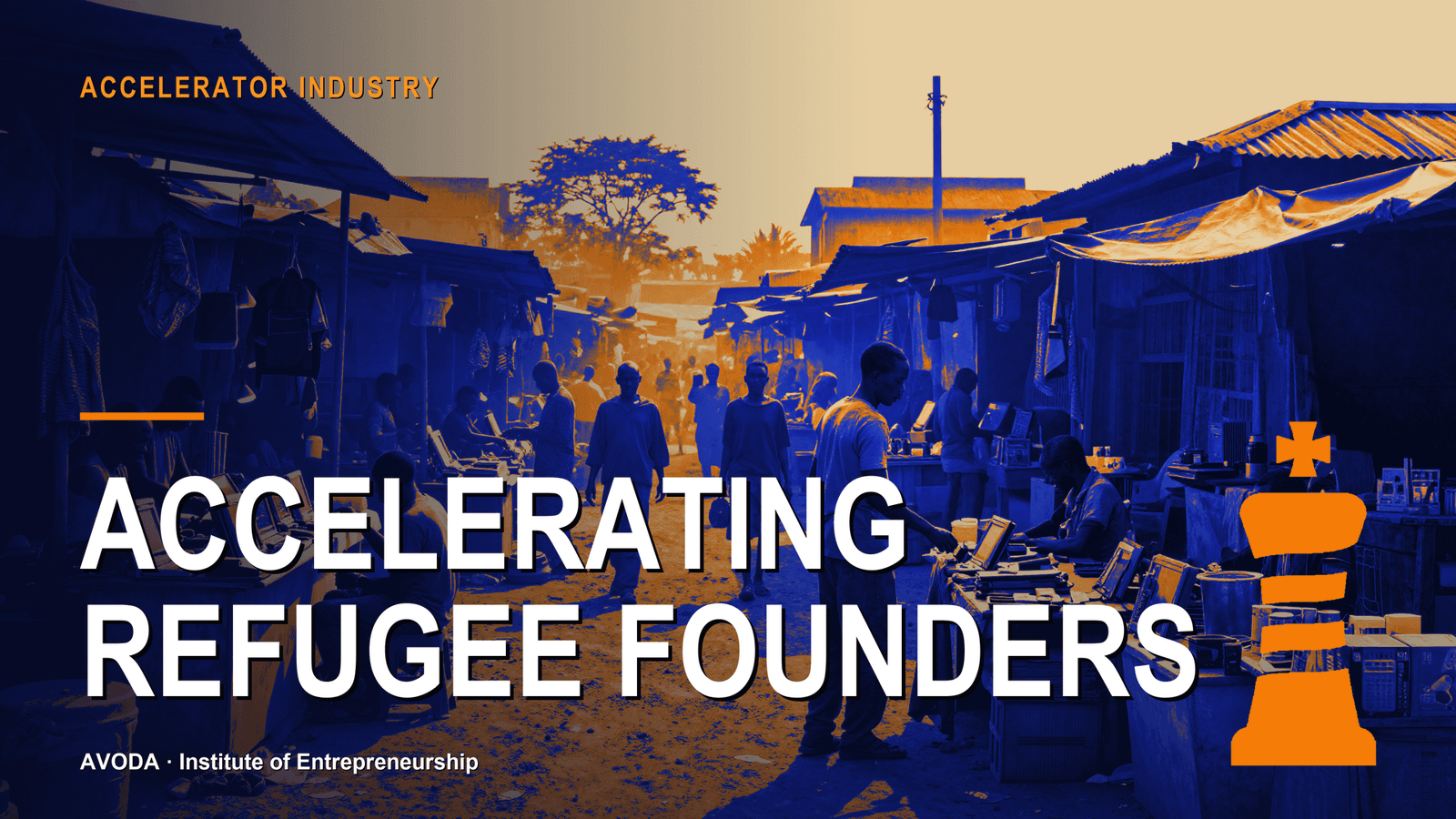
Uganda hosts one of the largest refugee populations on earth, well over a million people, and does so under a policy architecture humanitarian agencies cite as a global model: refugees receive land plots, the right to work, freedom of movement, and the right to start businesses. The result, visible in Nakivale, Bidi Bidi, Kyaka, and the Kampala neighborhoods where displaced Congolese, South Sudanese, Somali, and Eritrean communities trade, is not the dependency tableau of the fundraising brochure but a dense, constrained enterprise economy: restaurants, tailoring, electronics repair, cross-border trade running on diaspora rails, and wholesale networks linking settlement markets to Kampala’s. Studies of Kakuma across the border and of Uganda’s settlements document the same finding: refugee economies are real markets with real entrepreneurs, trading with host communities at scale. What they lack is what the missing middle always lacks, capital, documentation, market access, plus a displacement-specific layer: legal ambiguity in practice, ID-linked financial exclusion, and program designs built for stable populations. Acceleration can serve this population. It cannot serve it unmodified.
Key Takeaways
- Uganda’s self-reliance policy makes it the world’s most important test of refugee enterprise: work rights and business rights exist on paper and function imperfectly in practice.
- Settlement economies are genuine markets: research documents substantial refugee-host trade, real firm formation, and entrepreneurs whose constraint profile is bankability, not capability.
- The displacement-specific constraints are nameable: ID and KYC exclusion, collateral impossibility, planning horizons distorted by resettlement hopes, and network severance from home-market trust structures.
- The Displacement-Adjusted framework modifies four program components: documentation pathways, instruments without collateral or credit history, host-refugee integrated cohorts, and portability of everything.
- The theological framing is not decoration here: the stranger’s economic inclusion is among scripture’s most repeated commands, and the region’s faith networks are already the deepest institutions inside the settlements.
What do the settlement economies actually look like?
Markets, with the receipts to prove it. The research corpus on Kakuma, the IFC’s market study famously sized its economy in the tens of millions of dollars, and on Uganda’s settlements documents thousands of enterprises, active refugee-host trade in both directions, and price-integrated markets rather than sealed camps. The entrepreneur profiles repeat across studies: traders leveraging cross-border community networks, Congolese textile and Somali wholesale specialists whose diasporic supply chains are genuine competitive advantages, service providers serving both populations, and agricultural producers on allocated plots feeding settlement markets. The capability level routinely surprises program designers who arrive with livelihoods-training assumptions: many displaced founders ran businesses at home, some substantial, and their constraint is not knowing how to trade but being invisible to every formal system, banks that cannot KYC a refugee ID, lenders with no collateral pathway, tender systems that require documents displacement destroyed, and programs that treat them as beneficiaries rather than the market’s existing operators.
What breaks when standard acceleration meets displacement?
Four assumptions, each fixable once named. Documentation: standard programs assume registrable firms and bankable founders; refugee IDs face inconsistent recognition at banks and registries despite formal rights, so the program must build the pathway, partnered banks with agreed KYC interpretations, mobile-money onramps, cooperative structures where individual registration stalls, as part of the offer, not a referral. Capital: collateral is doubly impossible, no land, no credit file, so instruments must underwrite on cash flow and community standing, group-liability structures, inventory finance, and revenue-share designs that price actual settlement trading rather than paper histories. Horizon: resettlement hopes and return possibilities distort investment horizons rationally; programs answer with portability, businesses, records, and skills designed to travel, digital rails, documented reputations, transferable certifications, rather than fixed-asset strategies displacement can strand. And cohort design: refugee-only programs reproduce the side-room error; the trade already crosses communities, so the cohort should too, host and refugee founders in one room, which builds the peer trust commerce needs and quietly does more social-cohesion work than any workshop titled social cohesion.
What is the Displacement-Adjusted framework?
The named framework of this essay: four component modifications that convert a standard program into one this population can actually use.
- Documentation as a program deliverable. Mapped legal pathways, partnered institutions with agreed ID interpretations, and cooperative or aggregator structures where individual formalization stalls. The origin-file logic: the paperwork is the product here too.
- Instruments without history. Cash-flow and community-standing underwriting: group liability, supplier credit, inventory finance, revenue shares, sized to settlement economics and dignity-priced in collection.
- Integrated cohorts, brokered markets. Host-refugee rooms by default, with buyer brokerage into Kampala wholesale, institutional procurement, including the humanitarian agencies’ own supply chains, the largest under-tapped buyer inside every settlement, and diaspora trade corridors.
- Portability of everything. Digital records, mobile-first operations, credentials and reputation artifacts that survive relocation, so resettlement or return converts the business rather than destroying it.
The framework’s premise is respect: these are operators in a hard market, not trainees in a queue, and the program’s job is removing the displacement-specific walls between their capability and the market that already trades with them.
Why should faith-driven builders be first in line?
Because the mandate is explicit and the infrastructure is already theirs. Scripture’s economics of the stranger is not a footnote, the ger’s gleaning rights, the repeated “you were foreigners in Egypt,” the judgment scene’s “I was a stranger”, and the region’s churches and mosques are the densest functioning institutions inside the settlements: congregations that span host and refugee communities, trust networks that commerce already runs on, and moral standing to convene integrated rooms no NGO can convene. A faith-based accelerator serving displacement contexts holds every advantage this corpus has catalogued, service-motivated faculty, covenant community mechanics, patient capital constituencies, plus the one that matters most here: a theology that reads the refugee founder not as a beneficiary or a security question but as Bezalel in exile, capability bearing the image, waiting for the walls to move. Uganda’s policy opened the legal door further than anywhere on earth. The programs that walk founders through it, documented, capitalized, integrated, and portable, are doing development, security, and discipleship in a single design.
FAQ
Can refugees legally run businesses in Uganda?
Yes: Uganda’s policy grants work rights, movement, land plots, and business rights, the world’s most progressive framework. Practice lags paper at banks and registries, which is exactly where programs must build pathways.
Are settlement economies real markets?
Demonstrably: studies of Kakuma and Uganda’s settlements document thousands of enterprises, tens of millions in economic activity, and substantial refugee-host trade in both directions.
What breaks standard program design?
Four assumptions: registrable documentation, collateral-based capital, stable planning horizons, and single-community cohorts. Each has a displacement-adjusted replacement.
What is the Displacement-Adjusted framework?
Documentation delivered as a program component, history-free capital instruments, integrated host-refugee cohorts with brokered market access, and portability of records, operations, and credentials.
Why integrated rather than refugee-only cohorts?
Because the trade already crosses communities and separate tracks reproduce the side-room error. Integrated rooms build the peer trust commerce needs and do genuine cohesion work as a byproduct.
Related Reading
- Theology of Work for the Informal Economy
- Agent Networks, Trust, and Scale
- Women-Only Cohorts: What the Outcome Data Shows
- The Church as an Economic Institution in Africa
Sources and Evidence
- IFC: Kakuma as a Marketplace: the market study sizing refugee settlement economies.
- Refugee Studies Centre, Oxford: Refugee Economies: research on refugee-host trade in Uganda and Kenya.
- UNHCR Uganda: the self-reliance policy framework and settlement data.
- World Bank: forced displacement and development: evidence on economic inclusion of displaced populations.