
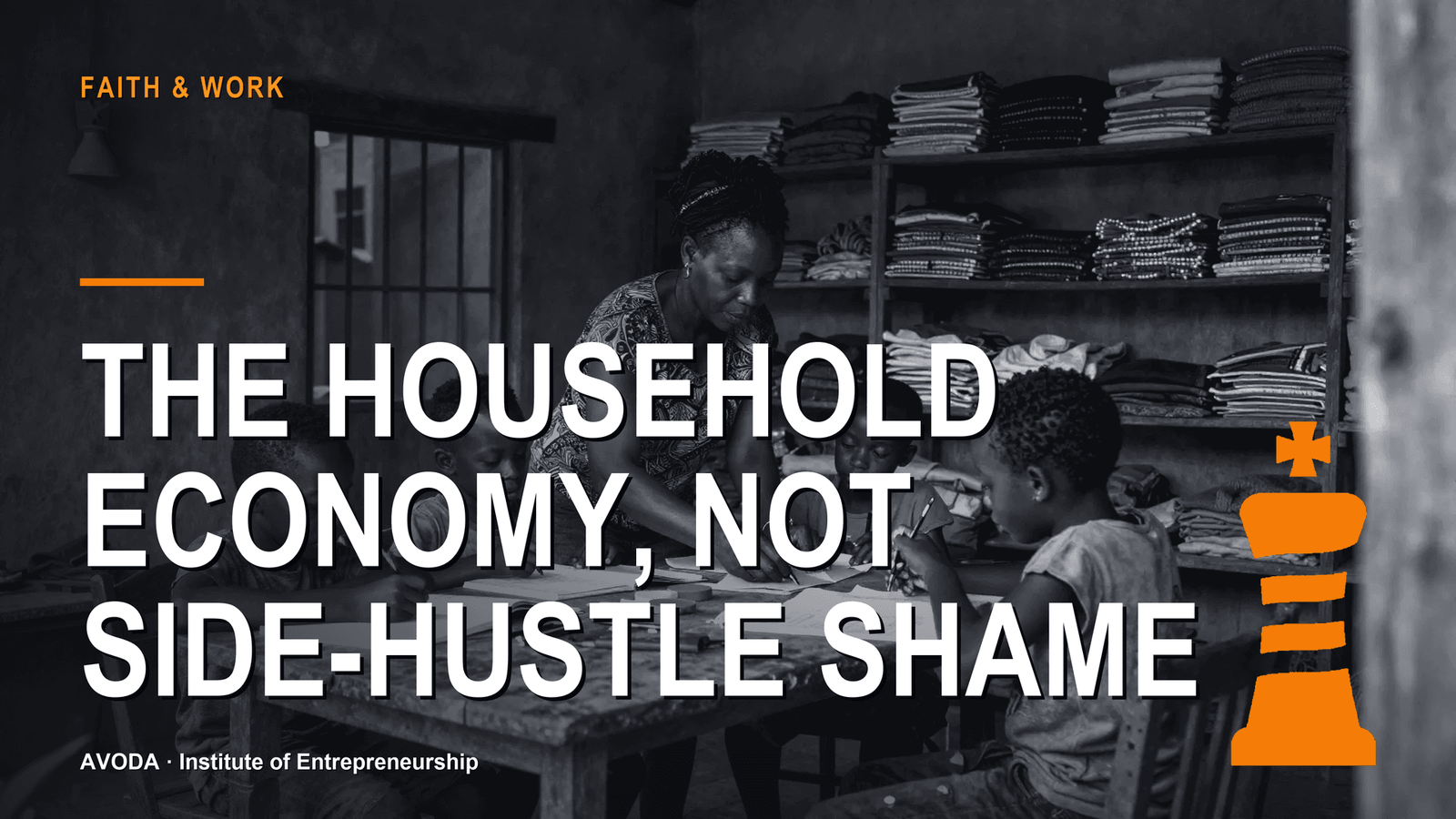
The vocabulary arrives with an apology built in. “It’s just a side hustle,” says the teacher of her weekend catering; “just something small at home,” says the mother of the veranda shop that pays two school fees; the kitchen-table tailoring, the boot-of-the-car boutique, the WhatsApp bakery, each introduced with the diminutive, as if enterprise conducted from home were business’s embarrassed cousin, waiting to become real by acquiring premises. The shame is imported and recent. For most of economic history, and in the tradition’s own showcase text, the household was the firm: the Proverbs 31 enterprise runs from a home, trades in textiles and land and vineyards, employs, provisions, and is praised in the city gate precisely for it (1). This essay recovers the frame: the home-based business as household economy, an integrated production unit with its own logic, advantages, and disciplines, neither a hobby awaiting seriousness nor a rehearsal for an office, and then does what recovery requires, the operating practices that let home and enterprise strengthen instead of consume each other.
Key Takeaways
- The side-hustle frame diminishes what it names: enterprise at home read as pre-business, its operator as amateur, its revenue as pocket money, shame where the tradition placed praise.
- The household economy is the older, truer frame: home and enterprise as one integrated provisioning unit, history’s default firm and Proverbs 31’s honored pattern.
- Its real advantages are structural: zero premises cost, labor flexibility across the household, formation of children inside real work, and enterprise fitted to caregiving rather than at war with it.
- Its real risks are boundary failures: business cash and household cash fused, work that never closes, family labor unpriced and unthanked, and rooms that belong to nothing.
- The disciplines are named lines, not separation: the split ledgers, the named hours, the priced family labor, the defined spaces, and the household council governing both books.
- The growth question is optionality, not destiny: the household economy may scale out, or may deepen in place, and both are full-fledged outcomes.
What did the side-hustle frame get wrong?
It read the household through the office’s eyes and graded it deficient. The frame assumes real business happens in dedicated premises, on separated time, by specialized labor, and everything else is preliminary: the home enterprise as larval stage, its operator perpetually asked when she will open a real shop. The media blind spot this corpus mapped compounds it, and the shame does measurable damage: operators who will not price properly because “it’s just small,” will not keep books because books are for real businesses, will not claim the trader’s dignity the enterprise has earned, undercapitalized ambition wearing modesty’s clothes.
The tradition never graded this way. Scripture’s economy is household economics, the very word derives from it, and its portrait of commercial excellence is domestic: she considers a field and buys it, her lamp does not go out, she makes linen garments and sells them, strength and dignity are her clothing (1). The household there is not where business waits to begin; it is where provision, production, formation, and generosity integrate, the family OS with a revenue line. History agrees: the farm, the workshop-under-the-house, the trading family were the human norm, and the commute is the anomaly. The region’s veranda economies are not behind the office era. In several respects this corpus keeps finding, integration, presence, formation, they are ahead of it.
What are the household economy’s real advantages?
Four, each unavailable to the premises firm at any rent. Cost structure: zero premises overhead is unit economics’ best line, margin the shop-renting competitor pays away, and survivability in lean seasons no lease allows. Labor elasticity: the household flexes around the enterprise’s waves, the harvest fortnight, the December orders, the school-fee sprint, without a payroll’s rigidity. Formation: children raised inside honest work absorb the apprenticeship no school sells, the ledger explained at the table, the customer served well in front of small watching eyes, discipleship by proximity as a daily byproduct. And care-compatibility: the enterprise fitted around caregiving rather than warring with it, the region’s mothers running real firms in the seams the office economy pretends do not exist, which is not a lesser arrangement but a differently-ordered one, provision and presence held together.
What are the disciplines that keep it whole?
Boundary failures are the household economy’s native disease, and the cure is named lines inside integration, not the office’s separation. Split ledgers: business money and household money in distinct books from the first shilling, the enterprise paying the household a named draw rather than bleeding into it, because fused cash makes both the unit economics and the household budget unknowable. Named hours: the home enterprise’s special temptation is closing never, the always-open thread ten steps from the bed; stated hours, kept and taught to customers, are Sabbath’s domestic infrastructure. Priced family labor: the daughter who minds the stall, the husband who does deliveries, named contributions, thanked and where substantial paid, because unpriced family labor breeds the resentments that no family constitution should have to arbitrate and teaches children that their work is worthless. Defined spaces: even one shelf, one corner, one veranda-half that is the business, so the enterprise has edges the home can close. And one governing council: the household money meeting reviewing both books together, the integrated economy governed integratedly, enterprise decisions weighed with household ones by the people living both.
The growth question then arrives without shame in either direction: the household economy may scale out, premises, staff, the first manager, when the numbers and calling say so, or may deepen in place, better margins, an apprentice, a stronger craft, a fuller integration, and both are completed stories. The frame’s whole gift is the removal of the waiting: the veranda shop is not becoming a business. It is one, of the oldest kind on record, and its operator, considering her field, buying it, and keeping her lamp lit, stands in the tradition’s most praised commercial company. Introduce her enterprise accordingly, starting with how she introduces it herself.
FAQ
What is wrong with the “side hustle” frame?
It grades home enterprise as pre-business, breeding operator shame that causes real damage: underpricing, unkept books, and unclaimed dignity, modesty’s clothes on undercapitalized ambition.
What is the household-economy frame?
Home and enterprise as one integrated provisioning unit, history’s default firm and Proverbs 31’s honored pattern: production, provision, formation, and generosity run together under one roof and one governance.
What are its structural advantages?
Zero premises cost (the best unit-economics line available), household labor that flexes with demand waves, children formed inside real work, and enterprise compatible with caregiving rather than at war with it.
What disciplines prevent home and business consuming each other?
Split ledgers with a named draw, stated hours kept, family labor named and priced, defined physical edges, and one household council governing both books together.
Must a home business eventually move out?
No: scaling out and deepening in place are both completed outcomes. The frame removes the waiting: the veranda enterprise is not becoming a business; it already is one.
Related Reading
- The Household Operating System for Generational Stewardship
- Marketplace Ministry When You Are the Entire Org Chart
- Teaching Children Money Stewardship
- Biblical Entrepreneurship Without the Hustle Gospel
Sources and Evidence
- Proverbs 31:10-31, ESV: the household enterprise praised in the gate, fields, textiles, trade, and lamp-lit industry from home.
- ILO, “Women and Men in the Informal Economy”: the home-based share of the region’s actual firms.
- 1 Thessalonians 4:11-12, ESV: working with your hands in your own affairs, the quiet household economy commended.