
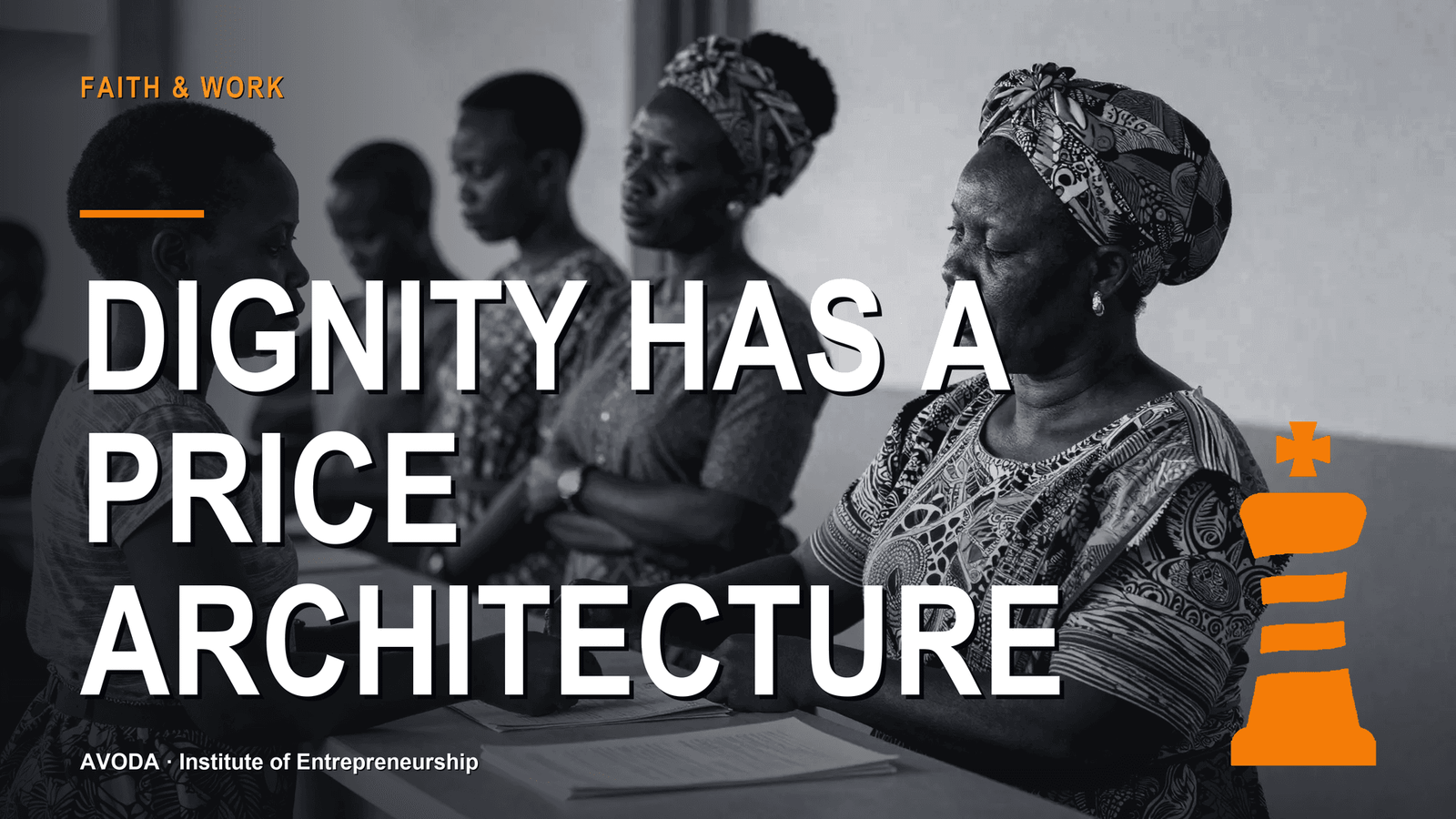
The development world’s pricing debate is usually staged as a binary: charge, and exclude the poor; give freely, and reach them. This corpus’s founding essay on the question reported the operator’s discovery that the binary is false, that charging founders something changed who came, how they engaged, and what they built, and that the anti-aid instinct behind it has a real P&L. This essay does the follow-up engineering, because “charge something” is a conviction, not an architecture, and the architecture is where dignity is actually designed or destroyed. Price too high and the program becomes a class filter wearing merit language; price at zero and it communicates, precisely to people the aid economy has told so for decades, that this, and perhaps they, are worth nothing; subsidize opaquely and the discount becomes charity’s old shame in new packaging. The design goal is exact: a price every participant genuinely pays, a subsidy honestly named, and a structure in which no one, payer or funder or participant, can mistake the program for either a luxury good or a handout.
Key Takeaways
- Zero-price signals zero-worth in economies saturated with free programming: payment is information, commitment, and dignity at once, the charging essay’s field result generalized.
- Full-cost pricing excludes exactly the participants development exists for: the architecture problem is holding real payment and real access simultaneously.
- The four architectural elements: a universal floor (everyone pays, always), a means-honest ladder (price bands by capacity, verified respectfully), named subsidy (the gap funded visibly, as investment, not charity), and skin-in-the-game symmetry (commitment expressed in money and in kept obligations).
- The floor’s size matters less than its universality: a token everyone pays outperforms a large fee some pay and others have waived in whispers.
- Subsidy language does moral work: participants told a funder invested in their seat carry a mandate; participants told they were given a free slot carry a debt of gratitude, and the two produce different graduates.
- Scholarships are covenant instruments: named, criteria-public, obligation-bearing (attendance, completion, alumni contribution), and never anonymous mercy.
Why does zero communicate worthlessness here?
Because price is a language, and the region’s poor have been spoken to in it for sixty years. Decades of free programming, free trainings attended for the transport allowance, free inputs resold at the market, free certificates papering no change, have taught a precise lesson: what costs nothing is worth nothing, and programs that arrive free are for the funder’s report, not the participant’s life. The charging essay documented the flip side: payment re-sorted the room toward the committed, converted attendance into engagement, and, participants said in exit interviews, restored something the free economy had taken, the standing of a customer, who can demand quality, over a beneficiary, who can only receive it.
The economics beneath the psychology are ordinary information theory: a price paid is a costly signal of commitment that no application essay can fake, and the willingness to pay something is the cheapest honest filter for the seriousness selection-heavy programs need. But the same logic, unmanaged, runs to the opposite failure: price as class filter, where ability to pay impersonates readiness to build, and the program graduates its way into serving whoever needed it least. Hence architecture: the goal is payment’s information and dignity without payment’s exclusion, and that requires designing four elements at once rather than sliding along the free-to-full spectrum.
What are the four elements?
The universal floor. Everyone pays; no one pays nothing. The floor can be modest, a registration amount, a materials fee, but it is never waived, because its function is not revenue: it is the constitutional statement that every seat in the room was bought by its occupant. Programs report the floor’s strange power: the participant who paid the modest floor defends her attendance to her household differently than the one attending free, and the household economics matter because the household is where the dropout decision is actually made.
The means-honest ladder. Above the floor, price bands by genuine capacity: the salaried professional, the trading SME owner, the pre-revenue founder pay different rungs for the same room. The verification must be respectful, self-declaration anchored by observable proxies (business type, employment) rather than humiliating means-testing, and the bands public, so the ladder reads as design rather than negotiation. The pricing craft the SME corpus teaches applies to program design too: differential pricing is honest when the differences are.
The named subsidy. The gap between a participant’s rung and the program’s true cost is funded, and the funding is named out loud: a foundation, a church, an alumni fund invested in this seat. The naming does double moral work. It converts the discount from hidden charity into visible investment, someone believed this cohort was worth backing, and it holds the program honest about its real unit economics, because subsidy that hides inside vague pricing eventually hides the program’s viability from itself, the arithmetic avoidance this corpus warns against.
Skin-in-the-game symmetry. Money is one commitment currency; obligation is the other. Scholarship seats carry covenant terms: attendance thresholds, completion, a defined give-back, mentoring a later cohort, the alumni contribution that builds the network, so the subsidized participant pays in the currency she has. Symmetry matters in both directions: the full-payer is not buying exemption from the obligations, and the scholar is not receiving exemption from seriousness. One room, one covenant, several currencies.
How does this cash out in a real program?
As a one-page architecture any faith-integrated program can adopt and publish. The floor, stated. The ladder, three or four rungs with public criteria. The subsidy, named per cohort with its funders. The scholarship covenant, written, criteria-public, signed. And two disciplines that keep the architecture honest over years: the annual re-costing, true cost per participant recomputed and the subsidy gap faced, unit economics before prayer requests; and the dignity audit, exit interviews asking not “could you afford it?” but “did the price arrangement honor you?”, because the participant is the only auditor of whether the architecture achieved its point. Fikkert’s warning that helping can hurt was always about this layer: aid that communicates incapacity injures what it funds (1). Price architecture is the operational answer, dignity designed into the money itself, and for the Kingdom-minded program the theology closes cleanly: the laborer is worthy of hire, the guest is worthy of cost, and the covenant, as always, names its terms out loud.
FAQ
Why should development programs charge anything at all?
Because payment carries information (a costly commitment signal), engagement (customers demand quality; beneficiaries receive it), and dignity (a bought seat is defended differently at home), while decades of free programming have taught precisely the opposite lessons.
How is exclusion avoided if everyone must pay?
Through the architecture: a modest universal floor, a public ladder of price bands matched to genuine capacity, and named subsidy funding the gap, real payment and real access held simultaneously.
Why must subsidy be named?
Naming converts hidden charity into visible investment, gives the subsidized participant a mandate rather than a shame, and forces the program to face its true unit economics annually.
What do scholarship covenants contain?
Public criteria, attendance and completion thresholds, and a defined give-back (often mentoring later cohorts): commitment expressed in the currency the scholar has, symmetric with the payer’s.
How is the architecture kept honest over time?
Annual re-costing of true per-participant cost against the subsidy gap, and a dignity audit in exit interviews: not “could you afford it?” but “did the price arrangement honor you?”
Related Reading
- What We Learned Charging African Founders Instead of Giving Acceleration Away
- When Prayerful Fundraising Becomes Avoidance of Unit Economics
- East Africa’s Christian Accelerators
- Pricing: The Neglected Lever of the African SME
Sources and Evidence
- Chalmers Center / Corbett and Fikkert, “When Helping Hurts”: aid that communicates incapacity, the dignity problem this architecture answers.
- Global Accelerator Learning Initiative (GALI): selection and commitment dynamics in entrepreneur programs.
- Luke 10:7, ESV: the laborer worthy of wages, worth named in money. See also 2 Samuel 24:24, refusing to offer what costs nothing.