
Don’t build the African Mayo Clinic. Build the rails under the duka la dawa — the drug shop — that already serves everyone. African digital health is growing faster than any other region, a roughly $5.6 billion market in 2025 heading higher (1)(2), and in East Africa the action is at the pharmacy counter, the first and often only point of care for hundreds of millions of people. Maisha Meds has digitized a network that passed 1,000 active facilities across Kenya, Uganda, Tanzania, Nigeria, and Zambia — now approaching 4,000 — backed by USAID Development Innovation Ventures and the Gates Foundation (3)(4). Health-system transformation here will be bottom-up, retail-first, and unglamorous — exactly the kind of business that compounds.
Key Takeaways
- African digital health is the world’s fastest-growing regional market, projected at roughly $5.6 billion in 2025 and rising, with East Africa a priority expansion region (1)(2).
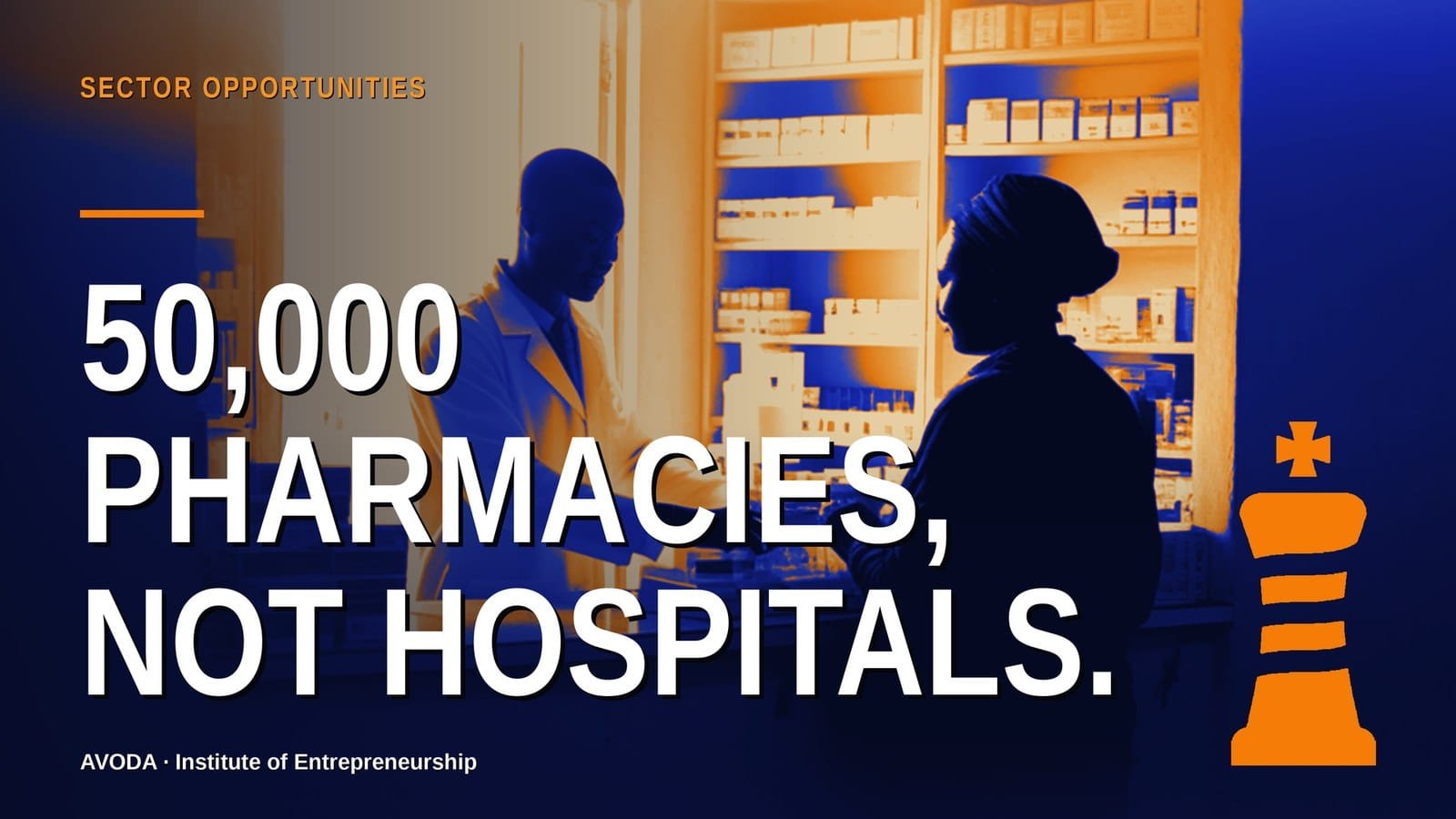
- Most East Africans receive primary care from roughly 50,000 private pharmacies and drug shops, not hospitals — making the pharmacy counter the real point of care to digitize.
- Maisha Meds digitized a network that crossed 1,000 active facilities across Kenya, Uganda, Tanzania, Nigeria, and Zambia and is now approaching 4,000, backed by USAID DIV, the Gates Foundation, CIFF, and Pfizer (3)(4).
- Pharmacy and health-tech has been capturing a large share of African health-sector funding, reflecting investor recognition that the drug shop is the system’s true front line (5).
- The hard truth: thin pharmacy margins make pure software a hard sell — winners bundle inventory finance, insurance reimbursement, and diagnostics into the rails (3).
- Whoever digitizes the payments, supply, and reimbursements of the region’s pharmacies becomes the de facto health-financing infrastructure for hundreds of millions of people.
Why is the pharmacy the real point of care?
Because the mental model most health investment runs on — that healthcare happens in hospitals and clinics staffed by doctors — describes a system that, for most East Africans, does not exist in daily practice.
The reality on the ground is different. When an East African feels unwell, the first and often only point of contact with the health system is not a hospital or a doctor; it is the local pharmacy or drug shop — the duka la dawa. There are an estimated 50,000 such private pharmacies and drug shops across the region, and they are where people go for diagnosis-by-symptom, medication, advice, and basic care. Hospitals are distant, expensive, overcrowded, and reserved for serious cases. The pharmacy is near, affordable, trusted, and open. For the majority of routine health needs of hundreds of millions of people, the pharmacy is the health system’s front line. This is not a deficiency to be fixed by building more hospitals; it is the actual architecture of African primary care, and it is far more efficient and accessible than the hospital-centric model the region could never afford to replicate at scale.
This reframing changes where the opportunity sits entirely. If you believe healthcare happens in hospitals, you build (or fund) hospitals — capital-intensive, slow, serving few. If you recognize that healthcare actually happens at the pharmacy counter, you build the rails under the pharmacy — the digital infrastructure for its payments, inventory, and reimbursements — which is capital-light, fast to scale, and serves the millions who already use these outlets. The pharmacy is the hospital for most people, which means the pharmacy counter, not the hospital ward, is where health-system transformation will actually happen. The same bottom-up, infrastructure-first logic that built the region’s mobile-money payment rails applies to its health system: don’t replace the front line, digitize it.
What does the Maisha Meds case show?
It shows that digitizing the pharmacy is real, scalable, and attracting the most serious health funders in the world — and it reveals exactly where the business model must sit.
Maisha Meds, founded in 2017, built a point-of-sale and business-management platform for pharmacies, drug shops, and clinics. It crossed 1,000 active facilities and has expanded across Kenya, Uganda, Tanzania, Nigeria, and Zambia, building toward a network approaching 4,000 outlets (3)(4). Its backers are a who’s-who of serious global health funders: USAID Development Innovation Ventures, the Bill & Melinda Gates Foundation, the Children’s Investment Fund Foundation, Grand Challenges Canada, and Pfizer (3). That backing is significant — these institutions underwrite on rigorous evidence of impact and viability, and their support signals that digitizing the pharmacy counter is a proven, fundable model, not a speculative bet.
But the most instructive part of the Maisha Meds story is what it digitizes. It does not sell software for software’s sake; it builds rails for payments and reimbursements — including digital reimbursement programs that route subsidies and insurance through private drug shops, and increasingly health-insurance delivery itself (3). This points to the central strategic truth of the sector: the pharmacy is not a software customer, it is a financial node. The money flows — patient payments, insurance claims, subsidy reimbursements, inventory financing — are the real product. Maisha Meds works because it sits in the flow of money and medicine through the drug shop, not merely on its back-office computer. That distinction is the difference between a healthtech business that compounds and one that stalls.
Why does pure software fail at the pharmacy counter?
Because the economics of the drug shop are brutal, and they punish any business that tries to extract value from thin margins through a subscription alone.
A typical East African pharmacy or drug shop operates on thin margins, tight cash, and informal practices. Asking such a business to pay a meaningful monthly software fee for a management tool is a hard sell — the value of pure record-keeping software, however nice, does not justify the cost to an operator counting every shilling. This is why so much “digitize the pharmacy” effort has stalled: it tried to sell software to businesses that could not or would not pay for software alone. Pharmacy-and-health-tech has nonetheless been capturing a large share of African health-sector funding (5), precisely because the smart operators figured out the answer.
The answer is to bundle financial value into the rails. The winning model does not charge the pharmacy for software; it makes the pharmacy more profitable and more capable by providing services it genuinely needs and will pay for through value created, not fees extracted: inventory finance (working capital to stock medicines, repaid from sales), insurance and reimbursement processing (connecting the drug shop to subsidies and insurance claims it could not otherwise access), and diagnostics (point-of-care testing that adds revenue and capability). Each of these gives the pharmacy more money, more stock, or more services to sell — so the digital rails pay for themselves through value delivered rather than cost imposed. The software is the trojan horse; the financial services are the business. This is the same insight that distinguishes durable African fintech: the rail is valuable only when it carries money and credit the user actually needs, not merely data.
The Pharmacy Rail Stack: how to build the health-financing layer
Here is the framework I use to map how a healthtech business actually wins at the pharmacy counter. Call it the Pharmacy Rail Stack — four layers, where the software is the entry point and the financial services are the value.
Layer 1 — The digital counter (entry point). A simple, genuinely useful point-of-sale and inventory tool that the pharmacy adopts because it makes daily operations easier. This is the wedge — it must be near-free or free, because its value to the business is acquisition, not revenue. Maisha Meds’ POS app is this layer (3).
Layer 2 — Inventory finance (the first real value). Working capital to help the pharmacy stock medicines, underwritten against the sales data the digital counter now produces and repaid from those sales. This solves the drug shop’s biggest constraint — cash to stock — and is the first layer the pharmacy will genuinely pay for, because it directly grows the business.
Layer 3 — Reimbursement and insurance rails (the compounding layer). Connecting the pharmacy to insurance claims, subsidy reimbursements, and health-financing programs it cannot access alone. This is where the business becomes infrastructure: by routing health payments through the drug shop, the platform becomes the de facto reimbursement and insurance rail for primary care — a position that compounds with every facility and every payer added.
Layer 4 — Diagnostics and services (the expansion layer). Point-of-care diagnostics, telehealth links, and adjacent services that turn the pharmacy from a dispensary into a basic care node — adding revenue for the pharmacy and clinical value for the patient, on top of the rails already built.
The Pharmacy Rail Stack inverts the failed approach. Instead of selling software and hoping thin-margin pharmacies pay, it gives the software away to win the counter, then builds the financial and service layers that make the pharmacy more profitable — capturing value from the money and medicine flowing through the rails. Build all four layers and you do not have a software vendor; you have the health-financing infrastructure for hundreds of millions of people.
What should founders, investors, and policymakers do?
The path is clear, and it rewards the unglamorous, infrastructure-first approach.
For founders, the opportunity is the rails, not the clinic. Building the payment, inventory-finance, reimbursement, and diagnostics layers under the existing 50,000 pharmacies is a capital-efficient, fast-scaling, deeply defensible business — and it fits the revenue-based and embedded-finance structures the region’s capital base now supports far better than capital-heavy hospital builds. The model pairs naturally with the region’s insurance greenfield, since the pharmacy rail is also an insurance-distribution and claims rail, and with local pharmaceutical manufacturing, which needs exactly this kind of last-mile distribution and data.
For investors, healthtech-at-the-pharmacy offers the rare combination of massive social impact and a compounding, infrastructure-like business model — the kind of opportunity that the region’s proof-of-concept markets like Rwanda are well-suited to validate before continental scale. For policymakers, supporting the digitization of the pharmacy front line — through enabling reimbursement and insurance rails to flow through drug shops — is one of the highest-leverage health-system investments available, because it strengthens the front line people actually use rather than the hospital system most cannot reach.
The conclusion is genuinely hopeful, and it requires letting go of an aspiration that was never going to work. East Africa was never going to build its way to universal healthcare through hospitals — the capital, the doctors, and the time do not exist. But it does not need to. It already has a dense, trusted, accessible network of 50,000 pharmacies serving as its real primary-care front line. The transformative opportunity is not to replace that network with something grander; it is to digitize it — to build the payment, finance, reimbursement, and diagnostic rails that make the pharmacy a more capable, better-financed, insurance-connected node of care. That is bottom-up, retail-first, unglamorous health-system building. It will not produce a gleaming hospital to cut a ribbon on. It will quietly become the health infrastructure for hundreds of millions of people — and that is exactly the kind of business, and the kind of impact, that compounds.
FAQ
Where do most East Africans actually get healthcare?
From roughly 50,000 private pharmacies and drug shops — the duka la dawa — not from hospitals or doctors. The pharmacy is near, affordable, trusted, and open, and serves as the first and often only point of care for routine health needs across the region, making it the real front line of the health system.
How big is the African digital health market?
African digital health is the world’s fastest-growing regional digital-health market, projected at roughly $5.6 billion in 2025 and rising, with East Africa repeatedly named a priority expansion region by leading healthtech innovators (1)(2)(5).
What does Maisha Meds do?
Maisha Meds digitizes pharmacies and drug shops with a point-of-sale platform and, crucially, financial rails — inventory finance, digital reimbursements, and health-insurance delivery. It crossed 1,000 active facilities across Kenya, Uganda, Tanzania, Nigeria, and Zambia and is approaching 4,000, backed by USAID DIV, the Gates Foundation, CIFF, and Pfizer (3)(4).
Why does pure pharmacy software fail to scale?
Because pharmacies operate on thin margins and tight cash, and will not pay meaningful fees for record-keeping software alone. Winners give the software away to win the counter, then make money by bundling services the pharmacy genuinely needs — inventory finance, insurance reimbursement, diagnostics — that grow the business and pay for themselves.
What is the biggest opportunity in East African healthtech?
Building the financial and data rails under the existing pharmacy network: payments, inventory finance, insurance and subsidy reimbursement, and point-of-care diagnostics. Whoever digitizes the money and medicine flowing through 50,000 drug shops becomes the de facto health-financing infrastructure for hundreds of millions of people.
Related Reading
- Make the Medicine Here: East Africa’s Pharmaceutical Manufacturing Window
- The Emptiest Market in Finance: East Africa’s Insurance Greenfield
- Rwanda: The Proof-of-Concept State
- AI Already Guards the Mobile Money Rails
Sources and Evidence
- Statista — Digital Health, Africa (market forecast) — Source for the ~$5.58 billion 2025 African digital-health market size.
- Kapsule — “Digital Health in Africa: Trends, Investment, and Impact” — Context on Africa as the fastest-growing digital-health region and East Africa’s priority status.
- Startup Weekly — “Kenyan E-health startup Maisha Meds hits 1000 active facilities, expands to Nigeria” — Source for Maisha Meds’ facility count, multi-country footprint, funders, and reimbursement/insurance model.
- Maisha Meds — official site — Primary source on the model (point-of-sale, drug shops, reimbursement, insurance) and the ~4,000-facility network.
- TechCabal — “Op-ed: Pharmacy health-tech in Africa” — Source for pharmacy-tech capturing a large share of African health-sector funding and the bundled-finance model.